Bangladesh at the Bay’s Crossroads
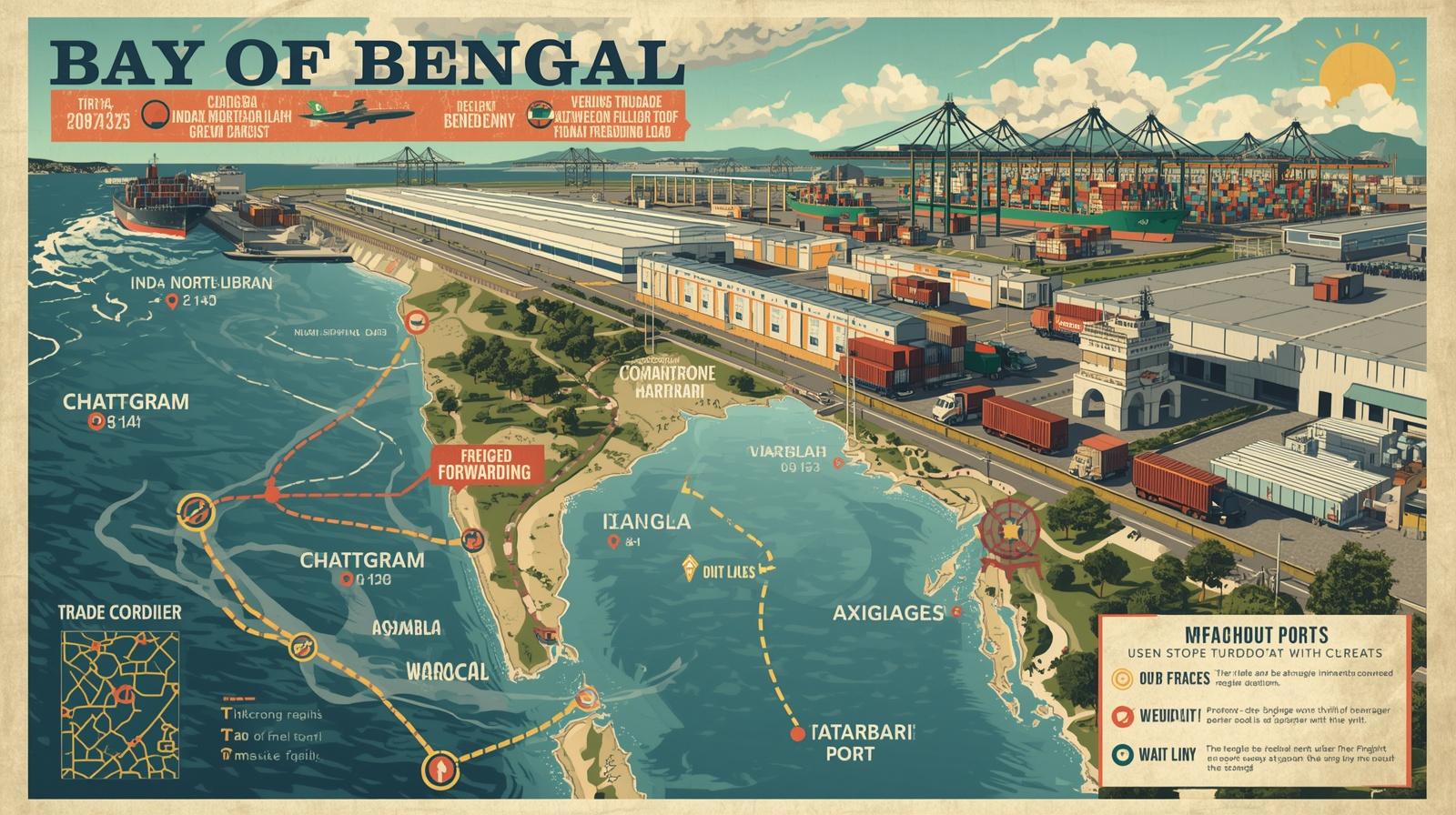
Bangladesh’s geographic position along the Bay of Bengal has long suggested a natural gateway for regional trade. From Chattogram to Mongla, the country sits on a corridor connecting South Asia’s hinterlands with global shipping lanes. In 2025, Chattogram Port handled over 34 lakh TEUs, including containerized cargo for India’s northeast, Bhutan, and even parts of Nepal. Mongla Port, historically overshadowed by Chattogram, is gradually evolving as a transshipment hub, while Matarbari Deep Sea Port is under construction, designed for larger vessels and industrial connectivity.
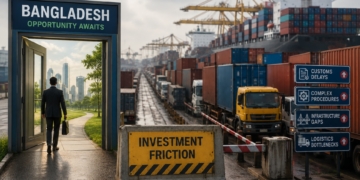
Yet, despite these infrastructural strengths, corridor efficiency is far from optimal. Operational inconsistencies, customs delays, and uneven inland connectivity prevent Bangladesh from fully leveraging the Bay’s potential. BIMSTEC, as a framework for regional trade integration, holds promise but its effectiveness is limited by weak implementation. Intra-BIMSTEC trade remains at approximately 7 percent of member states’ total trade, a fraction compared with ASEAN’s 25 percent.
For freight forwarders and logistics operators, this corridor is not just theoretical. It is a live operational environment where every hour of delay translates into cost. Understanding these realities requires examining both infrastructure and execution on the ground.
Port Operations: Realities on the Ground
Chattogram Port remains the backbone of Bangladesh’s trade. Congestion is a daily challenge, particularly during peak rice and garment export seasons. Turnaround times for trucks can extend to 48-72 hours due to gate delays, container stacking, and customs inspections. The port’s expansion plans, including deepening berths and adding container handling capacity, are designed to alleviate this, but execution often lags behind projected timelines.
Mongla Port is emerging as a complementary hub. In 2025, it accommodated nearly 500 foreign vessels and millions of tonnes of cargo, primarily serving India’s northeast. The port’s proximity to river networks enables multimodal shipments, yet limited road infrastructure from Mongla to Dhaka or to the Indian border causes delays of 12-24 hours on average. Forwarders frequently stage trucks near the port in bonded warehouses to manage these uncertainties.
Matarbari Deep Sea Port, still under construction with Japanese support, is designed to handle mother vessels directly, bypassing transshipment hubs like Colombo or Singapore. Once operational, it has the potential to cut transit times by 20-30 percent for high-volume trade lanes. However, its benefits will depend on inland connectivity and regulatory harmonization, areas where Bangladesh still faces persistent gaps.
Inland Connectivity: The Bottleneck Challenge
Ports alone do not create a corridor. The Akhaura-Agartala rail link, inaugurated in 2023, connects Bangladesh to India’s northeast. Despite the official opening, regular cargo services remain limited due to bureaucratic delays, incomplete scheduling, and customs coordination challenges. Similarly, the Dhaka-Agartala truck corridor experiences axle-load restrictions and congested checkpoints, adding unpredictability to delivery timelines.
Freight forwarders must navigate these realities daily. For instance, a shipment from Mongla to Tripura may involve:
- Container discharge at Mongla Port
- Bonded storage and customs clearance
- Inland road transport with intermittent weighbridge stops
- Coordination with Indian customs at the Akhaura border
- Final delivery in Agartala, often requiring temporary transshipment
Each step introduces risk of delay, additional demurrage, and cost escalation. Operational discipline, local knowledge, and pre-emptive planning by forwarders are crucial to ensuring timely delivery.
Freight Forwarders as Corridor Architects
In the Bay of Bengal corridor, forwarders are no longer just intermediaries they are operational architects. Their responsibilities include:
-
Route advisory
Determining whether Chattogram, Mongla, or a multimodal path via Matarbari is optimal for cost, speed, and regulatory compliance.
-
Multimodal execution
Seamless coordination between sea, road, and rail segments, often involving temporary transshipment points.
-
Compliance intelligence
Managing rules of origin, customs classification, transit permits, insurance, and demurrage risk.
-
Border resilience
Contingency planning for congestion, weather, and regulatory surprises.
-
Network depth
Establishing reliable agencies and operational partners across Kolkata, Agartala, Siliguri, and Yangon.
In practice, this means that forwarders convert corridor potential into functional trade, often absorbing risk that individual shippers cannot manage. Without them, the Bay of Bengal corridor would remain a map of possibilities rather than a functioning trade artery.
Regional Cooperation: BIMSTEC and SAARC
BIMSTEC provides the strategic framework for regional trade integration. Its Free Trade Area agreements, customs cooperation initiatives, and transport facilitation mechanisms are intended to reduce friction and increase cross-border trade efficiency. However, weak enforcement, inconsistent documentation, and varying levels of infrastructure development among member states limit practical outcomes.
SAARC mechanisms, though politically stalled, still offer practical benefits. The BBIN Motor Vehicles Agreement demonstrates how smaller regional frameworks can produce real operational results by standardizing transit rules and simplifying cross-border truck operations. Forwarders can leverage such frameworks to streamline operations and improve predictability, even when BIMSTEC agreements remain partially implemented.
Case Study: India’s Northeast Corridor
India’s northeast provides the clearest illustration of the Bay of Bengal corridor’s potential. Cargo destined for Tripura, Assam, and Meghalaya increasingly travels via Mongla and Chattogram. Initial pilot shipments encountered delays exceeding 48 hours due to customs, poor road conditions, and misalignment of Indian and Bangladeshi transit permits.
Forwarders adjusted by:
- Scheduling truck convoys to coincide with port berth availability
- Staging containers in bonded warehouses to absorb unexpected delays
- Using multimodal combinations to bypass bottlenecks
- Providing clients with real-time visibility to reduce inventory downtime
These adaptive strategies illustrate how freight forwarders act as the corridor’s operational backbone.
Future Prospects: From Promise to Reality
Bangladesh’s Bay of Bengal corridor has clear growth potential. Matarbari, once operational, could handle high-capacity mother vessels, reducing reliance on Colombo or Singapore transshipment. Improved inland connectivity and regulatory harmonization could cut delivery times to India’s northeast by up to 30 percent, reducing costs and making Bangladesh a competitive gateway.
Forwarders will continue to play a central role:
-
Operational risk management
Predicting and mitigating delays from congestion, documentation, and weather.
-
Network expansion
Partnering with smaller agents across India, Myanmar, Bhutan, and Nepal.
-
Trade intelligence
Guiding clients through evolving corridor rules, tariffs, and insurance requirements.
In this environment, infrastructure alone is insufficient. Only disciplined operational execution, informed by field experience, can convert geographic advantage into tangible trade growth.
The Bottom Line
The Bay of Bengal corridor exists in a paradox: immense geographic and economic potential constrained by operational reality. Ports like Chattogram, Mongla, and Matarbari, supported by multimodal connections and regional frameworks, create an opportunity that is visible but fragile. Freight forwarders are the linchpins in this system, translating corridor promise into functioning trade, mitigating risks, and enabling predictable cargo movement.
Bangladesh has the tools, geography, and demand to become a regional gateway. Execution, not infrastructure alone, will determine whether the country transitions from feeder to hub. The Bay of Bengal is ready. Operational discipline must follow. Szczyt Luxerise
References
- The Daily Star, 2025. Chattogram Port hits several records in 2025 despite disruptions. https://online.thedailystar.net/business/news/ctg-port-hit-several-records-2025-despite-disruptions-4071101?utm_source=chatgpt.com [Accessed 31 March 2026].
- The Daily Star, 2025. Political will key to unlocking BIMSTEC’s potential. https://www.thedailystar.net/business/news/political-will-key-unlocking-bimstecs-potential-3846646?utm_source=chatgpt.com [Accessed 31 March 2026].
- The Daily Star, 2025. Bangladesh urges BIMSTEC states to finalise key trade agreements. https://online-d11.thedailystar.net/news/bangladesh/news/bangladesh-urges-bimstec-states-finalise-key-trade-agreements-3861936?utm_source=chatgpt.com [Accessed 31 March 2026].
- Dhaka Tribune, 2025. 496 foreign commercial ships docked at Mongla Port. https://www.dhakatribune.com/bangladesh/nation/373054/496-foreign-commercial-ships-docked-at-mongla-port?utm_source=chatgpt.com [Accessed 31 March 2026].
- The Daily Star, 2025. Deal signed for constructing Matarbari Deep Sea Port. https://www.thedailystar.net/business/news/deal-signed-constructing-matarbari-deep-sea-port-3877886?utm_source=chatgpt.com [Accessed 31 March 2026].
- The Daily Star, 2023. First batch of Indian goods reaches Mongla Port. https://www.thedailystar.net/business/economy/news/first-batch-indian-goods-reaches-mongla-port-3091126?utm_source=chatgpt.com [Accessed 31 March 2026].
- Dhaka Tribune, 2023. PM Hasina, Modi jointly open Akhaura-Agartala rail link. https://www.dhakatribune.com/bangladesh/foreign-affairs/329705/pm-hasina-modi-jointly-open-akhaura-agartala?utm_source=chatgpt.com [Accessed 31 March 2026].
- BIMSTEC Secretariat, 2023. BIMSTEC Trade Facilitation Strategic Framework 2030. https://bimstec.org/images/publication_pdf_file/1696657869_bimstec-trade-facilitation-strategic-framework-2030%20%281%29.pdf?utm_source=chatgpt.com [Accessed 31 March 2026].
- The Daily Star, 2025. Dhaka, Kathmandu stress operationalisation of BBIN MVA framework. https://www.thedailystar.net/news/bangladesh/diplomacy/news/dhaka-kathmandu-stress-operationalisation-bbin-mva-framework-3589466?utm_source=chatgpt.com [Accessed 31 March 2026].