Foreign investment does not usually collapse because of one bad road, one delayed approval or one congested port. It weakens when small failures begin to form a system.
Bangladesh is now facing that problem at exactly the wrong moment.
The country is attracting new investment interest. BIDA says more than $400 million from its $1.5 billion investment pipeline has reached decision and implementation stages. BEPZA secured a record $717.71 million in proposed investments during FY2025–26. APM Terminals is preparing a $550 million greenfield container terminal at Laldia. Chinese companies are exploring manufacturing, logistics, electronics and other sectors.
These are not reasons for complacency. They are a stress test.
The question is no longer whether Bangladesh can attract investment announcements. The question is whether Bangladesh can execute the operating environment those investments require.
The investment story looks better on paper
Bangladesh’s FDI picture improved in 2025. UN Trade and Development reported that inflows rose to $1.77 billion, although the recovery was driven largely by reinvested earnings and intracompany loans rather than a dramatic surge in fresh equity.
That distinction matters.
Fresh foreign capital creates new factories, new capacity and new supply chains. Reinvested earnings are important, but they often indicate that existing investors are continuing to operate rather than that Bangladesh is suddenly winning a much larger share of new global investment.
At the same time, BIDA is building an impressive pipeline. Its own figures show more than $400 million of a $1.5 billion pipeline moving into decision and implementation stages. That is progress.
But even BIDA says the remaining $1.1 billion still needs to be converted into actual investment.
That word is important: converted.
An investment pipeline is not a factory. A proposal is not production. An MoU is not an export shipment.
The real scoreboard begins when capital is deployed and the investor has to operate.
BIDA has a conversion problem, not simply a promotion problem
BIDA deserves credit for trying to move beyond traditional investment promotion. Its One Stop Service has expanded, and in January 2026 it brought the total number of institutions integrated into the platform to 52.
But here is the uncomfortable question: if investors still have to navigate a fragmented ecosystem after entering through the “one stop” door, how much has the stop actually been simplified?
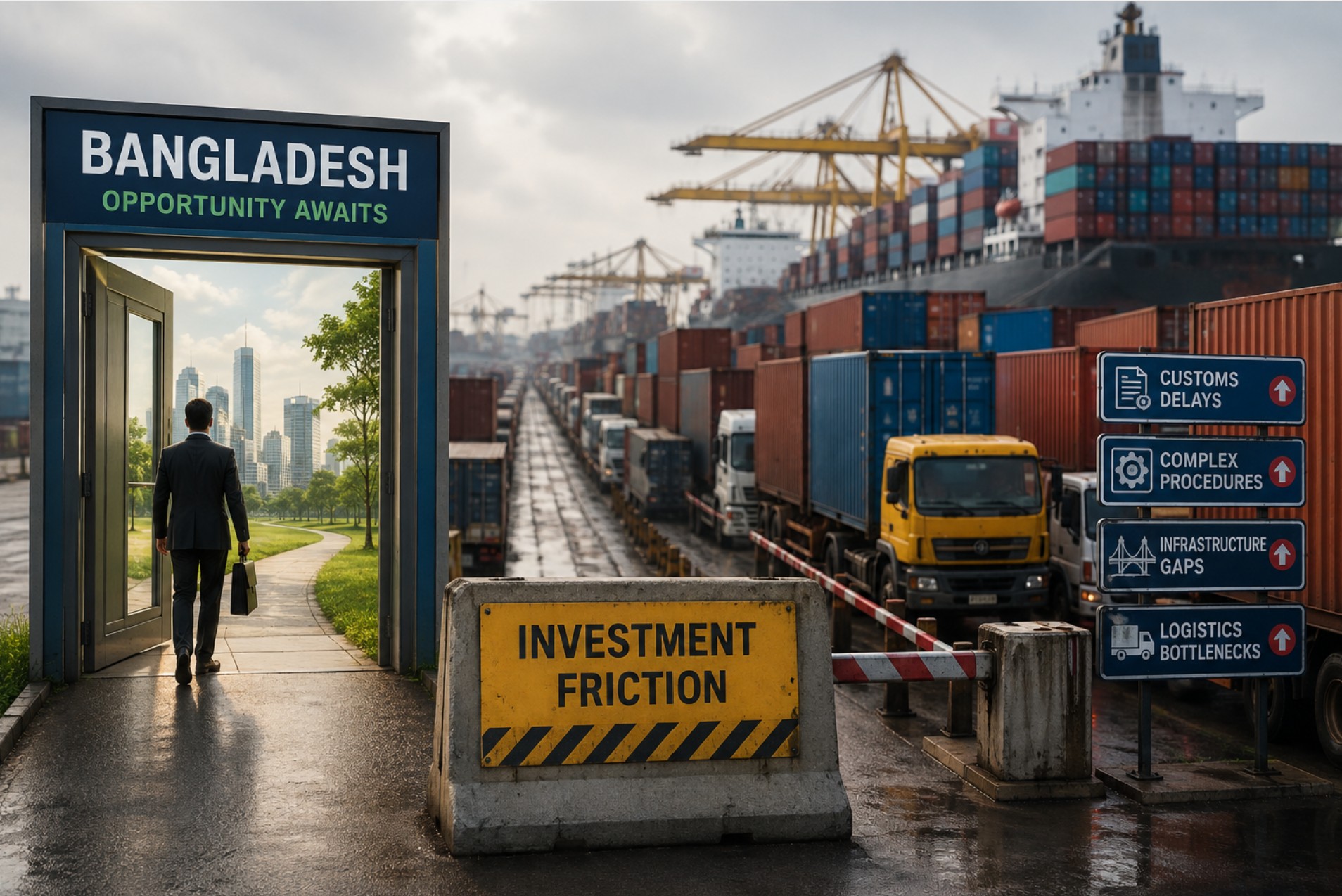
The Foreign Investors’ Chamber of Commerce and Industry recently highlighted the problem bluntly. Foreign investors can face basic approvals taking up to a year, port waiting times more than double those in neighboring South Asian countries, banking weaknesses, gas shortages and interaction with as many as 23 government agencies.
That is not an investment promotion problem. It is a management problem.
Bangladesh has been adding facilitation layers while the underlying system remains fragmented.
The government has now passed the Invest Bangladesh Bill, 2026, creating a single investment promotion authority by merging BIDA, BEZA, BHTPA and PPPA. The objective is to reduce duplication and improve coordination.
That is potentially important.
But another institutional merger will not automatically improve the investor experience.
If the same procedures, delays, unclear responsibilities and weak accountability simply move under a larger umbrella, Bangladesh will have created a bigger institution rather than a better system.
The real investment test begins after the handshake
Consider what a new manufacturing investor actually needs.
It needs land and approvals. Then utilities. Then machinery imports. Then customs clearance. Then transport. Then banking. Then labour. Then certification. Then raw material flows. Then exports.
Each step may involve a different authority.
Each delay adds cost.
And the cost does not remain inside that particular department.
A delayed machinery shipment can delay factory commissioning. A delayed factory commissioning can leave financing costs running while production has not started. Unreliable logistics can force higher inventory. Customs uncertainty can make procurement planning harder. Port disruption can affect export commitments.
The investor experiences all of this as one thing.
Bangladesh.
This is why “our department completed its process” is not the same as “the investor received the service on time.”
Chattogram shows what friction looks like in real life
Bangladesh’s trade system is heavily dependent on Chattogram Port. In July 2026, the Chittagong Chamber said around 90% of the country’s import and export trade moves through the port and warned that restrictions on empty container storage were worsening congestion.
Earlier in 2026, the port faced a different operational problem. A shortage of lighter vessels slowed unloading from mother vessels. Another episode saw the Chattogram Goods Port Yard holding 1,352 containers against a capacity of 825, with limited railway services contributing to delays.
These are not abstract logistics statistics.
For an investor, they translate into vessel delays, storage costs, demurrage exposure, production uncertainty and working capital tied up in cargo.
The same shipment can become more expensive without the freight rate itself changing.
That is investment friction.
Customs is where paperwork becomes economics
Bangladesh’s own trade facilitation research provides another uncomfortable example.
A Time Release Study at Benapole found average import clearance time of 10 days, 8 hours and 11 minutes from truck arrival to final release. The range extended from less than two hours to more than 35 days.
The spread is more important than the average.
An investor can plan around a predictable ten-day process.
Planning becomes much harder when the same process can sometimes take more than a month.
This is why investors price uncertainty.
They may tolerate a higher logistics cost if it is predictable. They struggle when they cannot reliably estimate when goods will be released.
That difference eventually enters the investment model.
The forwarder cannot fix the system. But it can protect the investor from it.
This is where Bangladesh’s local logistics capability becomes strategically important.
A capable freight forwarder is not merely a company that books a container.
For a foreign investor entering Bangladesh, the right local logistics partner can connect international freight with the realities of customs, ports, inland transportation, documentation, warehousing, cross-border movement and delivery planning.
It can identify bottlenecks before cargo arrives. It can coordinate documentation. It can plan alternative routing. It can manage transport capacity. It can monitor cargo milestones and communicate realistic timelines.
In other words, local logistics expertise can reduce friction.
But there is an important limit.
A freight forwarder can manage a delay. It cannot eliminate a broken process.
It can coordinate around congestion. It cannot create port capacity.
It can prepare documents correctly. It cannot rewrite customs rules.
It can arrange trucks. It cannot manufacture predictable public infrastructure.
That distinction matters because Bangladesh should not outsource systemic responsibility to the private logistics sector.
There is also an opportunity hiding inside the problem
Bangladesh is not without solutions.
The proposed $550 million Laldia Container Terminal, backed by APM Terminals, is designed to add more than 800,000 TEUs of annual capacity and handle larger vessels than the current port system.
BIDA has also proposed expanding the use of private inland container depots for import clearance and improving digital integration among customs and regulatory agencies.
These moves point in the right direction: capacity, competition, digitalization and decentralization.
But execution will decide whether these become genuine investment enablers or simply another set of announcements.
The same principle applies to Bangladesh Shipping Corporation.
The state-owned carrier has recently renewed its fleet, with its fleet reaching seven ships after the acquisition of two vessels. One of the new vessels, MV Banglar Nabojatra, began a commercial voyage to the United States in February 2026.
This is an opportunity to think bigger.
A stronger Bangladesh Shipping Corporation should not be judged only by how many ships it owns. It should be developed as an internationally credible national shipping platform that can support Bangladesh’s trade interests, build commercial partnerships and participate more actively in global maritime networks.
A competitive national carrier will not solve every logistics problem. But it can strengthen Bangladesh’s maritime capability and give the country another instrument in an increasingly fragmented global trading system.
The question Bangladesh should be asking
The recent investment pipeline should not make Bangladesh complacent. It should make the country more demanding of itself.
For every new investment, ask:
- How long will the factory take to become operational?
- How predictable will machinery imports be?
- How quickly can raw materials move through the port?
- How reliably can finished goods reach global customers?
- How many government touchpoints will the investor still need after BIDA’s facilitation?
- Who owns the problem when the answer is delayed?
These are not anti-investment questions.
They are the questions serious investors already ask.
Bangladesh has potential. It has a manufacturing base, a strategic location, a large workforce, growing port capacity and increasing interest from foreign companies.
But potential does not create returns.
Execution does.
Bangladesh cannot keep measuring success by the size of investment announcements while ignoring the friction that determines whether those investments become productive assets.
The country does not necessarily need to be the cheapest place to invest.
It needs to become one of the more predictable.
Because investors can price labor.
They can price taxes.
They can price freight.
They can price infrastructure.
What they cannot easily price is uncertainty.
And if Bangladesh makes investors spend too much time managing Bangladesh itself, some of that capital will eventually decide to build somewhere else.
The opportunity is still here.
So is the warning.
Bangladesh is attracting investment.
Now it has to prove that it can manage it.
References
- Bangladesh Investment Development Authority (BIDA) – The Business Standard
- BEPZA – Official source
- Foreign Investors’ Chamber of Commerce and Industry (FICCI) – The Daily Star
- Bangladesh Trade Portal – Government of Bangladesh
- UN Trade and Development (UNCTAD)
- Public Private Partnership Authority (PPPA) – Laldia Container Terminal investment
- PPPA – Laldia Container Terminal project profile
- Bangladesh Shipping Corporation / The Business Standard – MV Banglar Nabojatra
- The Daily Star – Invest Bangladesh Bill 2026
- The Daily Star – Will ‘Invest Bangladesh’ make investing easier?
- The Business Standard – BIDA’s $1.5 billion investment pipeline
- BEPZA – Record $718 million investment proposals in FY2025–26