The World Is Rebuilding Its Supply Chains
For decades, businesses optimized supply chains around one simple objective: produce where costs were lowest. China became the factory of the world, supported by vast industrial ecosystems, world class ports and unmatched manufacturing scale. That model delivered efficiency, but it also created concentration risk.
Then came a series of shocks.
The Covid 19 pandemic exposed the danger of relying on a single production base. The United States China trade tensions accelerated the search for alternative manufacturing locations. The Red Sea crisis reminded businesses that a single disruption could delay cargo, increase freight costs and disrupt inventory planning across continents. At the same time, climate related disruptions at key maritime gateways reinforced the importance of resilient logistics networks.
The response from global manufacturers has not been to abandon globalization. Instead, they have regionalized it.
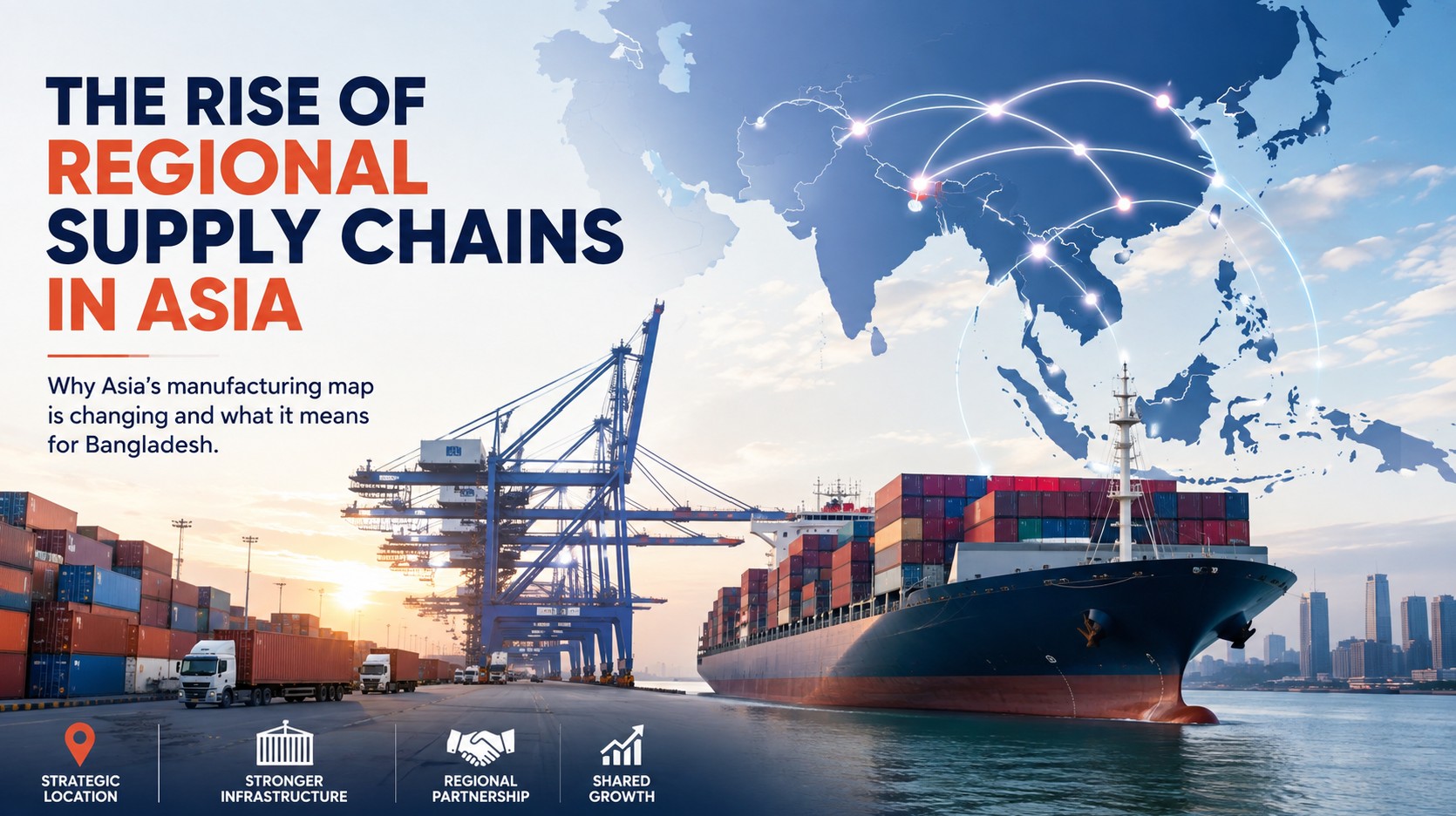
Production is increasingly being distributed across multiple Asian countries instead of remaining concentrated in one. Components may originate in China, be assembled in Vietnam, packaged in Malaysia and shipped through Singapore before reaching consumers in Europe or North America. Asia is no longer a collection of competing manufacturing countries. It is becoming an interconnected production network.
This structural shift is one of the most significant changes in global trade over the last decade. For Bangladesh, it presents a once in a generation opportunity.
Why Asia Is Becoming the New Manufacturing Map
Regional supply chains are built on one principle: resilience.
Global manufacturers are no longer asking only where production is cheapest. They are asking where production is dependable, diversified and capable of recovering quickly from disruption.
This explains why companies such as Apple have expanded manufacturing footprints across India and Vietnam while maintaining significant operations in China. Samsung transformed Vietnam into one of its largest global production hubs. Electronics, automotive components, semiconductors and consumer goods are increasingly being produced through regional manufacturing ecosystems rather than single country operations.
Developing Asia continues to attract the largest share of global foreign direct investment, confirming that the region remains the engine of global manufacturing. Rather than shifting away from Asia, multinational companies are investing deeper within Asia while diversifying production across several economies.
This is not simply a manufacturing trend. It is a logistics transformation.
Ports, highways, inland container depots, customs systems, rail corridors and digital supply chain visibility have become as important as factories themselves. Countries capable of connecting these elements efficiently are emerging as preferred destinations for long term investment.
Bangladesh: A Natural Contender
Bangladesh enters this transformation with significant advantages.
Its location on the Bay of Bengal places it at the crossroads of South Asia and Southeast Asia. It sits close to India’s eastern states while maintaining maritime connectivity to the world’s major shipping routes. Few countries in Asia possess such strategic geography.
The country has already established itself as one of the world’s largest apparel exporters. A young workforce, competitive manufacturing costs and decades of export experience provide a strong industrial foundation. Massive infrastructure investments including Padma Bridge, the Matarbari Deep Sea Port project, the Patenga Container Terminal and improved highway connectivity demonstrate a national commitment to strengthening logistics.
Chattogram Port deserves particular recognition.
Handling more than ninety percent of Bangladesh’s seaborne trade and almost all containerized cargo, the port recorded its highest ever throughput during 2025, handling over 3.4 million TEUs alongside strong cargo growth. Operational improvements over recent years have significantly enhanced its capability.
These achievements matter. However, they also raise an important question.
If Bangladesh possesses strategic geography, manufacturing capability and improving infrastructure, why is it still not emerging as one of Asia’s leading regional supply chain hubs?
Bangladesh Should Be Winning. So Why Isn’t It?
The answer lies beyond factories and ports. Regional supply chains reward predictability. A manufacturer can manage higher wages. A shipping line can adjust freight rates. An importer can absorb currency fluctuations.
What businesses struggle to manage is uncertainty. Consider a sourcing manager in Europe evaluating suppliers in Vietnam and Bangladesh. Product quality meets expectations in both countries. Labour costs remain competitive. Production capacity exists.
The deciding factor often becomes confidence.
- Can raw materials reach factories on time?
- Can export cargo move through inland logistics without unexpected delays?
- Can customs procedures remain consistent?
- Can delivery commitments be honoured during peak seasons?
These questions influence investment decisions far more than many businesses publicly acknowledge.
Bangladesh has historically been viewed through the lens of manufacturing costs. The next phase of competition will be determined by logistics performance. The country must move beyond simply exporting products and begin exporting confidence.
Another challenge is export concentration.
The readymade garment industry remains Bangladesh’s export champion and deserves enormous credit for transforming the national economy. Yet dependence on one dominant sector also increases vulnerability. Regional supply chains favor economies with diversified manufacturing capabilities supported by strong supplier networks.
Vietnam provides an important lesson. It did not replace garments.
It added electronics, machinery, consumer products and technology manufacturing while simultaneously strengthening logistics infrastructure and supplier ecosystems.
Diversification strengthened resilience. Bangladesh now faces a similar opportunity.
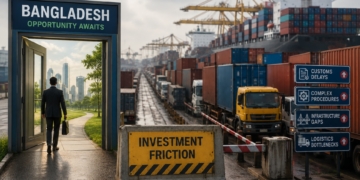
Opportunity Meets Friction
Foreign investors rarely make decisions based solely on tax incentives or labour costs.
Their experience begins long before the first shipment leaves a factory.
They evaluate how easily a company can be established, how efficiently approvals move through government institutions, how consistently regulations are applied and how predictable customs processes remain throughout the investment lifecycle.
Every unnecessary delay increases uncertainty. Every inconsistent interpretation of regulations raises operational risk. Every additional administrative layer extends project timelines.
Most global manufacturers are prepared to invest. They simply want confidence that systems will function predictably. This is where logistics professionals become far more important than many people realize.
Freight forwarders, customs specialists, transport operators and supply chain consultants increasingly act as strategic partners rather than cargo coordinators. Their ability to integrate ocean freight, inland transportation, customs compliance, warehousing and real time shipment visibility directly influences how foreign investors experience Bangladesh.
Strong logistics companies reduce friction. They become trusted guides through operational complexity. In a regional supply chain, that capability creates competitive advantage.
The Race Is Against Time
Bangladesh is not competing against countries with weaker economies. It is competing against Vietnam, India, Indonesia, Malaysia and Thailand. Every one of these countries is investing aggressively in industrial corridors, logistics infrastructure, trade facilitation and port modernization.
The competition is not slowing. Regional supply chains are forming today. Supplier ecosystems become stronger with every new investment. Industrial clusters become more attractive as supporting industries expand.
Once global manufacturers establish reliable regional networks, those ecosystems become increasingly difficult to replace. Time therefore becomes a strategic factor. The question is no longer whether Bangladesh has potential.
The question is whether Bangladesh can convert potential into execution before competing ecosystems become permanently established elsewhere.
From Potential to Performance
Bangladesh does not need to reinvent itself. It needs to connect existing strengths more effectively. Several priorities deserve immediate attention.
- Improve multimodal connectivity between ports, inland container depots, rail and highways.
- Strengthen customs modernization and digital trade facilitation.
- Simplify administrative procedures affecting foreign investment.
- Diversify manufacturing beyond apparel while supporting existing export strengths.
- Develop integrated national logistics policies connecting ports with industrial zones and regional corridors.
- Accelerate regional connectivity through BBIN and Bay of Bengal trade initiatives.
Another opportunity deserves greater national attention. Bangladesh Shipping Corporation can play a much larger regional role.
As the country’s state owned carrier expands its fleet, it should gradually position itself beyond national cargo carriage and develop stronger regional liner services, support coastal shipping, strengthen feeder connectivity and participate more actively in emerging Bay of Bengal logistics networks. Combined with modern ports and private sector logistics expertise, a stronger national shipping capability could improve resilience while reducing dependence on foreign carriers for selected regional services.
This should not be viewed as competition with the private sector. It should be viewed as strengthening Bangladesh’s overall maritime ecosystem. Regional supply chains require capable ports, efficient shipping, reliable inland logistics and coordinated public private collaboration.
No single institution can achieve that transformation alone.
Final Thoughts
Asia’s manufacturing map is being redrawn.
Not through dramatic announcements, but through thousands of investment decisions made every month inside corporate boardrooms around the world.
Those decisions increasingly favor countries that combine manufacturing capability with logistics reliability.
Bangladesh already possesses many of the essential ingredients.
- Strategic geography.
- Manufacturing experience.
- A resilient private sector.
- Improving infrastructure.
- An expanding logistics industry.
The challenge is no longer identifying opportunities. The challenge is removing friction.
Regional supply chains will continue expanding across Asia regardless of whether Bangladesh participates fully.
That reality makes the coming decade critically important. Bangladesh has already won the geography lottery. The next chapter will be determined by execution.
If the country can deliver predictable logistics, stronger institutional coordination, diversified manufacturing and seamless connectivity between public infrastructure and private enterprise, it will become more than a manufacturing destination. It will become an indispensable link in Asia’s evolving supply chain network.
The future of manufacturing will not belong to the country with the lowest production cost.
It will belong to the country that global supply chains trust the most.
References
- Bangladesh Sangbad Sangstha (2026) Chattogram Port achieves record container and cargo handling.
- Chattogram Port Authority (2025) Annual performance and operational statistics.
- UN Trade and Development (UNCTAD) (2025) Shipping data: UNCTAD releases new seaborne trade statistics.
- UN Trade and Development (UNCTAD) (2025) Report on the Implementation of the Investment Policy Review of Bangladesh.
- UN Trade and Development (UNCTAD) Case Study 22: Port of Chittagong, Bangladesh.
- The Business Standard (2026) Bangladesh apparel export competitiveness and regional comparison.
- The Daily Star (2026) Bangladesh can be world’s No. 1 RMG sourcing hub.