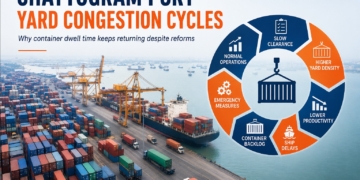
By Dawn, the Queue Is Already Alive
Before the sun fully rises over Benapole, the story has already started. Engines are idling. Drivers are leaning against doors with tea in hand. Clearing agents are checking phones for updates that may change within the hour. Some trucks will move. Some will not. Some will clear faster than expected. Others will be trapped by one missing document, one customs instruction, one policy twist from the other side of the border. That is the reality of Benapole in 2026. Bangladesh’s busiest land port is still the country’s most important overland trade artery with India, but it remains a place where congestion returns with uncomfortable regularity, even after new investments, new systems, and years of promises about modernization.
This is why Benapole deserves to be read not as a border crossing, but as a live trade corridor under stress. Every delay here reaches far beyond Jashore. It touches factories in Gazipur, warehouses in Dhaka, buyers in Kolkata, transporters in Khulna, importers of raw materials, exporters of garments, and every freight coordinator trying to keep a delivery promise intact. When trucks queue up at Benapole, it is not a local inconvenience. It is a national supply chain event.
The Border That Never Really Sleeps
Benapole remains the main land gateway for Bangladesh India truck base trade, handling a large share of industrial inputs, textile raw materials, machinery, chemicals, food items, and export cargo. On normal days, the volume itself explains why pressure builds so quickly. According to trade stakeholders quoted during the Eid resumption in June 2025, roughly 450 to 500 trucks on average enter Bangladesh daily through Benapole from India, while 200 to 250 trucks move out on export runs. That kind of frequency leaves almost no room for operational mistakes. If even one day’s flow is interrupted, the backlog does not politely disappear the next morning. It stacks. Then it spreads.
That is the first truth many outside the trade lane miss. Benapole is not just busy. It is tightly timed. It functions like a conveyor belt. Once the rhythm breaks, the queue becomes the headline.
One Border, Two Clocks
The Benapole Petrapole corridor suffers from a classic South Asian problem. It is one commercial route managed like two separate worlds. Bangladesh may be ready to clear. India may slow inspection. One side may reduce operational hours. The other side may continue receiving trucks but not release them at the same pace. One authority may classify a cargo as routine. The other may suddenly treat it as sensitive. The result is predictable. The border remains technically open, but the corridor stops behaving like a functioning corridor.
This is exactly why truck queues keep returning in 2026. The problem is no longer just lack of parking or lack of yard space. The deeper problem is timing mismatch. Benapole and Petrapole are adjacent, but they do not always operate with the same urgency, same risk tolerance, or same commercial logic. That gap is where delay is born.
The Day One Timing Decision Choked the Lane
If anyone still believes congestion at Benapole is only about infrastructure, the October 2025 customs hour shock should end that argument. When customs operations were halted after 6 pm, trade immediately slowed and truck pressure intensified. Reports from the time showed that the normal inflow of around 400 to 450 trucks dropped sharply to around 180 to 200. More than 1,500 trucks reportedly became stranded across Benapole and Petrapole. That is how fragile the lane is. One operational timing decision, and a high volume border starts gasping.
This was not a technical glitch. It was a lesson. Benapole runs on throughput discipline. Reduce working hours at a peak corridor without full bilateral synchronization, and the queue grows faster than most planners expect. A border port like this cannot be managed with office hour thinking. It must be managed like a logistics artery.
When a Truck Reaches the Gate and Still Cannot Enter
The second lesson came from cargo specific policy shocks. In April 2025, four Bangladeshi trucks were sent back from Benapole after India revoked the transshipment facility that had allowed Bangladeshi cargo bound for third countries to move via Indian land ports. The trucks had reached the corridor. The transport was real. The freight had already committed. Yet the route was suddenly no longer commercially valid for that cargo category.
Then in May 2025, 36 Bangladeshi trucks carrying ready made garments were stranded after India imposed fresh restrictions on certain Bangladeshi imports through land ports. Garments that had previously moved through land gateways now faced rerouting requirements through seaports such as Kolkata or Nhava Sheva. This is the kind of disruption that hurts beyond the truck itself. It hits delivery commitments, buyer confidence, LC timelines, and working capital exposure.
A truck queue at Benapole is often not caused by too many trucks. Sometimes it is caused by one policy circular issued elsewhere.
The Betel Nut Pile-Up That Exposed the Real Weakness
If 2025 had one incident that captured the human and commercial cost of this corridor, it was the betel nut stalemate. More than 150 export bound trucks carrying betel nut worth around Tk 100 crore remained stranded at Benapole for nearly two months. Exporters reported daily carrying costs around Tk 3 lakh, driven by truck detention type expenses. Traders alleged delays on the Indian side under quality testing grounds. Whatever the procedural justification, the commercial damage was undeniable.
This was not a dramatic one-day shutdown. It was worse. It was slow suffocation.
When a truck sits for weeks, the pain multiplies:
- Fleet utilization collapses
- Drivers remain tied up
- Export cash cycles freeze
- Buyers begin to question reliability
- Commodity quality risks increase depending on product nature
- Smaller traders lose negotiating power first
That is the point where a border bottleneck becomes a business model threat. For many operators, the real loss is not only the cargo value. It is the erosion of trust in the lane itself.
Benapole Got Bigger. But Did It Get Faster?
To be fair, the state has not been idle. The cargo vehicle terminal opened at Benapole in November 2024 was a major physical intervention. Built on 41 acres at a reported cost of Tk 329 crore, it can accommodate around 1,500 trucks. That is serious capacity. It reduces roadside spillover. It gives the port more breathing room. It improves basic traffic discipline around the gateway.
In December 2025, the National Board of Revenue also launched the “Truck Movement” digital sub module under ASYCUDA World at Benapole on a pilot basis. For the first time, Indian cargo truck entry and empty return movements began shifting from manual records toward electronic tracking. That matters. A busy border without data is a blind border. With digital visibility, customs can track dwell time, identify stuck cycles, and generate operational intelligence instead of depending entirely on fragmented manual records.
But here is the blunt reality. Bigger is not always faster. A larger terminal can hold more trucks. It cannot automatically clear more trucks. A digital dashboard can show where congestion forms. It cannot by itself resolve a bilateral inspection delay, a policy reversal, or a cargo admissibility dispute. Benapole’s upgrades are necessary. They are not yet sufficient.
This Is Where Freight Forwarders Become Corridor Operators
The public often sees freight forwarding companies as paperwork handlers or middlemen. That view is outdated, especially on a volatile lane like Benapole Petrapole. In 2026, the best freight operators in this corridor are not just clearing cargo. They are managing uncertainty.
Their real value now lies in six quiet but critical moves:
- Checking documentation before dispatch so a truck does not reach the gate with preventable defects
- Advising shippers on cargo categories facing higher risk of sudden restriction or enhanced scrutiny
- Timing dispatches to avoid known post-holiday or post shutdown congestion spikes
- Diversifying routings where feasible through alternative land ports such as Bhomra, Hili, or Sonamasjid
- Managing communication between buyer, seller, transporter, and customs facing stakeholders before frustration becomes commercial conflict
- Protecting working capital by staging loads, splitting shipments, and avoiding overexposure on one border window
This is why the corridor’s future will quietly belong to companies that can combine operations, compliance, and trade judgment. At Benapole, the smartest player is no longer the cheapest truck provider. It is the one who sees trouble before the queue forms.
After Every Holiday, the Real Work Begins
Another underreported reason queues keep returning is shutdown aftershock. The Eid closure in June 2025 offers a clean example. Trade remained suspended for ten days during the holiday period, and when operations resumed, heavy congestion was immediate. Backlog had piled up. Workers returned. Trucks returned. Customs returned. But flow did not return instantly. This matters because the border is not a switch. It is a recovery curve.
Every long closure creates a secondary crisis:
- Backlog of pending documents
- Yard pressure
- Delayed unloading cycles
- Unbalanced truck turnaround
- Tighter buyer pressure on overdue cargo
For operators who know the lane, the day after reopening is often more dangerous than the day of closure itself. That is where planning wins or loses margin.
SAARC Talk Failed. Corridor Discipline Still Can Win
Benapole’s future should not be trapped in old bilateral firefighting. This route must be seen as part of a larger Bay of Bengal trade system. SAARC promised regional connectivity but repeatedly failed to turn geography into reliable logistics. The commercial logic, however, remains valid. If SAARC politics stays slow, the practical solution is to move through narrower, more executable frameworks such as BBIN.
The BBIN Motor Vehicles Agreement was built for precisely this kind of transformation. The principle is simple: treat movement as a corridor, not as disconnected border posts. For Benapole, that means the next phase of reform should be brutally practical:
- Synchronized service hours across both sides
- Real time queue data exchange between Benapole and Petrapole
- Pre arrival document alignment for selected commodities
- Faster green channel treatment for repeat low risk cargo
- Joint holiday and closure protocols announced in advance
- Commodity wise escalation cells when one side suddenly changes interpretation
If that discipline takes hold, Benapole stops being just a Bangladesh India land port. It becomes a stronger gateway in a wider Bay of Bengal trade architecture linking factories, inland transport, seaports, and regional cargo corridors.
The Future Will Be Won in Process, Not Concrete
Benapole in 2026 is a paradox. It is more important than ever. It is better equipped than before. And yet it still gets trapped by the same familiar scene: a line of trucks waiting for systems to align.
That is the real conclusion. The queue keeps returning not because Benapole has failed to grow, but because growth in physical infrastructure has moved faster than growth in corridor governance. The port is larger. The process is still vulnerable. The data is improving. The bilateral rhythm is still uneven. The cargo keeps coming. The trust keeps getting tested.
Benapole does not need another grand speech about connectivity. It needs sharper choreography between two borders that pretend to be separate while serving one commercial bloodstream. The day Bangladesh and India begin managing Benapole and Petrapole as a single living trade artery, the queue will finally stop being the headline. Until then, the trucks will keep arriving before dawn, and the corridor will keep teaching the same hard lesson: in South Asian trade, the real bottleneck is rarely the road. It is the way the road is governed. Κέντρο Luxorion
References
- Asian Development Bank (ADB) (n.d.) Bangladesh, Bhutan, India and Nepal Motor Vehicles Agreement Initiative.
- New Age (2025) 4 Bangladeshi trucks sent back from Benapole. 10 April.
- The Business Standard (2025) 36 garments-laden trucks stranded at Benapole port. 18 May.
- The Daily Star (2024) Cargo vehicle terminal opens at Benapole land port. 14 November.
- The Daily Star (2025) Digital sub-module launched to track truck movement at Benapole. 18 December.
- The Daily Star (2025) Over 100 crore worth of betel nut stranded at Benapole. 8 December.
- The Daily Star (2025) Trade resumes through Benapole port after 10-day Eid holiday. 15 June.