

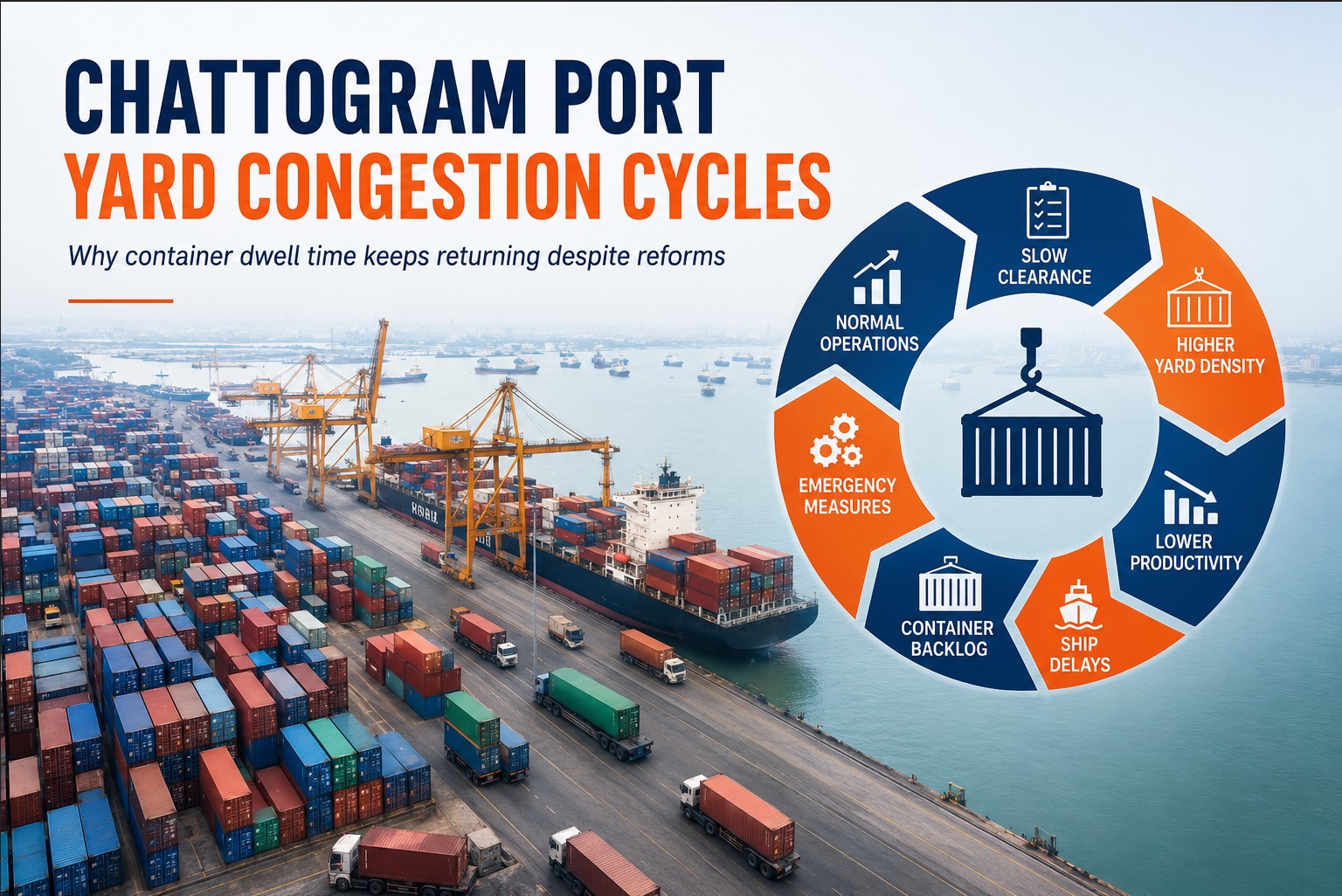
Every few months, the same headlines return. Chattogram Port is congested. Import containers are piling up. Ships are waiting outside the harbor. Exporters are worried about missing sailing schedules. Truck queues stretch beyond terminal gates. Then emergency measures are introduced. Yard pressure gradually falls. Vessel waiting times improve. Trade returns to normal. A few months later, the cycle begins again.
This repeating pattern raises an important question. Why does congestion keep returning despite years of investment, policy changes, digitalization and operational reforms?
The answer is more complex than blaming a port, a customs authority or a shipping line. Chattogram Port is not operating in isolation. It is the center of Bangladesh’s trade ecosystem, where shipping companies, freight forwarders, customs, transport operators, inland depots, importers, exporters and government agencies depend on one another. When one part of that ecosystem slows down, the effects quickly spread across the entire supply chain.
Understanding these congestion cycles is important because nearly all of Bangladesh’s containerized international trade passes through Chattogram Port. Every delay eventually translates into higher logistics costs, reduced competitiveness and uncertainty for businesses.
Congestion is a supply chain problem before it becomes a port problem
Most people associate congestion with containers stacked inside a terminal yard. In reality, the problem usually begins several days earlier.
A vessel arrives on schedule and containers are discharged efficiently. Yard cranes place them in designated storage areas. The operation appears normal. The real challenge starts when containers do not leave the port at the expected pace.
Some importers are waiting for customs clearance. Others are arranging bank documentation or duty payments. Some have no warehouse space available. Transporters may not have enough trucks during peak periods. Inland container depots may already be operating close to capacity.
Each individual delay may appear insignificant. Combined, they create a chain reaction.
As containers remain inside the terminal for longer periods, available yard space gradually reduces. Terminal equipment spends more time relocating containers instead of loading trucks. Truck turnaround becomes slower. Vessel discharge takes longer. Incoming ships wait outside the port because berths cannot be released quickly enough.
Congestion is therefore not created by ships arriving. It is created when cargo stops moving.
Container dwell time remains the biggest challenge
One of the most important performance indicators of any container port is dwell time, the number of days a container stays inside the terminal before leaving.
Ports are designed to move cargo, not to store it.
Several studies conducted by the World Bank have consistently identified long import container dwell time as one of the major operational constraints affecting Bangladesh’s logistics performance. Although improvements have been achieved over the years, dwell time continues to fluctuate depending on cargo volumes, customs processes and inland logistics capacity.
Every additional day that an import container remains inside the terminal occupies valuable yard space that could otherwise accommodate newly arriving cargo.
This creates a hidden bottleneck that cannot be solved simply by expanding physical infrastructure.
The most efficient ports in the world focus on reducing dwell time rather than continuously building larger storage yards.
Recent events demonstrate how quickly congestion develops
The congestion experienced during 2025 illustrates how multiple operational issues can combine within a short period.
Reports from The Daily Star highlighted increasing yard occupancy, vessel queues and extended waiting times after a combination of slower cargo evacuation, customs related disruptions and operational challenges affected container movement.
The situation did not arise because of one single failure.
Instead, several independent events occurred simultaneously.
- Import clearance slowed.
- Truck movement became less efficient.
- Container evacuation reduced.
- Yard occupancy increased.
- Ship waiting time expanded.
- The result was another familiar congestion cycle.
This demonstrates an important lesson for every logistics professional. Congestion rarely arrives overnight. It develops gradually through many small operational delays.
The responsibility belongs to the entire logistics ecosystem
Whenever congestion occurs, public discussion often focuses on identifying a single organization responsible for the problem.
Reality is far more balanced.
- The Chattogram Port Authority manages berths, equipment, yard planning and infrastructure development.
- National Board of Revenue and Customs oversee import clearance, inspections and regulatory compliance.
- Shipping lines manage vessel schedules, container equipment and documentation.
- Importers arrange payments, customs documentation, transport and warehouse availability.
- Transport companies provide trucks that evacuate cargo from the terminal.
- Inland Container Depots receive containers moved away from the port.
- Freight forwarding companies coordinate almost every stage connecting these stakeholders.
- No individual organization can completely eliminate congestion.
- Likewise, no single organization alone creates it.
Ports operate as integrated systems where the weakest operational link determines the overall performance.
The invisible role of freight forwarding
Freight forwarding is often misunderstood as simply arranging shipments. In reality, professional freight forwarders serve as supply chain coordinators. Their influence begins well before a vessel reaches Bangladesh.
- Commercial invoices, packing lists, certificates, permits, letters of credit, customs declarations and shipping instructions all require careful preparation before cargo arrives.
- Documentation errors may appear small on paper but can keep containers inside the port for several additional days.
Experienced freight forwarders reduce this risk by ensuring documentation accuracy before vessel arrival.
Pre arrival customs preparation enables importers to begin clearance immediately after discharge rather than several days later.
Transport planning also plays a critical role.
Rather than searching for trucks after customs clearance, experienced forwarders coordinate vehicle availability in advance. Warehouses are informed. Delivery appointments are confirmed. Inland depots are booked where necessary.
Every hour saved during cargo evacuation contributes to reducing yard occupancy. Modern freight forwarding has evolved into predictive logistics rather than reactive logistics. This shift is becoming increasingly important for Bangladesh’s growing international trade.
Digital coordination matters more than digital paperwork
Bangladesh has made considerable progress in introducing digital customs systems and modernizing port operations. However, digital documents alone cannot eliminate congestion.
- The real value comes from information sharing across the logistics chain.
- Shipping schedules should be visible to transport operators.
- Truck arrivals should be coordinated with terminal operations.
- Importers should receive advance notifications before vessel arrival.
- Customs processing should integrate with port operations wherever possible.
Many leading international ports have invested heavily in Port Community Systems that connect multiple stakeholders through one digital platform. The objective is not simply automation. The objective is coordinated decision making.
As Bangladesh’s trade volumes continue growing, integrated digital coordination will become increasingly important.
Infrastructure expansion alone will never solve congestion
Bangladesh has invested significantly in improving port infrastructure.
The Bay Terminal project promises additional capacity. The Patenga Container Terminal has expanded operational capability. Road connectivity has improved through major infrastructure projects. Rail connections continue to receive investment.
These developments are essential. Yet international experience shows that infrastructure alone does not eliminate congestion. Without efficient cargo evacuation, even the largest container yards eventually become full. Operational efficiency must grow alongside physical capacity.
The two cannot be separated.
Inland logistics determines port performance
A container port performs only as efficiently as the transport network connected to it.
- Road congestion between Chattogram and industrial zones directly influences yard occupancy.
- Truck shortages during festival seasons reduce cargo evacuation.
- Warehouse capacity affects importer collection decisions.
- Container depots become essential pressure relief points during busy periods.
- Rail transportation also presents opportunities for increasing inland cargo movement.
A balanced logistics network distributes cargo more efficiently than relying almost entirely on road transport. Future investment should therefore consider the complete logistics corridor rather than focusing solely on the port itself.
Bangladesh Shipping Corporation deserves a larger role
Bangladesh Shipping Corporation has traditionally focused on supporting the country’s maritime transport capability through its government owned fleet.
As Bangladesh’s international trade continues expanding, the corporation has an opportunity to evolve beyond its conventional role.
Global shipping companies increasingly invest in digital fleet management, integrated logistics services, specialized cargo handling and regional feeder networks.
Bangladesh Shipping Corporation can gradually position itself in similar directions by strengthening operational excellence, expanding strategic partnerships, investing in modern vessels and supporting regional connectivity within the Bay of Bengal.
A stronger national carrier also contributes to greater resilience during periods of global shipping disruption, while creating opportunities for Bangladeshi maritime professionals to gain international exposure and technical expertise.
Reaching international standards will require sustained investment, commercial agility and continuous operational improvement, but the foundation already exists.
What Bangladesh should focus on next
Reducing congestion should not be measured only by shorter vessel waiting times.
The more meaningful indicators are faster cargo evacuation, lower container dwell time and stronger coordination across the logistics chain.
Priority areas include:
- Faster import documentation before vessel arrival.
- Wider adoption of risk-based customs inspections.
- Better truck appointment and gate management systems.
- Stronger integration between ports, customs and inland depots.
- Greater use of predictive shipment planning by freight forwarding companies.
- Improved utilization of rail and inland logistics corridors.
- Continued investment in digital connectivity across all logistics stakeholders.
None of these measures individually will eliminate congestion.
Together, they can significantly reduce the frequency and severity of future congestion cycles.
Looking beyond the next congestion headline
Chattogram Port has demonstrated remarkable resilience despite handling rapidly increasing trade volumes over many years. The challenge is no longer whether Bangladesh can expand port capacity. The challenge is ensuring that every container moves smoothly through the entire logistics corridor.
Congestion is rarely the result of one delayed vessel or one crowded terminal. It is usually the cumulative effect of documentation delays, slower customs clearance, transport constraints, warehouse limitations and fragmented coordination.
Professional freight forwarding companies play a central role in connecting these moving parts. Their ability to anticipate problems, coordinate stakeholders and accelerate cargo movement makes them an increasingly valuable contributor to national trade efficiency. As Bangladesh aims to strengthen its position in global supply chains, the logistics industry must move beyond transaction-based services towards integrated supply chain management.
The future of Chattogram Port will not be defined solely by larger terminals or additional cranes. It will be determined by how effectively every participant across the logistics ecosystem works together to keep cargo moving. When containers flow instead of waiting, ports become more productive, exporters become more competitive and Bangladesh strengthens its position as a reliable trading nation in an increasingly demanding global marketplace.
References
- Asian Development Bank (2023) Project Performance Evaluation Report: Chittagong Port Trade Facilitation Project.
- Chattogram Port Authority (2025) Official Statistics and Operational Information.
- The Daily Star (2025) Ctg Port Congestion Turns Acute.
- World Bank (2021) Moving Forward: Connectivity and Logistics to Sustain Bangladesh’s Success.
- World Bank (2023) Bangladesh Development Update and Logistics Performance Analysis.


