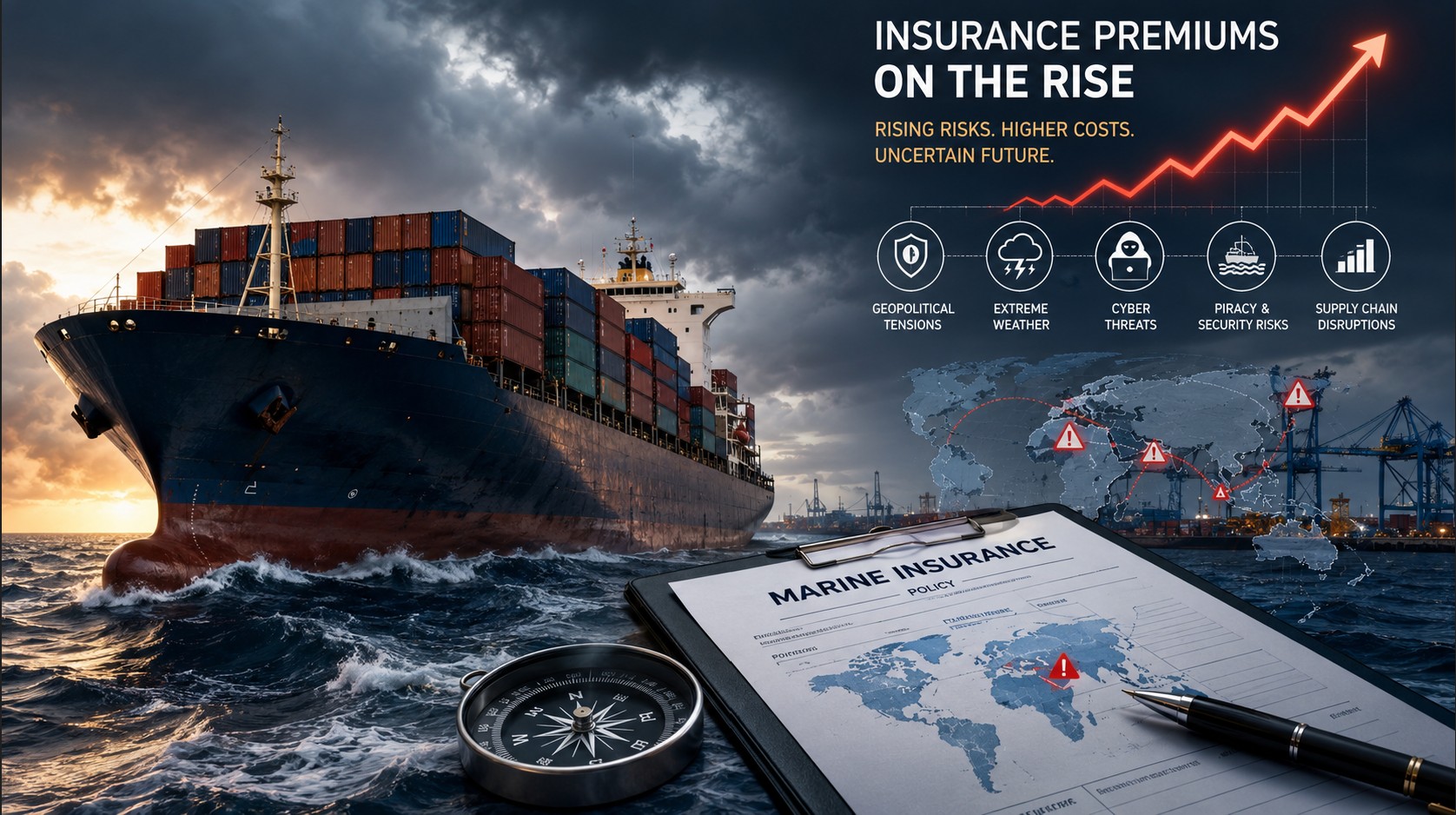
For decades, marine insurance was built around historical loss patterns. Underwriters evaluated storms, collisions, machinery failures, piracy hotspots, cargo claims, and vessel quality before assigning premiums. That framework is rapidly changing. Today’s maritime insurance market is increasingly shaped by geopolitical uncertainty, cyber risks, supply chain disruption, climate events, and unpredictable trade lane volatility. The result is an unprecedented reassessment of maritime risk.
Insurance is no longer simply another operational cost in shipping. It has become a strategic indicator of global trade confidence. Every increase in insurance premiums eventually reaches cargo owners, freight forwarders, importers, exporters, retailers, and finally consumers.
The question is no longer whether insurance costs are increasing. The real question is why insurers have fundamentally changed how they evaluate maritime risk.
The Red Sea became the turning point
The attacks on commercial vessels in the Red Sea since late 2023 fundamentally changed the insurance industry’s outlook.
For years, shipping companies treated the Suez Canal route as one of the most efficient corridors connecting Asia and Europe. That confidence disappeared when commercial vessels began facing missile and drone attacks, forcing many operators to divert around the Cape of Good Hope.
The impact was immediate.
A longer voyage meant higher bunker consumption, additional crew expenses, increased vessel operating costs, longer container turnaround time, and significantly higher insurance exposure.
More importantly, war risk insurance premiums surged.
Industry reports showed that additional war risk premiums for some Red Sea voyages increased from around 0.3 percent of a vessel’s value to well above 1 percent in certain high risk situations. On a vessel valued at US$100 million, that represents hundreds of thousands or even millions of dollars in additional insurance costs for a single transit depending on the assessed exposure. Recent geopolitical developments have continued to keep insurers highly cautious across the region.
Insurance companies were no longer pricing only the probability of physical damage. They were pricing uncertainty itself.
Insurance companies are rebuilding their models
Marine insurers traditionally relied on decades of historical claims data.
Today’s underwriting process increasingly incorporates real time intelligence.
Instead of looking only at previous accidents, insurers now monitor:
- Active military conflicts
- Regional political stability
- Naval security reports
- Vessel ownership structures
- Trading history
- Flag registry
- Previous port calls
- Sanctions exposure
- Cybersecurity preparedness
- Weather forecasting
- Satellite tracking information
The insurance industry has effectively shifted from historical modelling to predictive risk assessment.
A vessel may be technically seaworthy yet still attract significantly higher premiums simply because of the ports it intends to visit or the waters it intends to cross.
Every disruption creates another layer of cost
Insurance inflation rarely happens in isolation.
One disruption creates multiple financial consequences.
A vessel rerouted around southern Africa may experience:
- Longer voyage duration
- Additional fuel consumption
- Increased crew costs
- Higher charter expenses
- Delayed cargo delivery
- Increased inventory carrying costs
- Greater cargo exposure period
- Higher insurance premium
This creates a compounding effect.
UN Trade and Development noted that longer sailing distances, congestion, higher operating expenses, and rising insurance costs contributed to higher global freight rates during the recent shipping disruptions.
Insurance therefore becomes one component inside a much larger inflation cycle affecting global trade.
Climate risk has entered the underwriting equation
- Climate change has become another major pricing variable.
- Extreme weather events have become more frequent across several shipping regions.
- Typhoons in East Asia.
- Cyclones in the Indian Ocean.
- Hurricanes across the Atlantic.
- Flooding affecting major ports.
- Extended drought reducing Panama Canal transit capacity.
- Each event generates new historical loss records.
- Insurance companies respond by recalculating future exposure.
- Ports that were previously considered low risk now experience weather related operational interruptions more frequently.
- That increases uncertainty.
- Uncertainty increases premiums.
Cyber-attacks now carry financial consequences
Modern ships are floating digital systems.
Navigation, engine management, cargo tracking, communications, documentation, customs processing, and port connectivity all rely on digital infrastructure.
Cyber-attacks against shipping companies have demonstrated how vulnerable maritime operations have become.
Insurers increasingly request evidence that shipowners and logistics operators maintain adequate cyber risk management before extending comprehensive cover.
Cyber preparedness is becoming an underwriting factor rather than merely an operational recommendation.
Companies investing in stronger cybersecurity are increasingly viewed as better insurance risks.
Freight forwarders have become risk managers
Many people still associate freight forwarding with booking cargo space.
That perception no longer reflects reality.
Modern freight forwarding companies increasingly influence cargo risk before a shipment even leaves the warehouse.
Professional forwarding teams help customers evaluate:
- Route selection
- Transit time
- Carrier reliability
- Port congestion
- Alternative gateways
- Customs risks
- Cargo packaging
- Insurance suitability
- Documentation quality
When geopolitical conditions suddenly change, experienced logistics professionals often recommend alternative routing before insurance costs escalate further.
This advisory capability creates value far beyond transportation.
The logistics provider becomes an extension of the customer’s supply chain risk management function.
Cargo owners are changing purchasing behavior
Higher insurance premiums also influence commercial decisions.
Importers increasingly ask different questions.
- Should inventory be sourced from a different country?
- Should production move closer to end markets?
- Should shipments be divided into smaller consignments?
- Should alternative ports be used?
- Should inventory levels increase to reduce emergency shipments?
Insurance inflation encourages businesses to reconsider supply chain design rather than simply negotiating freight rates.
That represents a significant structural shift.
Bangladesh cannot ignore these changes
Bangladesh depends heavily on maritime trade.
The country’s export economy, particularly the ready made garments sector, relies on stable ocean transportation.
When shipping insurance costs increase globally, Bangladesh inevitably feels the impact.
Export competitiveness depends not only on manufacturing efficiency but also on transportation reliability.
Local freight forwarding companies therefore have an increasingly important role.
Rather than acting solely as shipment coordinators, they can become strategic advisors by helping exporters:
- Select resilient shipping routes
- Evaluate carrier stability
- Plan shipment timing
- Reduce avoidable cargo risks
- Improve documentation accuracy
- Arrange suitable cargo insurance
- Diversify transport options through regional gateways where commercially appropriate
Businesses that understand global insurance trends can often respond faster than competitors.
Knowledge itself becomes a competitive advantage.
Bangladesh Shipping Corporation has an opportunity
The current market disruption also presents an opportunity for Bangladesh Shipping Corporation.
As the country’s state owned shipping company, Bangladesh Shipping Corporation occupies a strategically important position.
The international shipping industry is increasingly seeking dependable regional operators with transparent governance, modern fleets, strong compliance, and predictable service quality.
Strengthening Bangladesh Shipping Corporation could support that objective.
- Several areas deserve attention.
- Continued fleet modernization.
- Investment in fuel efficient vessels.
- Adoption of international digital fleet management systems.
- Enhanced environmental compliance.
- Stronger cybersecurity standards.
- Improved crew training.
- Closer collaboration with global classification societies and international insurers.
As underwriting increasingly rewards operational excellence, every improvement in safety, compliance, and risk management enhances long term credibility.
A stronger national carrier would not only support Bangladesh’s trade but also strengthen the country’s reputation within international maritime markets.
Data is becoming the new insurance currency
Marine insurance is moving toward continuous assessment.
- Artificial intelligence.
- Satellite monitoring.
- Automatic Identification System tracking.
- Weather analytics.
- Port congestion data.
- Cargo visibility platforms.
These information sources are gradually influencing underwriting decisions.
Instead of annual reviews, insurers increasingly monitor operational behaviour throughout the policy period.
Companies demonstrating consistent operational discipline may enjoy better access to insurance markets over time.
Poor operational practices become visible much faster.
Collaboration will outperform price competition
One important lesson has emerged from the current insurance environment.
The lowest freight rate does not necessarily represent the lowest logistics cost.
- Poor route selection.
- Weak documentation.
- Inexperienced handling.
- Unreliable carriers.
- Inadequate cargo protection.
Each can trigger insurance complications that ultimately cost far more than the initial freight savings.
The strongest logistics partnerships increasingly involve collaboration between exporters, importers, freight forwarders, shipping lines, insurers, surveyors, and financial institutions.
Each participant contributes to reducing overall supply chain risk.
Insurance companies increasingly reward such disciplined ecosystems.
The future belongs to resilient supply chains
Marine insurance is entering a new era.
Premium inflation reflects much more than higher claims.
It reflects a fundamental reassessment of geopolitical stability, operational resilience, technological preparedness, environmental uncertainty, and global trade reliability.
The companies that will perform best are unlikely to be those simply negotiating lower freight rates.
They will be those investing in visibility, compliance, data driven decision making, diversified routing, stronger partnerships, and proactive risk management.
For logistics professionals, this shift creates a significant opportunity.
The industry is moving beyond transportation.
It is becoming an intelligence driven service where understanding risk is just as valuable as moving cargo.
As insurers continue rewriting maritime risk models, freight forwarders, shipping companies, exporters, and national carriers that embrace this transformation will be better positioned to compete in an increasingly uncertain global marketplace.
References
- Bangladesh Shipping Corporation (BSC) 2024, Annual Report, Bangladesh Shipping Corporation.
- Joint War Committee 2023, Listed Areas Update, Lloyd’s Market Association.
- Reuters 2024, Red Sea insurance costs soar as Houthi shipping threats loom.
- Reuters 2026, Red Sea war insurance costs rise after Houthi blockade, sources say.
- UN Trade and Development (UNCTAD) 2024, Review of Maritime Transport 2024.
- UN Trade and Development (UNCTAD) 2025, Review of Maritime Transport 2025.