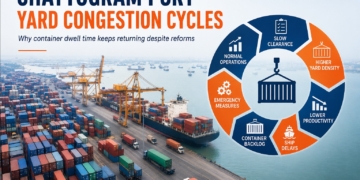
The Strategic Role of Inland Container Depots in Bangladesh
Inland Container Depots (ICDs), commonly referred to as Off-Dock facilities in Bangladesh, were introduced to solve a structural limitation at Chittagong Port limited yard space and mounting container dwell time. With over 90% of Bangladesh’s external trade moving through this port, the inland extension model was never optional; it was inevitable.
The operational logic was straightforward:
- Move export containers from factories to private ICDs for stuffing and customs clearance
- Transfer import containers from the port to ICDs for destuffing and delivery
- Reduce pressure on the port yard
- Improve vessel turnaround time
However, over the last decade, ICDs themselves have come under structural strain. Congestion, regulatory inconsistency, infrastructure gaps, and political patronage have gradually reduced their intended efficiency gains. The consequence is not always visible in headlines. It is embedded upstream in freight rates, demurrage charges, transport bottlenecks, and working capital erosion for exporters.
This article examines what is verifiably happening inside Dhaka-linked ICD operations and how inefficiencies are translating into systemic cost shifts.
Export Concentration and ICD Dependency
According to data published by Bangladesh Inland Container Depots Association (BICDA), more than 85% of export containers particularly ready-made garments are handled through private ICDs rather than directly through port premises. The rationale is functional:
- Garment factories are concentrated around Dhaka, Gazipur, Narayanganj, and Savar
- Transporting loose cargo to Chattogram for port stuffing is inefficient
- Customs clearance inland reduces port-side dwell time
The major public ICD facility at Kamlapur Inland Container Depot was originally built for rail-based container handling but has long been capacity-constrained. Designed decades ago, it cannot match today’s export volume growth. Rail connectivity between Dhaka and Chattogram exists but is insufficient in frequency and wagon availability.
As a result, the private ICD network around Dhaka became the backbone of export logistics.
But dependency without structural expansion creates pressure.
What Congestion Actually Looks Like on the Ground
Congestion in ICDs does not resemble port congestion alone. It manifests in multiple operational forms:
Truck Queue Spillover
- Long queues on approach roads, especially during peak export weeks
- Waiting time extending beyond 24 hours during shipment rush before vessel cut-off
- Increased local transport costs due to detention
Yard Density Beyond Optimal Levels
- Container stacking beyond efficient retrieval height
- Higher reshuffling movements
- Slower gate-in and gate-out turnaround
Documentation Bottlenecks
- Manual processes persisting despite partial automation
- Delays in customs examination during peak enforcement drives
- Lack of synchronized digital integration between customs, shipping lines, and depots
Equipment Imbalance
- Shortage of reach stackers during peak days
- Occasional chassis shortage affecting timely evacuation
These issues have been repeatedly reported by local newspapers such as The Daily Star and The Financial Express when export backlogs intensify before major Western buying seasons.
The impact is measurable not only in hours lost but in cascading cost structures.
Dhaka ICD and the Rail Limitation
The public ICD at Kamlapur was originally envisioned as a rail-centric cargo hub connecting directly to Chattogram. In practice:
- Limited freight train slots
- Passenger train priority on shared tracks
- Aging wagon stock
- Capacity mismatch with container growth
Rail share of container movement remains far below its potential. Reports from Bangladesh Railway have acknowledged operational constraints including locomotive shortages and infrastructure bottlenecks.
This forces a disproportionate reliance on road transport between Dhaka and Chattogram. Consequently:
- Highway congestion increases
- Fuel consumption rises
- Transport cost volatility affects export pricing
- Environmental cost remains unaccounted
The structural weakness of rail integration has indirectly intensified pressure on ICD yard turnover.
Political Influence and Structural Stagnation
The expansion and licensing of private ICDs have not been free from political considerations. Over the years:
- Licensing approvals were influenced by business group affiliations
- Land allocation around Dhaka’s periphery often intersected with political patronage
- Infrastructure approvals did not always align with national logistics master planning
Multiple investigative reports in national dailies have documented how ICD approvals expanded in certain clusters without corresponding road widening or urban traffic integration. Instead of strategic dispersion, facilities concentrated in already congested industrial belts.
The result:
- Local road networks became chokepoints
- Community resistance emerged due to heavy truck traffic
- Enforcement drives occasionally disrupted operations
Political protection often insulated certain operators from strict compliance enforcement, creating uneven standards across facilities. Inconsistent regulatory enforcement undermines systemic efficiency because:
- Some depots invest in technology and yard planning
- Others rely on volume capture through rate competition
This distorts service quality consistency across the supply chain.
Cost Shifting: How Congestion Moves Upstream
Congestion rarely appears as a single invoice line item. It spreads.
-
Factory Level
- Additional truck detention
- Extra handling due to cut-off misses
- Urgent transport premium for re-booked vessels
-
Freight Forwarder Level
- Increased coordination hours
- Vessel roll-over risk
- Space re-confirmation effort
-
Shipping Line Level
- Container repositioning imbalance
- Yard planning disruptions
- Reduced schedule reliability
-
Exporter Level
- Missed delivery windows
- Air freight fallback for urgent shipments
- Working capital lock-up
Evidence from Bangladesh Garment Manufacturers and Exporters Association (BGMEA) indicates that logistics inefficiencies directly affect lead time competitiveness against Vietnam and India.
When ICD congestion extends container dwell by even 48-72 hours during peak season, buyers adjust buffer margins, and exporters absorb cost.
Import Container Pressure and Urban Reality
While exports dominate ICD discussion, import handling adds complexity.
Imported raw materials, machinery, and chemicals often move from port to private ICDs for destuffing. When yard occupancy rises:
- Import container evacuation slows
- Shipping lines apply detention pressure
- Consignees face extended clearance timelines
The industrial belts of Gazipur and Narayanganj depend on timely import raw materials. Any ICD backlog affects factory production cycles.
What Is Actually Needed in Bangladesh
Evidence-based analysis suggests several structural priorities:
Rail Capacity Expansion
Government planning documents from Ministry of Railways Bangladesh emphasize double-tracking and modernization between Dhaka and Chattogram. Without increasing freight-dedicated train frequency, ICD congestion relief will remain partial.
Functional Pangaon Utilization
The inland river terminal at Pangaon Inland Container Terminal was designed to reduce road pressure via river transport. Yet utilization remains below potential due to schedule inconsistency and limited barge frequency. Strengthening river logistics can meaningfully offload road corridors.
Unified Digital Platform
Customs automation under National Board of Revenue has progressed, but depot-level integration varies. A unified digital cargo tracking system linking:
- ICDs
- Customs
- Shipping lines
- Freight forwarders
would reduce documentation delays and physical visit requirements.
Transparent Licensing Policy
Future ICD approvals must align with a national logistics zoning plan. Unregulated clustering deepens urban congestion. Licensing should include:
- Minimum yard size standards
- Equipment ratio requirements
- Mandatory digital capability
- Rail or river connectivity potential
Road Infrastructure Upgrade
Access roads to ICD clusters require structured widening and traffic management. Without coordinated planning with local government authorities, yard efficiency alone cannot solve external congestion.
The Role of Freight Forwarding Companies
Freight forwarders are often treated as intermediaries, but in Bangladesh’s ICD ecosystem, they are operational stabilizers.
Their contributions can be structural:
-
Pre-Shipment Planning
- Align factory production schedule with realistic ICD cut-offs
- Avoid last-minute congestion surges
-
Container Forecasting
- Provide shipping lines with accurate volume projection
- Reduce empty container imbalance
-
Digital Adoption Pressure
- Demand electronic gate passes
- Push for online documentation acceptance
-
Collaborative Dialogue
- Participate in joint forums with BICDA, BGMEA, and port authorities
- Highlight systemic bottlenecks using documented case data
-
Diversification of Routing
- Utilize river or rail options when feasible
- Encourage multimodal experimentation
Freight forwarders, especially global players operating in Bangladesh, possess comparative operational exposure. They can benchmark local ICD efficiency against regional hubs and advocate measurable reform.
Political Will Versus Operational Reform
Infrastructure reform in Bangladesh has historically accelerated when national visibility aligns with political priority such as the expansion of Hazrat Shahjalal International Airport cargo facilities or mega bridge projects.
ICD reform lacks similar public visibility. It operates quietly behind factory gates. Yet it influences billions of dollars in export trade annually.
Sustained reform requires:
- Depoliticized licensing
- Transparent performance metrics
- Public reporting of average dwell time
- Independent compliance audits
Without measurable accountability, congestion becomes normalized rather than resolved.
Competitive Context in South Asia
Regional competition is intensifying. India’s Dedicated Freight Corridor projects and port modernization initiatives create cost advantages. Vietnam continues to streamline inland logistics around Ho Chi Minh City.
Bangladesh’s export growth remains strong, but logistics cost as a percentage of product value remains comparatively high according to trade competitiveness assessments published by World Bank.
ICD inefficiency may not singularly define competitiveness, but it compounds other structural costs including energy pricing and port dwell time.
The Risk of Complacency
Export resilience in Bangladesh has historically masked structural inefficiencies. High global demand for garments often absorbs logistics friction. However,
- Buyer consolidation increases cost scrutiny
- ESG standards now include supply chain transparency
- Carbon accounting may penalize excessive road reliance
If ICD congestion forces repeated truck idling and inefficient routing, environmental compliance pressure may grow.
Structural Reform Framework
A practical roadmap, grounded in existing institutional mandates, would include:
- Annual ICD capacity audit jointly by port authority and BICDA
- Rail freight quota protection for container trains
- Incentives for off-peak gate operations
- Public performance dashboard for container turnaround
- Gradual shift toward inland dry port model with stronger rail linkage
Bangladesh does not lack policy documents. Implementation consistency remains the challenge.
Operational Reality and Systemic Implications
Daily operations in Dhaka-linked ICDs reflect a logistics system operating at high utilization with limited slack capacity. High utilization maximizes asset productivity but reduces shock absorption capability. When political events, enforcement drives, or seasonal peaks occur, buffers collapse quickly.
This fragility shifts cost invisibly:
- Exporters absorb small incremental charges
- Freight forwarders allocate additional manpower
- Transporters increase one-way trip pricing
- Importers adjust inventory buffers
The accumulation of small inefficiencies compounds national logistics cost.
Bangladesh’s ambition to transition toward higher-value exports technical textiles, pharmaceuticals, light engineering requires logistics precision. ICD reform is not peripheral; it is foundational.
Sustained structural correction will depend on coordinated action between government regulators, private depot operators, freight forwarders, and exporter associations. Political insulation of inefficient operators delays necessary consolidation and modernization.
The corridor from Dhaka to Chattogram carries the weight of the national economy. Its inland nodes cannot remain perpetually congested without measurable economic consequence. Apex Finviora
References
- Bangladesh Inland Container Depots Association (BICDA).
- Bangladesh Railway. Official reports and freight operations data.
- Bangladesh Garment Manufacturers and Exporters Association (BGMEA). Trade statistics and industry reports.
- Ministry of Railways Bangladesh. Development plans and infrastructure projects.
- National Board of Revenue (NBR). Customs automation and policy notices.
- Pangaon Inland Container Terminal. Bangladesh Inland Water Transport Authority information.
- The Daily Star. Multiple reports on ICD congestion and port pressure. Available at:
- The Financial Express. Coverage on logistics, ICD operations, and trade bottlenecks.
- World Bank. Bangladesh logistics performance assessments.