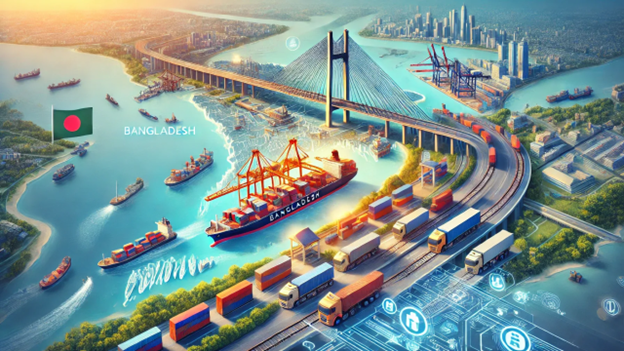
A Geographic Destiny Realized
Nestled in the fertile delta of the Ganges-Brahmaputra, Bangladesh has long been defined by its challenging geography. Today, that same geography is being recast as its greatest strategic asset. In the complex chessboard of global trade, Bangladesh is no longer a passive pawn but an emerging queen, moving with purpose to connect the economic powerhouses of South and Southeast Asia. This nation of resilient entrepreneurs and booming industries is rapidly shedding its past constraints, leveraging its pivotal location, demographic energy, and ambitious reforms to claim its place as a central node in the world’s next great trade network.
Propelled by staggering economic growth and a series of visionary infrastructure projects, Bangladesh is not just participating in regional trade; it is actively seeking to reshape it. However, the path to becoming a seamless logistics hub is fraught with enduring challenges—from congested ports to bureaucratic inertia. This article delves into the multifaceted journey of Bangladesh’s ascent, exploring the powerful drivers of its trade boom, the formidable obstacles it must still overcome, and the strategic initiatives that are paving its way toward an economic destiny long foretold by its position on the map.
The Bedrock of Trade: Strategic Location and Soaring Volume
The most compelling argument for Bangladesh’s rise is written on the map itself. Its unique position offers an unparalleled advantage in the age of regional economic integration.
Proximity to Economic Giants
Bangladesh sits at the confluence of immense economic activity. It shares its longest land border with India, one of the world’s fastest-growing large economies and a massive consumer market. To the northeast, it is in close proximity to China, the globe’s manufacturing epicenter and a voracious importer of raw materials and consumer goods. This geographic reality positions Bangladesh not as a peripheral player, but as a crucial land and maritime bridge between these two giants, offering the shortest and most cost-effective routes for the flow of goods.
The Corridors of Commerce
This natural advantage is being actively harnessed through formal regional frameworks. Bangladesh is a key member of the Bay of Bengal Initiative for Multi-Sectoral Technical and Economic Cooperation (BIMSTEC), which connects the economies of South Asia and ASEAN. Furthermore, its integration into the Asian Highway Network (specifically routes AH1 and AH41) and the Trans-Asian Railway network provides a standardized, high-quality framework for multimodal transport, linking its ports and highways directly to international trade arteries.
The Numbers Don’t Lie: A Trade Powerhouse in the Making
The proof of this potential is in the explosive growth of its trade volumes. In the Fiscal Year 2022-2023, Bangladesh’s total trade (exports and imports) soared to exceed $125 billion, a figure that underscores its deepening integration into the global economy (Bangladesh Bank, 2023). This is not a flash in the pan but the result of decades of consistent growth and industrial policy.
-
Export Dynamism: The engine of this export miracle is, unequivocally, the Ready-Made Garment (RMG) sector. In FY 2023, export earnings reached a record $55.79 billion, with RMG constituting a staggering 84% of that total (Export Promotion Bureau, 2023). This has cemented Bangladesh’s status as the world’s second-largest apparel exporter. However, there is a growing and conscious effort to diversify into other sectors such as pharmaceuticals, leather goods, and jute products, making the export basket more resilient.
-
The Import Equation: A growing economy and a burgeoning middle class have also made Bangladesh a major consumer market. Imports, which include essential raw materials for its industries, capital machinery for expansion, and consumer goods, totaled approximately $70 billion in FY 2023 (Statista, 2023). This balance of strong exports and robust imports paints the picture of a dynamic, two-way trade relationship with the world.
Building the Bridges: Infrastructure Transformations Unlocking Potential
Recognizing that potential is nothing without the means to realize it, Bangladesh has embarked on one of the most ambitious infrastructure development journeys in the region.
The Padma Bridge: A Symbol of National Ambition
More than just a physical structure, the Padma Bridge, opened in June 2022, is a powerful symbol of self-reliance and economic ambition. By connecting the capital, Dhaka, with 21 southwestern districts, it has slashed travel times, reduced logistics costs, and unlocked immense agricultural and economic potential in a previously underserved region. Its impact is projected to boost the national GDP by a significant margin, fundamentally altering the country’s internal economic geography.
Chittagong Port: The Beating Heart of Trade
Handling over 90% of the country’s seaborne trade, the Chittagong Port is the indispensable lifeline of the economy. Chronic congestion has been a major bottleneck, but ongoing expansion projects—including new container terminals, enhanced gantry crane capacity, and dredging for larger vessels—are aimed at dramatically improving its throughput capacity and efficiency. Its modernization is not just a national priority but a regional necessity.
Rail Links and Multimodal Connectivity
The development of the Dhaka-Jashore Rail Link as part of the Trans-Asian Railway network is a critical step towards creating a multimodal logistics corridor. Enhancing rail connectivity with India through crucial land ports like Benapole-Petrapole is vital for decongesting roads and offering a cheaper, more efficient alternative for bulk cargo, thereby deepening regional integration.
Navigating the Chokepoints: Persistent Challenges
Despite this progress, significant hurdles remain on the path to becoming a frictionless trade hub.
-
Infrastructure Bottlenecks: While mega-projects make headlines, last-mile connectivity issues, insufficient hinterland logistics, and congested urban road networks continue to create delays and increase costs for businesses.
-
Policy and Regulatory Hurdles: Despite improvements, complex and sometimes opaque customs procedures, inconsistent regulatory interpretations, and bureaucratic delays still pose a significant burden on traders, eroding competitiveness.
-
The Slow Pace of Regional Integration: The full implementation of transformative agreements like the BBIN Motor Vehicle Agreement (MVA) has been slower than hoped. While the framework is in place, operationalizing seamless cross-border movement of cargo vehicles remains a work in progress, limiting the full potential of regional trade.
The Blueprint for the Future: Government Initiatives and Reforms
The government is acutely aware of these challenges and is implementing a multi-pronged strategy to address them.
-
Special Economic Zones (SEZs): With 97 SEZs planned across the country, the government aims to create plug-and-play environments for both foreign and domestic investment. These zones are designed to diversify exports beyond RMG, attract high-value manufacturing, and create clusters of industrial efficiency with streamlined regulations.
-
Customs Modernization: The implementation of the National Single Window (NSW) is a game-changer. By allowing traders to submit all regulatory documents through a single electronic portal, it aims to slash clearance times, reduce paperwork, and enhance transparency, bringing Bangladesh in line with international best practices.
-
Proactive Diplomacy and Trade Agreements: Bangladesh is actively negotiating and strengthening bilateral and multilateral trade agreements with partners like India, China, and ASEAN members. These efforts focus on improving market access, reducing tariffs, and resolving non-tariff barriers, ensuring its products remain competitive.
Seizing the Century
Bangladesh’s journey to becoming a preeminent regional trade hub is well underway, but it is far from complete. Its geographic destiny, once a constraint, is now its calling card. The foundations have been laid through sheer economic force and monumental infrastructure projects. The next phase of this journey requires a relentless focus on the softer aspects of trade: policy coherence, regulatory efficiency, and deep, operational regional integration.
By continuing to dismantle internal bottlenecks and embracing its role as a connective tissue between major economies, Bangladesh has the opportunity to not only achieve its development goals but also to set a new standard for sustainable and inclusive trade growth in Asia. The world’s eyes are indeed turning towards this rising economy, and the signs suggest it is ready for its moment on the global stage.
References
Bangladesh Bank. (2023). *Annual Report 2022-2023*. Dhaka: Bangladesh Bank. Available from: https://www.bb.org.bd/en/index.php/pub/annual/annual.php (Accessed: 24 October 2023).
Export Promotion Bureau (EPB). (2023). *Export Performance FY 2022-2023*. Dhaka: Government of the People’s Republic of Bangladesh. Available from: http://www.epb.gov.bd/ (Accessed: 24 October 2023).
Ministry of Commerce. (2023). Import Policy and Data. Dhaka: Government of the People’s Republic of Bangladesh.
Rahman, M. & Khatun, F. (2022). ‘Beyond Borders: Leveraging Regional Agreements for Bangladesh’s Trade Growth’, Journal of Asian Economics, 83, 101543.
Statista. (2023). Value of imports into Bangladesh from fiscal year 2014 to 2023. Available from: https://www.statista.com/statistics/438200/import-value-in-bangladesh/ (Accessed: 24 October 2023).
World Bank. (2023). Logistics Performance Index (LPI). Washington, DC: World Bank Group. Available from: https://lpi.worldbank.org/ (Accessed: 24 October 2023).