The Strategic Lifeline of Global Trade
The Suez Canal corridor is one of the most strategically sensitive maritime arteries in global trade. Connecting the Mediterranean Sea with the Red Sea, the route allows ships travelling between Asia and Europe to avoid the long detour around the African continent. For modern supply chains, this waterway is not merely a geographic shortcut but an economic foundation supporting thousands of shipping rotations annually.
Approximately 13% of global trade moves through the Red Sea-Suez corridor, including large volumes of containerized goods, crude oil, liquefied natural gas, industrial machinery, and agricultural commodities. The majority of Asia-Europe container traffic depends heavily on this route because it reduces both transit time and fuel consumption. In normal conditions, ships travelling from Shanghai to Rotterdam save nearly two weeks compared with the alternative route around the Cape of Good Hope.
However, since late 2023 and continuing into 2026, geopolitical tensions in the Middle East have transformed the economics of this corridor. Missile attacks on commercial vessels, naval confrontations, and escalating tensions involving Iran have turned the Red Sea and surrounding maritime zones into high-risk operational environments for global shipping lines.
The immediate result has been a dramatic increase in war-risk insurance premiums and the rewriting of freight contracts worldwide. The cost structure of shipping through the Suez Canal has changed so significantly that many carriers now treat the route as financially unpredictable rather than operationally efficient.
The Emergence of the War-Risk Insurance Crisis
Marine insurance traditionally consists of two principal components:
- Hull and Machinery insurance covering damage to the vessel
- War-risk insurance covering conflict-related threats such as missile strikes, terrorism, or military operations
In stable geopolitical conditions, war-risk premiums represent a small fraction of the vessel’s value. Historically, these premiums ranged between 0.02% and 0.10% of a ship’s value per voyage. For a large container vessel valued at around US$150 million, this meant an additional cost of roughly US$100,000 for a transit through the Suez corridor.
The security situation in the Red Sea changed this cost structure completely.
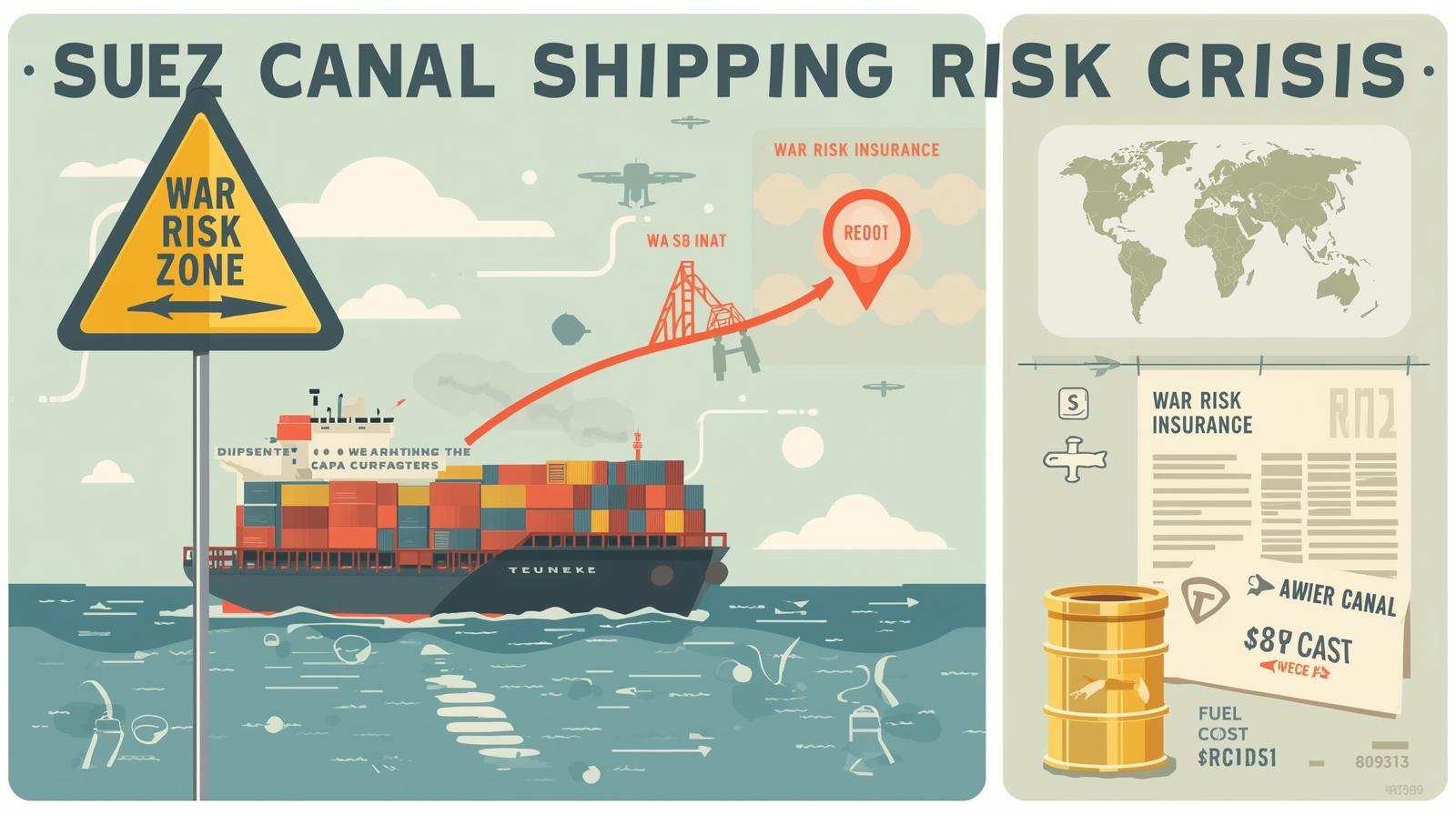
Following attacks on commercial vessels and increasing military tensions in the region, insurers classified large sections of the Red Sea as war-risk zones. Premiums rapidly surged to between 0.7% and 1% of vessel value per voyage. For the same US$150 million container vessel, this translated into insurance costs approaching US$1.5 million for a single transit through the region.
This escalation fundamentally altered shipping economics.
War-risk premiums alone now often exceed the cost savings generated by using the Suez Canal instead of sailing around Africa. In other words, a route originally designed to reduce costs has become financially risky for shipping companies.
Insurance markets also began reflecting a deeper concern: the instability is no longer perceived as temporary. Insurance data shows that war-risk premiums in the Red Sea remain several times higher than pre-crisis levels, suggesting that insurers now view geopolitical threats in the region as structural rather than episodic.
The Iran-US Tensions and Maritime Risk Escalation
The escalation of tensions involving Iran and the United States during early 2026 significantly intensified maritime risk calculations.
Military strikes and retaliatory actions in the region led to heightened threats against commercial vessels operating near key chokepoints such as the Strait of Hormuz and the Red Sea approaches to the Suez Canal. Several maritime insurers suspended coverage for ships operating in these waters, forcing shipping companies to reconsider their operational strategies.
Reports from the global insurance market indicated that war-risk premiums in the Gulf region increased dramatically, in some cases reaching twelve times their normal level. Insurance rates rose to nearly 3% of a ship’s value for certain voyages through the Strait of Hormuz. For large oil tankers or container vessels valued above US$100 million, this represents millions of dollars in additional insurance exposure for a single journey.
At the same time, several major shipping lines temporarily suspended cargo bookings to parts of the Middle East because of escalating security risks and uncertainty regarding insurance coverage. Shipping companies must secure war-risk insurance before entering designated high-risk zones, and without such coverage vessels cannot legally or commercially operate in those waters.
These developments created a cascading effect across global freight markets. Once insurers withdraw or raise premiums sharply, shipping companies immediately adjust their route planning and contractual terms with shippers.
The Economic Mathematics of Suez Diversion
When maritime risk escalates, shipping companies face a complex operational decision: whether to continue using the Suez Canal or divert vessels around the Cape of Good Hope.
The Cape route adds approximately 3,500 nautical miles to Asia-Europe voyages. This extension increases sailing time by roughly 10 to 14 days depending on vessel speed and weather conditions.
The economic implications of this diversion are significant:
Fuel consumption rises sharply due to the longer distance. Large container vessels typically incur additional fuel costs ranging from US$1 million to US$2 million per round voyage when sailing around Africa.
Transit time also increases by nearly 50%, meaning ships remain tied up in longer rotations. This effectively reduces the global shipping fleet capacity because each vessel completes fewer voyages annually.
Port scheduling becomes more complicated. Longer routes disrupt carefully designed port rotation plans, creating congestion risks when multiple ships arrive simultaneously after extended journeys.
Despite these additional operational costs, diversion around Africa can sometimes be economically preferable when war-risk insurance premiums become excessively high.
For example, if the war-risk premium for a Suez transit reaches US$1 million or more, the insurance cost alone can offset the savings gained from the shorter route. Under such conditions, shipping companies may prefer the Cape route despite the longer journey because it offers greater operational predictability.
Freight Contracts Are Being Rewritten
The surge in war-risk insurance premiums has directly influenced the structure of freight contracts across global shipping markets.
Historically, ocean freight contracts focused primarily on base freight rates and bunker adjustment factors. However, since the escalation of security risks in the Red Sea and Persian Gulf, new contractual elements have become increasingly common.
One of the most prominent additions is the War Risk Surcharge (WRS).
Shipping lines now incorporate these surcharges into freight contracts to recover the additional insurance costs associated with operating in high-risk regions. These charges can vary depending on the perceived threat level and may fluctuate rapidly when geopolitical tensions escalate.
Another contractual adjustment involves route flexibility clauses.
Shippers increasingly accept contractual provisions allowing carriers to alter routes if security conditions deteriorate. This means a container booked for transport via the Suez Canal may ultimately travel around the Cape of Good Hope if insurers or naval authorities classify the Red Sea as unsafe.
Transit time guarantees are also being revised.
Because diversions add significant delays, shipping lines are modifying service agreements to reduce liability for late arrivals caused by geopolitical disruptions.
The combination of these contractual changes means that freight pricing is no longer determined solely by supply and demand in shipping capacity. Instead, geopolitical risk has become an embedded component of freight rate calculations.
The Wider Economic Consequences
The disruption of the Suez corridor has ripple effects far beyond the shipping industry.
Egypt’s economy is heavily dependent on revenue from the Suez Canal. When shipping companies divert vessels around Africa, the canal authority loses significant income from transit tolls. Reports indicate that disruptions to Red Sea shipping have already reduced canal revenue substantially.
Energy markets are also affected.
The Red Sea and surrounding maritime routes handle large volumes of oil and liquefied natural gas shipments from the Middle East to Europe and Asia. Any disruption in these shipping lanes increases transportation costs and contributes to volatility in global energy prices.
Agricultural supply chains also experience delays.
Grain shipments from regions such as the Black Sea and Asia rely on efficient maritime transport through the Suez corridor. Extended transit times can disrupt supply schedules and contribute to food price fluctuations in importing countries.
The broader consequence is inflationary pressure across multiple sectors of the global economy. Higher shipping costs eventually translate into higher import prices for manufactured goods, raw materials, and consumer products.
The Operational Reality for Shipping Lines
For container shipping companies, the Suez risk premium represents a complex operational challenge rather than a simple financial surcharge.
Shipping lines must balance several factors simultaneously:
Crew safety is the most critical concern. Missile or drone attacks on vessels create severe risks for seafarers operating in conflict zones.
Insurance coverage must be secured before entering designated war-risk areas. Without adequate insurance protection, vessels cannot legally operate in those regions.
Fleet deployment decisions must be recalculated continuously as geopolitical conditions evolve.
As a result, many shipping companies have adopted dynamic route planning strategies. Instead of committing to a fixed route for an entire service schedule, carriers monitor security developments and adjust vessel routing accordingly.
This operational flexibility has become essential for maintaining supply chain reliability during periods of geopolitical instability.
The Strategic Role of Freight Forwarders
Freight forwarding companies have become critical intermediaries in managing the commercial impact of Suez-related disruptions.
When war-risk premiums increase, shippers often struggle to understand the financial implications or contractual adjustments required for their shipments. Freight forwarders play a key role in translating these changes into workable logistics strategies.
Their responsibilities increasingly include:
Negotiating freight contracts that incorporate war-risk surcharges transparently.
Advising clients on alternative routing options when security conditions deteriorate.
Coordinating multimodal solutions to mitigate delays caused by maritime diversions.
Providing updated transit time forecasts based on the latest operational realities.
Freight forwarders also act as risk managers for cargo owners. By monitoring geopolitical developments and insurance market trends, they help exporters and importers adjust their logistics planning accordingly.
In many cases, forwarders are the first point of communication when shipping lines introduce new surcharges or route changes. Their ability to interpret these developments determines how effectively businesses adapt to volatile shipping conditions.
A Structural Shift in Global Maritime Economics
The events surrounding the Suez corridor and the Iran-related tensions illustrate a broader transformation in global shipping economics.
For decades, maritime logistics operated under the assumption that major trade corridors would remain relatively stable. The Suez Canal, despite occasional disruptions such as the Ever Given grounding, was generally considered a predictable and secure route.
Recent geopolitical developments challenge that assumption.
Insurance markets now price maritime risk more aggressively, reflecting the possibility of recurring conflict in critical shipping regions. Shipping companies increasingly treat geopolitical instability as a permanent operational variable rather than a temporary anomaly.
This shift has profound implications for supply chain design.
Manufacturers may reconsider production strategies that depend heavily on long maritime supply chains. Importers may increase inventory buffers to account for unpredictable transit times. Governments may invest more heavily in alternative trade corridors and infrastructure projects.
In this environment, logistics is no longer purely an operational discipline. It has become deeply intertwined with global geopolitics.
Risk Premium as the New Freight Reality
The Suez Canal remains one of the most important maritime corridors in the world. Yet the economic assumptions underlying its use have changed dramatically.
War-risk insurance premiums, geopolitical tensions involving Iran, and continued security threats in the Red Sea have transformed the cost structure of global shipping routes. The once straightforward decision to sail through the Suez Canal now involves complex calculations involving insurance costs, geopolitical risk assessments, and operational contingencies.
Freight contracts are evolving to reflect this reality. War-risk surcharges, flexible routing clauses, and revised transit commitments are becoming standard features in international shipping agreements.
For freight forwarders, the challenge lies in helping businesses navigate this uncertain environment. Their expertise in contract negotiation, route planning, and risk management has become increasingly valuable as global trade adapts to a new era of maritime instability.
The Suez risk premium is therefore more than an insurance issue. It represents a structural shift in how global logistics systems operate under geopolitical pressure. Bitnex Crestfort
References
- Atlantic Council (2024). A lifeline under threat: Why the Suez Canal’s security matters for the world.
- Ballast Markets (2025). Suez vs Cape: The $2 Billion Routing Decision.
- Logistics Material (2026). Red Sea Shipping Crisis and Strait of Hormuz Risk.
- Shipping Intelligence Hub (2026). War Risk Premiums Spike to 1% as Red Sea Attacks Resume.
- Reuters (2026). US to reinsure maritime losses in Gulf up to about $20 billion.
- Financial Times (2026). Gulf insurance costs soar despite guarantees.
- The Guardian (2026). Maritime insurers cancel war risk cover in Gulf as Iran conflict disrupts shipping.
- Wall Street Journal (2026). Iran conflict delays shipping’s return to Suez Canal, Hapag-Lloyd says.