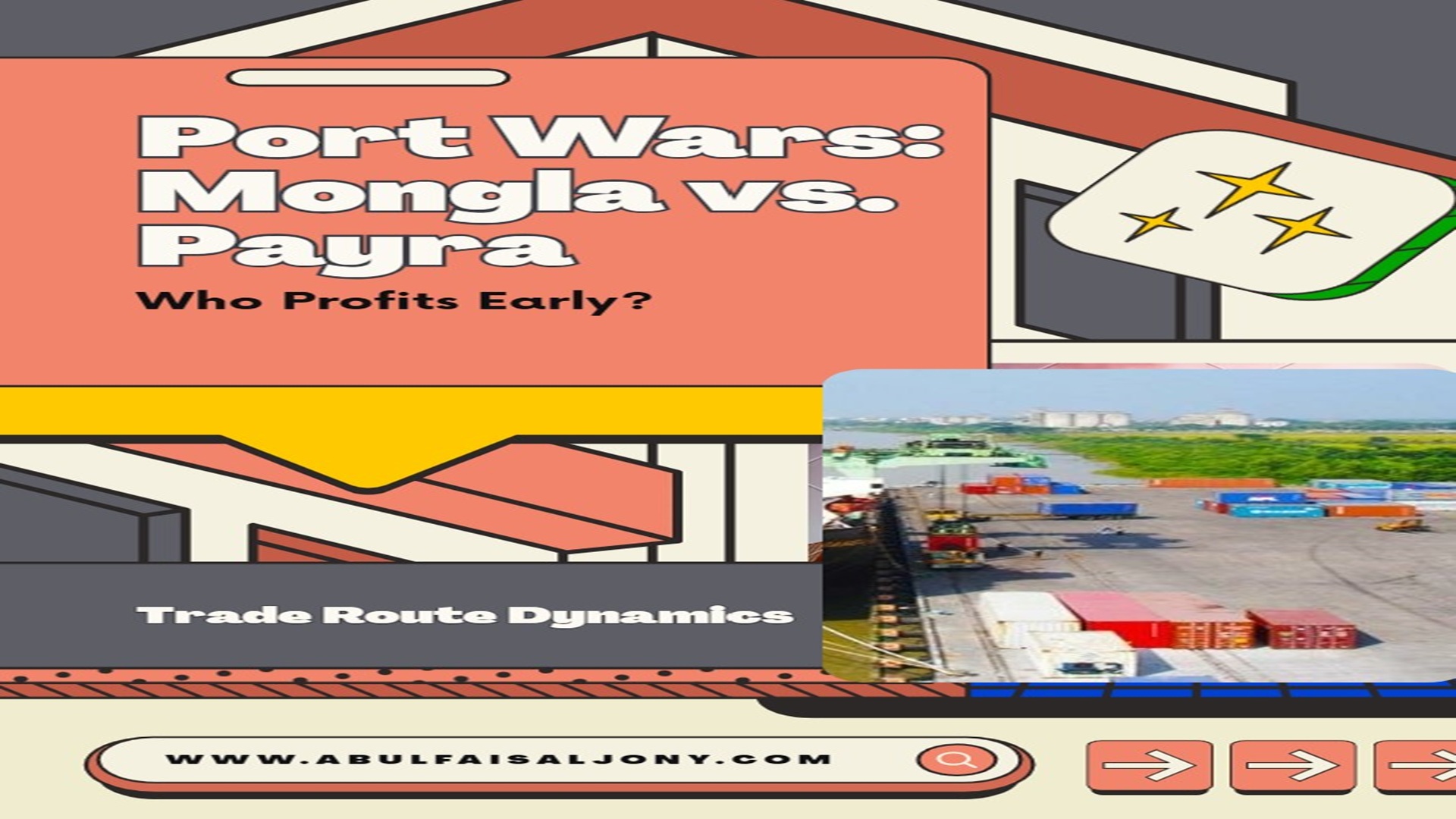
Bangladesh’s freight map is in flux. For decades, Chattogram has carried the nation’s trade on its back, leaving the rest of the seaboard as a footnote. That started to change when the Padma Bridge stitched Dhaka to the southwest corridor and put Mongla Port within realistic reach of factories and distributors. At the same time, Payra Port—designed as a southern gateway—has attracted attention, investment, and no small amount of debate about navigability and cost discipline.
Most cargo owners still default to Chattogram for predictable reasons: carrier frequency, a mature clearing ecosystem, and learned muscle memory. Yet the smartest operators don’t wait for consensus; they test the edges. This episode is about those edges—who profits early from Mongla and Payra, what makes their economics work today, and what signals will tell you when to scale.
The answer is not “everybody.” It never is. The early winners share a pattern: they are location-advantaged, time-sensitive, or infrastructure-savvy enough to overcome teething frictions. If that sounds like your operation—or the clients you serve—this playbook is for you.
The Decision Lens: Inland Math Beats Ocean Theory
A common mistake is to evaluate ports only from the quay wall out to sea. In Bangladesh, the inland leg often dominates the landed cost. With Padma Bridge, the Dhaka–southwest run contracted in both time and risk. For many movements, the question isn’t “Can a mother vessel call?” but “Can I get my box to the right port window on time without burning a day in road uncertainty?”
That is why Mongla is creeping into routing conversations: the inland clock is kinder. By contrast, Payra’s story is still being written at sea. Channel depth and maintenance dredging determine whether vessel plans hold. When those variables wobble, the cost of lighterage, double handling, and schedule slippage eats whatever inland savings were expected. Your first principle, then, is simple:
Pick the port where your biggest risk is smallest.
If road reliability is your headache, Mongla earns a trial.
If ocean access is your constraint, wait for Payra’s depth discipline to prove itself.
Mongla Today: The Bridge-Boosted Alternative (For the Right Cargo)
What’s changed: The Padma Bridge didn’t just shorten distance; it changed behavior. Night runs are cleaner. Truckers can stage to meet Port/ICD cutoffs with less drama. Dhaka shippers who once kept Mongla off the whiteboard now keep it as a live option—especially in weeks when Chattogram is tight or an EU cutoff looms.
What Still Holds Traders Back:
-
Vessel size & frequency: Mongla remains feeder-heavy; your reliability depends on hub connections and tight documentation.
-
Equipment perceptions: Users still compare productivity with Chattogram; any slip in crane/yard performance is magnified in the first months of a switch.
-
Ecosystem lag: Not every CHA, transporter, or insurer has Mongla muscle memory yet. The first one or two jobs feel slower simply because teams are learning.
Who Profits Early at Mongla:
-
High-value, low-weight exporters (apparel cartons, leather goods, light engineering components) and time-sensitive importers (FMCG, spares, medical). They win when inland reliability beats marginal differences in ocean leg.
-
Southwest-anchored manufacturers in Khulna–Jashore who always paid a distance penalty via Chattogram.
-
Project logistics within draft + crane limits, where the bridge simplifies permitting and escorts compared to eastern corridors.
What Early Adopters Do Differently:
-
Pre-gate discipline: They complete customs steps, bank endorsements, and port submissions before arrival (see case below).
-
Feeder alignment: They plan production to match feeder cutoffs, not the other way around.
-
Dual-port readiness: They keep a backup slot at Chattogram or an off-dock in Dhaka so they can switch if a window closes.
Payra Today: Promise vs Practice
On paper, Payra should be a southern star: closer to certain industrial belts, a relief valve for Chattogram, and a logic point for bulk. In practice, the port’s economics hinge on one variable: reliable channel depth. When depths hold, vessel options widen; when they don’t, the spreadsheet tilts fast toward lighterage, extra days, and renegotiations with insurers and charterers.
Where Payra Can Still Make Sense Now
-
Bulk/neo-bulk importers who already budget for lighterage (coal, clinker, aggregates) and have private discharge infrastructure to shorten time alongside lighters.
-
Near-port projects that value geographic proximity over mother-vessel economics (cement grinding units, power plant inputs).
-
Seasonal or opportunistic calls where a narrow arrival window matches temporary depth, and the buyer accepts schedule variance.
What Must Change for Payra to Scale Beyond Niches:
-
A transparent, ring-fenced maintenance program with public soundings and KPIs (depth at datum, siltation response time).
-
A stable carrier timetable with real penalties for missed windows—because schedule reliability is the only antidote to perception drag.
-
Road/rail last-mile strengthening so that even when ocean conditions are right, the inland piece doesn’t reintroduce risk.
Real-Life Composite Scenarios (Bangladesh context)
Scenario A – FMCG Importer Uses Mongla to Beat the Clock
A Dhaka FMCG brand faced a high-stakes launch. Their clearing agent completed document prep and bank endorsement before vessel arrival and notified customs officers in advance that SKUs were perishable launch items. With the bridge-enabled road run and a tight port plan, the importer shaved 1–2 days from the usual cycle. They didn’t switch everything to Mongla—just the SKUs where time was money. The net: lower demurrage exposure, faster retail placement, and a precedent that the team now repeats when marketing schedules demand certainty.
Scenario B – Apparel Exporter Pilots a Dual-Port Strategy
A knitwear exporter in Gazipur was tired of end-of-month scrambles. With their forwarder, they booked two playbooks: Plan A via Mongla (feeder to a regional hub) and Plan B via Chattogram. When a Friday truck disruption threatened the cutoff, the Mongla plan—supported by a night run across Padma—held. The customer in Spain never knew there was a switch. The exporter now keeps rolling Mongla options for peak weeks; not every week, just the ones where the risk premium pays.
Scenario C – Bulk Importer at Payra Prices in Lighterage
A sub-regional contractor importing coal for a southern plant decided to treat lighterage as baseline, not a surprise. They negotiated a blended rate with stevedores and a private jetty arrangement to shorten discharge time. When channel depths disappointed, they weren’t derailed; the plan already assumed lighters. Is it the cheapest way to land coal? Not always. Is it the most predictable given today’s constraints? For this operator, yes—and predictability is what keeps penalties out of contracts.
Scenario D – Project Cargo via Mongla within Draft Limits
A transformer shipment to Khulna moved in split pieces sized deliberately to Mongla’s constraints. The bridge cut the complexity of crossing to the southwest, and the route’s lower population density reduced the cost of escorts and road closures. The EPC’s lesson: design the move to the port, not the other way around.
Cost and Risk: How to think about the Trade-Offs
Inland Leg (Dhaka–port):
-
Mongla now beats Chattogram on consistency for many Dhaka/SW flows. The night window over Padma is especially valuable for time-sensitive goods.
-
Payra’s inland picture can be fine if your origin/destination is nearby; the ocean leg is the real swing factor.
Ocean Leg (Port–Hub–Destination):
-
Chattogram has scale and frequency.
-
Mongla is feeder-centric; the game is meeting the right cutoffs reliably.
-
Payra’s ocean economics are conditional on depth. Treat mother-vessel calls as upside, not baseline.
Port Time and Ecosystem:
-
Mongla’s learning curve is real—productivity, equipment, and even simple wayfinding can feel slower on the first job. It improves quickly when teams iterate.
-
Payra’s port-side performance is often less the issue than the pre-port navigability. If you control for that, yard time can be reasonable.
Insurance and Banking:
-
If you’re pitching a new routing to a risk team, present a variance scenario (best case / operating case / delay case) and show how documentation discipline keeps the operating case dominant.
-
For LC shipments, align Incoterms so that the buyer/seller risk division doesn’t punish you for smarter inland planning.
Who Profits Early
-
City-center brands with hard launch dates
FMCG and pharma with campaigns tied to weekends or holidays. Mongla lets you align truck dispatch to media schedules. -
Southwest manufacturers
Factories in Khulna/Jashore that always paid extra to reach Chattogram. Mongla compresses the inland pain if your ocean leg is flexible. -
Forwarders who sell certainty, not slogans
If you can show a client a two-port operating manual with cutoffs, truck slots, and customs templates, you become “the calm in the storm.” Those relationships turn sticky. -
Bulk importers with private discharge infrastructure
Payra can work if you own the last mile: jetty, conveyors, lighter contracts. Your margin comes from controlling touchpoints others outsource. -
Project cargo planners
Teams willing to engineer the cargo to the port (dimensioning to draft and crane realities) unlock routes competitors ignore.
A Practical Operating Playbook
For Mongla (Next 90 Days):
-
Lock a weekly night-run slot over Padma with a trusted fleet. Consistency beats lowest rate.
-
Document early: bank endorsement, HS code checks, and any special permissions filed before arrival. Share a status pack with customs contacts to pre-empt queries.
-
Feeder-first planning: build production around known cutoffs for your lane. If the box misses, it slides a week—your plan must prevent that miss.
-
Dual-port safety net: keep a small fall-back allocation via Chattogram for each month’s crunch week.
For Payra (Test-and-Learn):
-
Demand fresh depth reports before fixing a vessel. If the readings are marginal, assume lighterage and price accordingly.
-
Negotiate blended handling: stevedores + lighters + private jetty where possible, to compress discharge time.
-
Pick the right cargo: parcels that tolerate double handling or already run on coastal craft will transition best.
-
Protect the schedule with contract language: name weather windows, define acceptable delays, and set escalation paths.
Early-Warning Indicators (To watch each month)
-
Mongla feeder frequency and on-time performance: if two additional loops appear and hold for 8–12 weeks, capacity is deepening.
-
Clearance time dispersion (not just average): if the long tail shrinks, the ecosystem is learning.
-
Payra channel soundings and maintenance cadence: a stable 9–10 m across seasons changes everything; sporadic windows don’t.
-
Private investments near both ports: bonded warehouses, off-dock yards, reefer points, and truck parks signal durable user confidence.
-
Insurance/bank stances: when underwriters stop pricing Mongla/Payra as “exceptions,” you’re close to mainstream adoption.
Five Consultant Takeaways
-
Mongla is already rational for specific lanes where inland certainty trumps ocean scale. Pilot it with high-value or time-critical SKUs; measure days saved and demurrage avoided.
-
Payra is a conditional play. It works for bulk importers who control shore infrastructure and budget lighterage. Treat it as a niche until depth discipline is proven quarter over quarter.
-
The first-mover premium is relationship-shaped. Forwarders who master Mongla procedures, pre-gate documentation, and bridge night windows will be rewarded with sticky accounts.
-
Engineer the move to the port. Right-size project pieces; align cartonization to feeder realities; design for the constraint instead of fighting it.
-
Don’t bet the farm—bet a lane. Run controlled experiments. If three consecutive months meet your SLA, scale that template; if not, iterate without reputational damage.
Quiet Wins Before The Crowd Arrives
Port narratives change slowly—until they don’t. Chattogram will remain the flagship, but Mongla is already earning trust where it matters: in the calendar and in the cash flow of shippers who hate surprises. Payra’s moment will come when the hydrography stops being a headline and starts being a habit. Until then, the profits belong to planners who test early, document obsessively, and choose the port that shrinks their biggest risk.
If you’re a forwarder, this is your moment to be the voice of calm. If you’re a shipper, this is your chance to reclaim a day you thought you couldn’t. The war for Bangladesh’s next gateway isn’t won by speeches; it’s won by a clean truck gate, a matched cutoff, and a box that arrives exactly when you promised. Kärna Fintrix