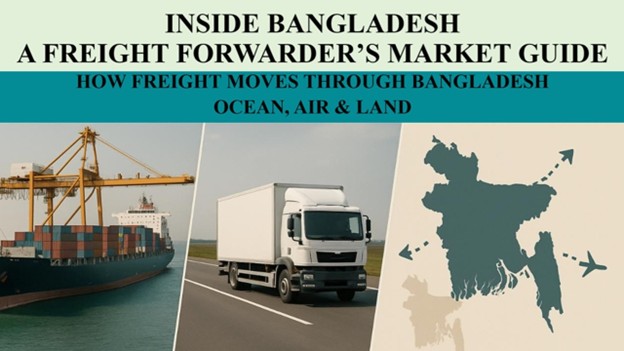
Following the momentum of the 2025 Investment Summit and the strong response to our teaser series, this episode begins by answering the most foundational question: How does freight really move through Bangladesh today?
Bangladesh is now more than just a manufacturing destination it’s a vital and increasingly strategic node in the global supply chain. With rising container throughput, evolving multimodal infrastructure, and increasing foreign interest post-2025 Investment Summit, global freight forwarders have a unique window to evaluate how to tap into this market.
Freight Snapshot: 2025 Trade Performance
-
Exports
$56.5 billion (↑ led by RMG, pharmaceuticals, agro-processing)
-
Imports
$72+ billion (capital machinery, intermediate goods, raw materials)
-
Top trade corridors
Europe (RMG), India (land freight), China & Southeast Asia (imports)
According to the National Board of Revenue and the Export Promotion Bureau, 2025 is seeing a 6.4% YoY increase in overall cargo movement, with robust trends in ocean freight and a notable uptick in bonded trucking across borders.
Ocean Freight: Bangladesh’s Lifeline
-
Chattogram Port
- Handles ~92% of seaborne trade, processing over 3 million TEUs in 2025.
-
- Challenges: Limited draft depth, congestion, aging berths
- Progress: The Bay Terminal slated for completion in 2026 is expected to add 500,000+ TEU capacity. Port Authority reports show 12% YoY growth in container traffic this year.
- ICD Development: Private inland container depots (ICDs) in Dhaka, Narayanganj, and Cumilla are taking pressure off Chattogram.
-
Mongla Port
-
- Up 28% YoY cargo volume; now key for Khulna and BEZA industrial zones.
- Government offering incentives for RMG and food exporters to reroute via Mongla.
-
Payra Port
-
- Operational but still developing; 2025 dredging contract signed to allow mid-sized bulk carriers.
-
Other Port Projects
-
- Matarbari Deep Sea Port is under construction to support high-capacity ocean carriers; phase I completion targeted for 2027.
- Teknaf and Sonadia Ports are being explored for coastal and transshipment opportunities in the southeast corridor.
Air Freight: A Rising Mode for High-Value Goods
Total air cargo volume handled in 2024-25 is estimated at ~260,000 MT, mostly driven by:
-
Hazrat Shahjalal Int’l Airport (DAC)
Expanded cargo terminal; Cargo Village Phase II launched April 2025.
-
Shah Amanat Int’l (Chattogram)
Cargo village under development to improve infrastructure for exporters in southeastern Bangladesh.
-
Osmani Int’l (Sylhet)
Growing role in international air freight; regular freighter operations by major brands like Inditex for garments and high-value cargo.
Sectors gaining traction: pharma, e-commerce, electronics, perishables, time-sensitive cargo
Note: Major airlines are all expanding frequency and capacity into Bangladesh’s key hubs.
Land Freight: The Backbone of Domestic & Cross-Border Trade
-
Benapole-Petrapole (India Border)
-
- ~70% of land freight between India and Bangladesh.
- Undergoing BDT 1.5 billion modernization (faster customs lanes, bonded truck terminals).
-
BBIN Corridor Activity (Bhutan, India, Nepal)
-
- BBIN MVA pilot fully operational in 2025.
- First bonded trucking between Dhaka-Kathmandu and Dhaka-Thimphu completed successfully (Jan & Mar 2025) as Trial Run.
- Land cargo to Nepal and Bhutan is steadily increasing, supported by regional agreements and improved customs coordination.
-
Domestic Inland Freight
-
- Road still dominates; however, rail freight frequency between Dhaka and Chattogram increased container trains daily.
- Multimodal terminals emerging in Sirajganj and Mymensingh as part of JICA-backed inland transport reform.
What Foreign Freight Forwarders Need to Know
If you’re planning to expand your freight operations into Bangladesh, here’s the 2025 ground truth:
-
Multimodal adaptability is key
Ports remain dominant, but air and rail are becoming viable complements.
-
Customs digitization is underway
But delays still occur without proper local handling.
-
Local partnership is a legal requirement
For freight forwarding licenses foreign companies must operate via JV or agent
-
Infrastructure bottlenecks exist
But there’s clear government focus (via BIDA, BEZA, NBR) on resolving these.
The 2025-26 Investment Pipeline
-
Bay Terminal (Chattogram)
Construction started, target capacity ~500k TEUs.
-
HSIA Cargo Village
Temp-controlled storage capacity doubled in 2025.
-
Bonded warehousing & dry ports
Several PPP models under approval by BEZA.
-
National Logistics Policy
Final draft expected Q4 2025 to streamline transport corridors & documentation.
Bangladesh in 2025 offers a dynamic logistics ecosystem in evolution. The opportunity is massive but navigation requires clarity, compliance, and local insight.
For foreign freight forwarders, entering Bangladesh now through the right local partner means early positioning in a market primed for regional leadership in South Asia’s trade.
Episode 2 will cover Bangladesh’s customs architecture, licensing procedures, and documentation realities vital for any logistics expansion plan.
The future of South Asia’s freight isn’t coming. It’s already arriving in Bangladesh.