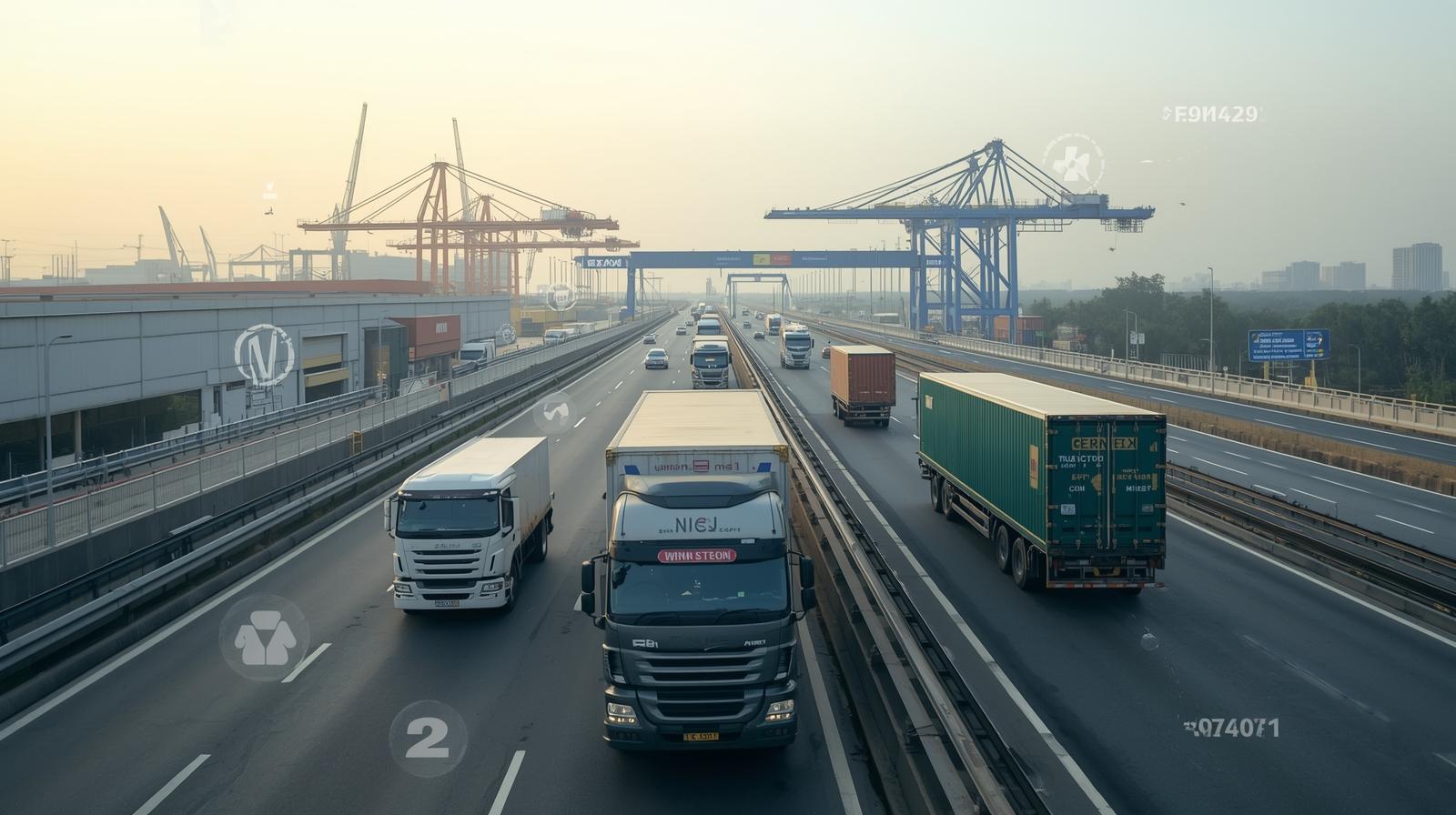
The Silent Structural Loss Inside Bangladesh’s Freight System
Bangladesh has invested heavily in transport infrastructure over the last decade. The Padma Bridge has reshaped southern connectivity. National highways such as N1 (Dhaka-Chattogram) and N2 have been widened. Chattogram Port capacity has expanded. Inland container depots around Dhaka have multiplied. Land ports have modernized under Bangladesh Land Port Authority (BLPA).
Yet one operational inefficiency continues to absorb economic value quietly: empty truck movement.
According to Bangladesh Road Transport Authority (BRTA) statistics, the country has more than half a million registered trucks and covered vans. Bangladesh Bureau of Statistics (BBS) data confirm that road transport carries the overwhelming majority of domestic freight. Roads and Highways Department (RHD) traffic surveys show heavy truck concentration on major corridors, especially Dhaka-Chattogram.
In such a road-dominant freight economy, empty backhaul is not a marginal inefficiency. It is a structural cost multiplier.
Defining Empty Miles in the Bangladesh Context
Empty miles refer to truck movement without cargo during return or repositioning trips.
In Bangladesh, empty movement occurs in predictable patterns:
- Import-heavy corridors with weaker reverse export flow
- Agricultural regions with one-directional seasonal demand
- Border points with trade imbalance
- Industrial distribution chains operating in silos
Unlike developed freight systems with centralized digital load matching, Bangladesh’s freight coordination is largely decentralized and broker-driven. This creates consistent mismatches between outbound and return cargo availability.
Each empty kilometer involves:
- Diesel consumption
- Driver wages
- Toll payment
- Mechanical wear
- Road occupancy
- Emissions
Bangladesh Petroleum Corporation (BPC) diesel price revisions in recent years, widely covered by Prothom Alo and Financial Express, have increased operating costs significantly. When trucks return empty, those fuel costs generate zero revenue recovery.
Dhaka-Chattogram Corridor: The Core Efficiency Challenge
The Dhaka-Chattogram highway (N1) is the backbone of Bangladesh’s trade logistics.
Import-Driven Flow
Chattogram Port Authority annual reports show continuous container throughput growth. Import containers move inland toward:
- Dhaka ICD (Kamalapur)
- Gazipur and Ashulia industrial clusters
- Savar, Narayanganj, and Tongi warehouses
- Private inland container depots
Trucks on this leg operate at full capacity.
Export Timing Mismatch
Export cargo movement to Chattogram is structured differently:
- Export bookings are tied to vessel schedules
- Cargo consolidation occurs through multiple forwarders
- Small exporters rely on staggered container stuffing
- Booking confirmation timing varies
As a result:
- Trucks delivering import cargo in Dhaka often cannot immediately secure export cargo
- Waiting time increases
- Some return partially loaded
- Others return empty to reposition for the next import assignment
The Daily Star and Financial Express have reported repeatedly on port congestion and truck queueing issues. While dwell time is highlighted, asset utilization inefficiency is less examined.
Export Promotion Bureau (EPB) trade statistics show that import weight often exceeds export weight. This structural imbalance directly affects trucking utilization.
Northern Agricultural Belt: Seasonal Directional Dependency
Northern Bangladesh illustrates another recurring empty-mile pattern.
Southbound Harvest Movement
Districts such as Rangpur, Dinajpur, Bogura, and Joypurhat produce:
- Potato
- Rice
- Maize
- Onion
- Vegetables
During peak harvest seasons, newspapers like Kaler Kantho and Jugantor report transport pressure and freight price fluctuations.
Trucks move south toward:
- Karwan Bazar
- Shyambazar
- Gabtoli wholesale markets
- Narayanganj distribution points
These trips are typically fully loaded.
Weak Industrial Reverse Flow
Return cargo toward the north is limited because:
- Industrial production is concentrated around Dhaka and Chattogram
- Northern regions have fewer manufacturing clusters
- Retail goods are distributed through separate contracted networks
Consequently:
- Return rates are negotiated lower
- Some trucks return empty
- Operators factor return risk into forward pricing
This seasonal inefficiency recurs annually.
Benapole Land Port: Trade Imbalance and Idle Capacity
Benapole is Bangladesh’s largest land port. BLPA annual reports and The Business Standard confirm that imports from India consistently exceed exports.
Structural Import Dominance
Bangladesh imports:
- Raw materials
- Consumer goods
- Industrial inputs
Export volume toward India remains comparatively lower.
This imbalance creates predictable backhaul inefficiency:
- Trucks carry export cargo to Benapole
- Return cargo availability depends on customs clearance timing
- Border documentation delays affect synchronization
- Trucks wait or return empty
Cross-border freight coordination remains documentation-driven rather than load-matching-driven.
Fragmented Domestic Distribution Chains
Domestic supply chains operate in parallel, not integrated structures.
Example scenario:
- Cement factories in Chattogram send bulk loads to Dhaka construction projects
- Trucks unload at sites across the city
- No centralized system matches these trucks with Dhaka-to-Chattogram cargo
Meanwhile:
- FMCG distributors independently contract trucks to serve southern districts
- Pharmaceutical companies operate separate route agreements
- Textile raw material movement is booked through different broker networks
The absence of cross-sector load pooling creates systematic empty return movement.
Structural Drivers of Empty Miles
Small Fleet Dominance
Industry reporting in Financial Express indicates that most operators own fewer than five trucks. Route diversification is limited. Small operators lack network access to secure structured return loads.
Informal Brokerage System
Booking practices remain largely manual:
- Phone-based negotiation
- Personal relationships
- No unified freight visibility
- No digital audit trail
This fragmentation prevents system-level optimization.
Absence of Freight Data Integration
BRTA maintains vehicle registration data.
Chattogram Port Authority publishes container statistics.
BLPA publishes border trade data.
EPB publishes export volume data.
However, these datasets operate independently. No integrated freight intelligence platform exists at national level.
Modal Imbalance
Bangladesh Inland Water Transport Authority (BIWTA) annual reports show inland waterways carry significant cargo, but integration with trucking networks is limited. Rail freight capacity also remains underutilized relative to potential. Without modal balancing, directional road imbalance intensifies.
The Economic Transmission Mechanism
Empty miles affect the economy through multiple channels:
- Increased diesel import requirement
- Higher freight rate quotations
- Reduced exporter margin
- Elevated consumer prices
- Accelerated road maintenance cost
- Increased congestion
- Higher emission levels
Bangladesh Bank and EPB data show annual merchandise trade exceeding 100 billion USD. Inland trucking touches nearly all goods moving through this trade system. Even marginal inefficiency magnifies at this scale.
Padma Bridge: Connectivity Without Utilization Reform
The Padma Bridge significantly reduced travel time between Dhaka and southwestern districts, as reported by RHD traffic assessments.
However:
- Faster routes increase trip frequency
- If reverse cargo coordination remains weak
- Empty return frequency can rise proportionally
Infrastructure expansion does not automatically ensure asset utilization efficiency.
Financial Fragility in the Trucking Sector
Financial Express reporting indicates that:
- Many operators expanded fleets through loans
- Diesel price volatility increased cost uncertainty
- Insurance and maintenance expenses rose
When trucks operate below optimal utilization:
- Loan repayment risk increases
- Informal pricing practices intensify
- Safety standards may decline under financial pressure
Operational inefficiency directly affects sector stability.
Environmental and Congestion Implications
Department of Environment publications highlight rising transport emissions in urban corridors.
Empty trucks:
- Emit carbon without economic output
- Increase traffic density on N1 and entry routes to Dhaka
- Occupy highway capacity that could be used productively
Reducing empty miles contributes directly to emission reduction without requiring new construction.
The Strategic Role of Freight Forwarders
Freight forwarders are positioned at the center of cargo information flows.
They manage:
- Import booking schedules
- Export container allocation
- Customs documentation timelines
- ICD coordination
- Vessel departure forecasts
Yet in Bangladesh, their role is often limited to documentation facilitation rather than network coordination.
Load Pooling Opportunity
Forwarders can:
- Aggregate export cargo from multiple small shippers
- Coordinate import delivery timing with export consolidation
- Provide structured return planning at booking stage
Contract-Based Round-Trip Structuring
Instead of negotiating per-trip one-way rates:
- Develop corridor-based rate agreements
- Link inbound and outbound volume
- Reduce uncertainty for fleet owners
Data Transparency
Forwarders can build:
- Digital load boards
- Verified carrier networks
- Real-time container availability tracking
Such steps would reduce brokerage fragmentation.
What Bangladesh Needs: Policy-Level Interventions
National Freight Data Exchange
Under Ministry supervision:
- Integrate BRTA vehicle data
- Integrate port throughput forecasts
- Integrate BLPA border statistics
- Provide anonymized corridor demand insights
Mandatory Digital Documentation
Electronic freight documentation would:
- Increase visibility
- Reduce booking opacity
- Enable statistical measurement of empty-mile ratio
Corridor-Level Pilot Projects
Start with:
- Dhaka-Chattogram
- Dhaka-Benapole
Measure:
- Utilization rate
- Idle time
- Empty return frequency
Publish findings through BBS.
Incentivized Digital Adoption
Tax or registration incentives for:
- GPS integration
- Digital freight matching
- Structured contract participation
Macroeconomic Scale of the Loss
Bangladesh’s trade scale and road dependency amplify the cost of inefficiency.
If:
- Hundreds of thousands of trucks operate daily
- Even a fraction return empty
- Diesel cost remains high
- Freight rates incorporate return risk
Then cumulative economic leakage becomes substantial.
The cost is distributed across:
- Export pricing
- Consumer goods inflation
- Fuel import bills
- Highway maintenance budgets
- Foreign exchange pressure
This is why empty miles represent a macroeconomic issue, not merely an operational inconvenience.
Utilization Efficiency Is the Next Reform Frontier
Bangladesh has demonstrated infrastructure-building capacity. The next logistics reform phase must focus on operational efficiency.
Empty miles are not unavoidable. They are the result of:
- Fragmented ownership
- Informal brokerage
- Trade imbalance
- Data isolation
- Limited coordination
Reducing them requires:
- Institutional integration
- Freight forwarder leadership
- Digital transparency
- Corridor-level planning
- Measured policy intervention
Each truck that returns loaded rather than empty represents reclaimed economic value. Multiplied across the national freight network, the gain is significant.
Infrastructure has been built. Now utilization must be optimized. Ren Sparevoll
References
- Bangladesh Road Transport Authority (BRTA) (2023) Annual Report 2022–2023. Dhaka: BRTA. (Accessed: 26 February 2026).
- Bangladesh Bureau of Statistics (BBS) (2023) Statistical Yearbook of Bangladesh 2023. Dhaka: BBS. (Accessed: 26 February 2026).
- Bangladesh Land Port Authority (BLPA) (2023) Annual Report 2022–2023. Benapole: BLPA. (Accessed: 26 February 2026).
- Chattogram Port Authority (CPA) (2023) Annual Report 2022–2023. Chattogram: CPA. (Accessed: 26 February 2026).
- World Bank (2022) Bangladesh Logistics Sector Development Study. Washington, DC: World Bank. (Accessed: 26 February 2026).
- Asian Development Bank (ADB) (2021) Bangladesh: Transport Sector Assessment, Strategy, and Road Map. Manila: ADB. (Accessed: 26 February 2026).
- Financial Express (Dhaka) (2023) Transport Sector Reports. (Accessed: 26 February 2026).
- Kaler Kantho (2023) Agricultural Transport Pressure Reports. (Accessed: 26 February 2026).
- RHD (2023) Traffic Survey and Annual Reports. Dhaka: Roads and Highways Department. (Accessed: 26 February 2026).
- Department of Environment (DoE) (2023) Transport Emission Assessments. Dhaka: DoE. (Accessed: 26 February 2026).