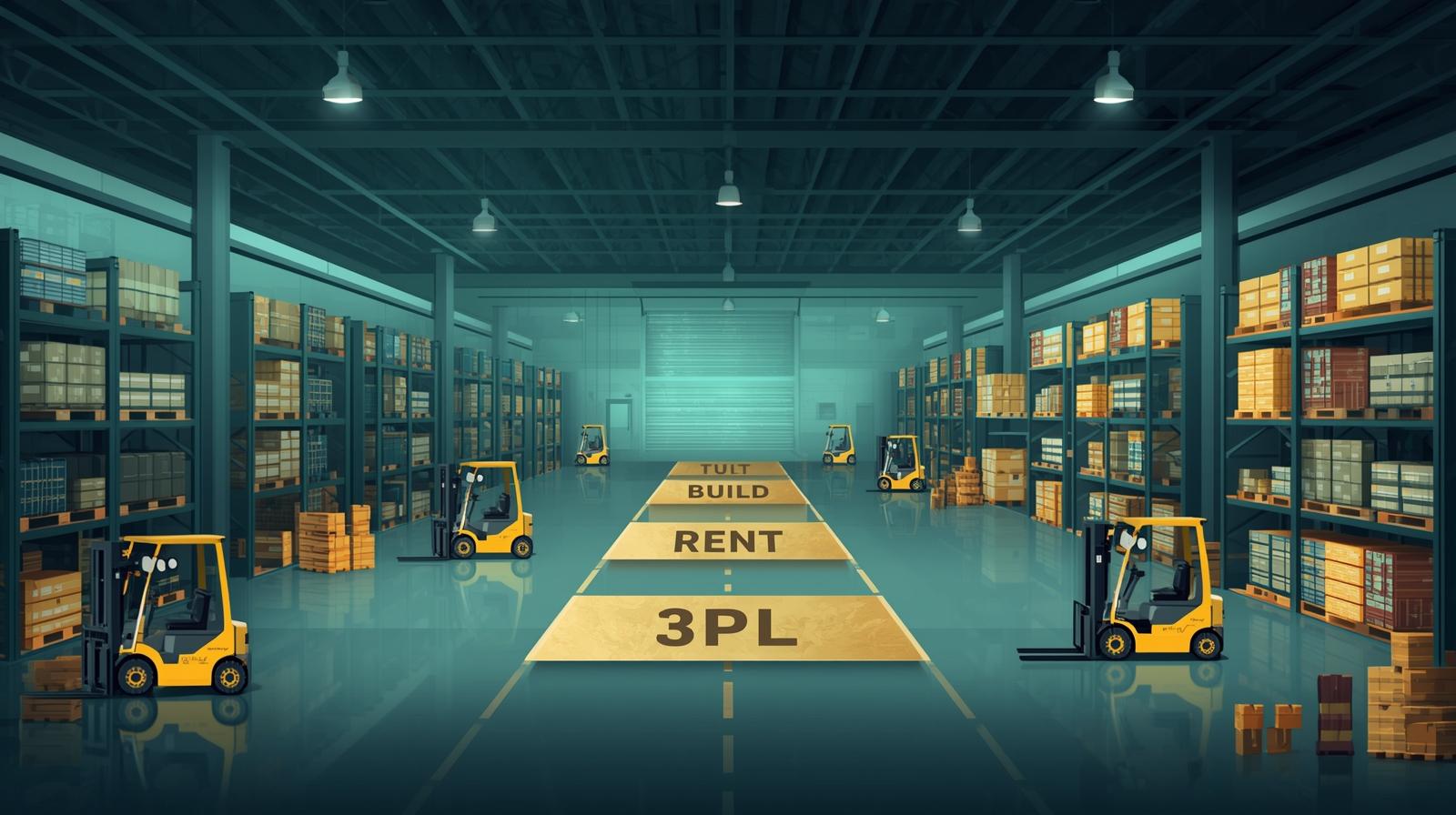
In the logistics world, few decisions weigh as heavily on cost, flexibility, and risk as the choice of warehousing strategy. Whether you build your own warehouse, rent space, or outsource to a 3PL (third-party logistics) provider, each path comes with its own tradeoffs. For many businesses in Bangladesh, this is not a theoretical debate it’s a daily operational dilemma.
Recently, a tobacco client approached us wanting to invest in a warehouse in the southern region, but their vision was unclear. They didn’t fully define their volume, seasonal peaks, or service-level requirements. As a result, the project failed before it could even break ground. Similarly, another textile business applied for bonded warehouse status for a built warehouse only to discover that the regulatory process was more challenging than they anticipated, and they could not operationalize as expected.
These real-life stories underline a critical lesson: warehouse decisions must be deeply strategic, combining financial discipline, regulatory awareness, and long-term vision. In 2025, as global warehousing costs shift and the 3PL market matures, making the right choice is more urgent than ever.
Global and Bangladesh Warehousing Trends
Global Landscape
The global warehousing sector is poised for sustained growth throughout 2025. According to TI Insight, demand for warehouse space is increasing, driven by growing manufacturing output, consumer spending, and evolving supply chain models. Costs, however, are under pressure: regional disparities are emerging, with Europe remaining expensive and Asia Pacific (APAC) costs increasing steadily.
Meanwhile, global warehouse rents are rising Savills reports a 3.6% increase over 12 months in total occupier cost, driven by higher operating expenses and demand for smarter, tech-enabled facilities. According to WarehousingAndFulfillment.com’s 2025 survey, pallet storage fees remain stable (~$20/pallet/month), but lease costs per square foot have climbed 12%. Long-term storage fees are becoming common nearly half of warehouses now charge up to $10 extra per pallet monthly for slow-moving inventory.
3PLs are also playing a major global role: according to CBRE, outsourcing warehousing to 3PLs has become a mainstream strategy, especially in a world where agility, e-commerce, and resilience matter more than ever.
Bangladesh Context
In Bangladesh, warehousing demand is rising in parallel with logistics growth. The Bangladesh logistics and warehousing market benefits from government infrastructure investments including the Padma Bridge and port upgrades that enhance connectivity. E-commerce growth (with an estimated 25% CAGR) has fueled demand for fulfillment centers and 3PL services, especially in Dhaka and Gazipur.
At the same time, the Bangladeshi 3PL market is projected to expand significantly. According to 6W Research, demand for warehousing and distribution services will rise between 2025–2031. However, many local businesses struggle with the cost and risk of building their own facilities and the regulatory and infrastructure realities of doing so.
The 5-C Warehouse Decision Framework
To guide your decision, consider a “5-C” framework five critical dimensions you should analyze before deciding whether to build, rent, or outsource to a 3PL.
Cost
- Build: high capital expenditure (land, construction), plus maintenance and staffing.
- Rent: lease payments, variable operating costs, potential escalation.
- 3PL: variable costs per pallet or cubic meter, long-term storage fees, and service-level charges.
Capacity Risk
- Build: fixed capacity; risk of underutilization.
- Rent: more flexible, but lease terms can lock you in.
- 3PL: scalable up or down, but subject to the 3PL’s capacity constraints.
Control
- Build: maximum control over inventory, location, and operations.
- Rent: good control, but less flexibility in infrastructure design.
- 3PL: low control over daily operations, but 3PLs often have advanced technology and processes.
Compliance & Regulation
- Build: must navigate zoning, permits, and possibly bonded-warehouse regulation.
- Rent: fewer regulatory burdens, but lease contracts matter.
- 3PL: regulatory burden mostly lies with the provider; you benefit from their compliance know-how.
Continuity & Risk
- Build: high fixed infrastructure risk, but long-term stability.
- Rent: moderate risk; leasing volatility.
- 3PL: dependent on partner stability and capacity planning; risk if 3PL fails or changes strategy.
Using this framework, many companies find that 3PL offers a more attractive balance of cost, flexibility, and risk especially in rapidly changing markets.
Comparative Table: Build vs. Rent vs. 3PL
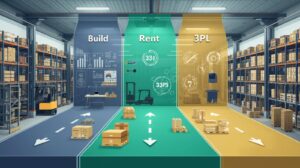
| Decision Path | Build (Own) | Rent | 3PL (Outsource) |
| CapEx / Upfront Investment | Very High | Medium | None or Low |
| Operational Control | High | Medium | Variable (by agreement) |
| Scalability | Fixed | Moderate | High Flexibility |
| Regulatory Risk | High (permits, bonded) | Medium | Low-to-Medium (handled by provider) |
| Cost Risk | High fixed costs | Lease risk, variable costs | Pay per use, but long-term storage fees risk |
| Strategic Risk | Land, location, underutilization | Leasing rigidity | Dependency on partner, service levels |
Based on this table, 3PL clearly offers a balance of flexibility and risk mitigation that often outweighs the cost benefits of other models, especially for dynamic or growing businesses.
Real-World Cases
Case Study 1: Bangladesh Tobacco Client Failure
A tobacco company in southern Bangladesh once approached us to build a dedicated warehouse. Their expectation: to store bulk inventory, manage seasonal peak volumes, and consolidate operations. However, they underestimated complexity. They did not define their throughput, peak demand, or service-route needs clearly. When the warehouse was built, it sat half-empty for much of the year. Over the first three years, lease and operating costs (labor, utilities, maintenance) exceeded their budget. Their return on investment fell short, and they eventually abandoned the warehouse model while continuing to outsource inventory to 3PLs for flexibility.
Case Study 2: Bangladesh Textile Company & Bonded Warehouse
Another prominent textile exporter invested in building a warehouse, applying for bonded status (meaning inventory could be held without immediate duty payment). But the regulatory process proved tougher than anticipated: approvals took too long, and maintaining the bonded license required ongoing compliance costs. By the time they were ready to use it, market conditions had changed, and the facility was underutilized. Their mistake was not simply financial they did not fully assess regulatory risks or the long-term need for a bonded premises.
Case Study 3: Global Asia-Based 3PL Expansion into USA
Asian logistics operators are increasingly leasing U.S. warehouses to support cross-border e-commerce. According to AP News, Asia-based companies (especially in China and nearby markets) more than doubled their leasing of U.S. warehouse space in 2024 compared to 2023. Instead of building their own facilities in the U.S., they rely on established 3PLs to serve both import and e-commerce needs. This model provides flexibility, low capital risk, and scalability exactly the advantages that 3PLs are designed to offer.
Why 3PL Often Wins in 2025 and especially in Bangladesh
Cost Efficiency Amid Cost Pressure
Global rent increases, according to Savills, are slowing (3.6% YOY) but operating costs remain volatile. At the same time, 3PL providers distribute fixed cost risk and offer pay-per-use models.
According to WarehousingAndFulfillment’s 2025 survey, minimum spend requirements are rising (from $337.50 in 2024 to $517 in 2025), and long-term storage fees are being imposed more frequently. This makes 3PLs more attractive for companies that don’t have consistent high volume.
-
Flexibility & Resilience
With geopolitical uncertainties, supply chain shocks, and demand volatility, locking into a fixed facility is risky. Outsourcing to 3PLs provides a buffer you can scale up or down without stranded assets.
-
Global Experience & Compliance Expertise
Particularly for exporters, working with multinational 3PLs allows access to compliance expertise, cross-border capabilities, and warehouse infrastructure that would be prohibitively expensive to build locally.
-
Resource Optimization
Not every company is in the logistics business. When a business focuses on its core competency and outsources warehousing to experts, it can optimize working capital, invest in core operations, and reduce idle costs.
Future Trends (2025–2030)
Looking forward, several warehousing trends will shape how businesses make their warehouse decisions:
-
Tech-Enabled Warehouses
As technology evolves, 3PLs are investing in automation, robotics, and AI-driven warehouse management systems. This reduces labour costs and increases throughput, making outsourced warehousing even more efficient.
-
Sustainable & ESG Warehousing
Tenants increasingly demand green, energy-efficient warehouses. 3PLs that can provide sustainably certified warehouses will gain a competitive edge.
-
Built-To-Suit (BTS) and Hybrid Models
Some companies may prefer hybrid models: custom-built warehouses (BTS) for core inventory + 3PL solutions for overflow or seasonal peaks. This strategy provides control without overinvestment.
-
4PL & Integrated Supply Chain Services
As outsourcing deepens, the concept of a 4PL (fourth-party logistics) provider that not only handles warehousing but also plans and manages your entire supply chain will gain traction, especially for global exporters.
-
Regional Warehousing Hubs
For Bangladesh-origin exporters, regional hubs (e.g., in Southeast Asia or the Middle East) could become logistics milestones. Outsourcing to 3PLs with regional networks may outperform local build or rent models.
Strategic Recommendations for Exporters and Logistics Professionals
- Don’t bet on one model just because it worked for someone else. Use the 5-C framework to evaluate build vs rent vs 3PL based on your volume, capital, and risk tolerance.
- Demand clarity before building. If you decide to build, fully define your business case, regulatory requirements (especially for bonded operations), and long-term strategy.
- Consider 3PL early. Even if you plan to build in the future, contract with a 3PL for overflow or flexibility now it avoids dead capacity.
- Partner with global or regional 3PLs. Their expertise in compliance, automation, and cross-border operations can provide significant value.
- Stay technologically ready. As warehousing evolves, adopting digital tools and analytics will be essential to maximize the benefits of whatever model you choose.
Warehouse decisions are no longer just operational they are strategic. For businesses in Bangladesh and beyond, the “right warehouse strategy” could be the difference between scaling with resilience and being buried under cost. Choose wisely, plan methodically, and adapt boldly. 제니스 인베릭스
References
- Ti Insight 2025, Global warehousing set for sustained growth in 2025, TI Insight, London. [Accessed 18 Nov 2025]
- WarehousingAndFulfillment.com 2025,Warehousing Costs & Pricing Survey, WarehousingAndFulfillment.com, Denver. [Accessed 18 Nov 2025]
- Savills 2025, Global warehouse costs rise by 3.6% in a year, Savills, London. [Accessed 18 Nov 2025]
- 6W Research 2024, Bangladesh Third-Party Logistics Market (2025–2031) Report, 6W Research, Dhaka. [Accessed 18 Nov 2025]
- The Financial Express, Expanding scope of operation of 3PL service providers, The Financial Express, Dhaka. [Accessed 18 Nov 2025]
- Knight Frank Research, India Warehousing Market Report H1 2025, Knight Frank, India. [Accessed 18 Nov 2025]