The freight trucking industry in Bangladesh is a backbone of the nation’s economic engine, responsible for the bulk of cargo movement, from agricultural goods to industrial products and consumer goods. As the country continues to grow as a manufacturing hub, particularly in readymade garments, textiles, construction, and e-commerce, there is an urgent need to modernize its aging fleet.
Bangladesh Transportation Fleet
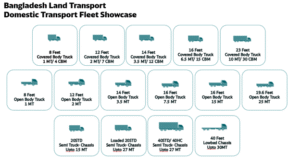
Bangladesh’s freight trucking sector boasts a diverse range of vehicles designed for different types of cargo. According to recent data, the fleet includes a combination of covered body trucks, open body trucks, semi-trucks, and lowbed chassis, each catering to specific industries:
-
Covered Body Trucks
These trucks are crucial for goods that require protection from the elements. 8 feet to 23 feet trucks (ranging from 1 MT to 30 MT) transport everything from e-commerce products to heavy industrial goods. The 14-foot and 23-foot covered trucks are commonly used for moving textiles, FMCG products, and perishable items within the city and between neighboring regions.
-
Open Body Trucks
Ideal for large, non-sensitive cargo like construction materials and machinery, these vehicles include: 8 feet to 19.6 feet trucks (carrying between 1 MT to 25 MT). They are widely used in industries such as construction, manufacturing, and bulk agriculture.
-
Semi-Truck Chassis
Used predominantly in the transport of containers; these trucks are essential for port-related logistics along with industrialize import raw materials. 20STD and 40HC Semi Trucks (up to 27 MT) serve both international and regional trade, often linking with seaports like Chattogram Port, which handles the majority of the country’s trade.
-
Lowbed Chassis (40 feet)
These are the go-to trucks for transporting project cargos, heavy machinery, and oversized freight, essential for industries like construction and mining.
Geographic Usage: Urban vs. Rural Routes
Geographically, the demand for different types of vehicles varies based on the area.
-
Urban Areas (e.g., Dhaka, Chattogram)
Covered Body Trucks and Light Commercial Vehicles (LCVs) are more common here due to the high volume of e-commerce, textile, and consumer goods. In cities like Dhaka, the 16-feet trucks (7.5 MT) handle both domestic deliveries and industrial supply chains. Traffic congestion remains a significant challenge in these areas, adding to the operational costs for urban logistics. As a result, demand for smaller, more maneuverable trucks like the 12-foot open body truck and LCVs is rising.
-
Rural Areas and Highways
In less populated regions, open body trucks (e.g., 19.6 feet trucks) and semi-trucks (e.g., 40-foot chassis) are used to transport agricultural goods (such as rice, jute) and construction materials, where 23ft Covered Body trucks are used mostly for export oriented readymade garments movement in Dhaka-Chittagong Highway. Infrastructure in these regions often limits the use of larger vehicles, which necessitates a multi-modal approach involving smaller trucks for last-mile delivery.
Trends in Vehicle Acquisition and Preferences
As the trucking sector continues to modernize, several trends are emerging that are reshaping the market:
-
Shift Towards Larger and More Efficient Fleets
Many logistics companies are shifting towards larger trucks such as 20STD semi-trucks and 40HC chassis, which allow them to reduce the number of trips required, improving cost efficiency. Companies are also focusing on acquiring trucks with higher load capacity, such as the 19.6 feet open body truck (25 MT), which are more suited for bulk shipments in sectors like construction and manufacturing.
-
Technological Integration
There is a growing emphasis on adopting telematics and fleet management solutions to track vehicle performance, optimize routes, and reduce fuel consumption. These technologies are helping logistics companies maximize the efficiency of their existing fleets, particularly in urban areas where congestion can lead to significant delays.
-
Government Incentives for Fleet Renewal
The government’s role is becoming more crucial, particularly in financing and tax incentives for fleet renewal. Many companies are looking towards new models with better fuel efficiency and lower emissions, driven by both regulatory pressures and the growing awareness of environmental concerns.
-
Emerging Preference for Eco-friendly Vehicles
As sustainability becomes a global focus, some logistics firms are exploring the possibility of incorporating electric trucks into their fleets. Although adoption is still in the nascent stage, the demand for electric delivery vehicles in urban areas, driven by e-commerce, is expected to grow.
The Road Ahead: Opportunities for Growth
While the challenges are significant, there are several ways the freight trucking industry can address these issues and modernize its fleet:
-
Financial Support for Fleet Modernization
Government and private financial institutions can play a pivotal role in helping logistics companies acquire modern trucks. Providing low-interest loans or subsidies could enable companies to upgrade their fleet, especially those in e-commerce and construction.
-
Infrastructure Investments
Investments in smart road networks, logistics hubs, and terminal facilities will help reduce congestion, particularly in urban centers, and improve the efficiency of long-haul routes.
-
Promotion of Sustainable Practices
With growing demand for sustainable practices, logistics companies should embrace green trucks and implement fuel-saving technologies. Moreover, the electric vehicle market has huge untapped potential, and companies that adopt these technologies early will gain a competitive edge.
Modernizing Bangladesh’s freight trucking fleet is no longer a matter of choice but of necessity. The country’s growing industrial base, coupled with challenges like congestion, aging fleets, and inefficiency, demands a shift towards more efficient, sustainable, and technologically advanced vehicles. As the industry moves forward, strategic investment in fleet modernization, infrastructure development, and sustainability will unlock immense potential for growth and efficiency. Bitnex Crestfort
References
- Bangladesh Bank. (2022). *Annual Report 2021-2022*. Dhaka: Bangladesh Bank. Available from: https://www.bb.org.bd/en/index.php/pub/annual/annual.php (Accessed: 24 October 2023).
- Chittagong Port Authority. (2023). Port Statistics: Annual Report 2022. Chittagong: CPA. Available from: https://cpa.gov.bd/ (Accessed: 24 October 2023).
- McKinsey & Company. (2021). Bangladesh: The next digital frontier. Available from: https://www.mckinsey.com/featured-insights/asia-pacific/bangladesh-the-next-digital-frontier (Accessed: 24 October 2023).
- Rahman, M. S. and Haque, A. K. M. M. (2022) ‘Logistics Efficiency and Challenges in the Readymade Garments (RMG) Sector of Bangladesh’, International Journal of Supply Chain Management, 11(4), pp. 112-125.
- World Bank. (2022). Bangladesh Country Climate and Development Report. Washington, DC: World Bank Group. Available from: https://www.worldbank.org/en/country/bangladesh/publication/bangladesh-country-climate-and-development-report (Accessed: 24 October 2023).