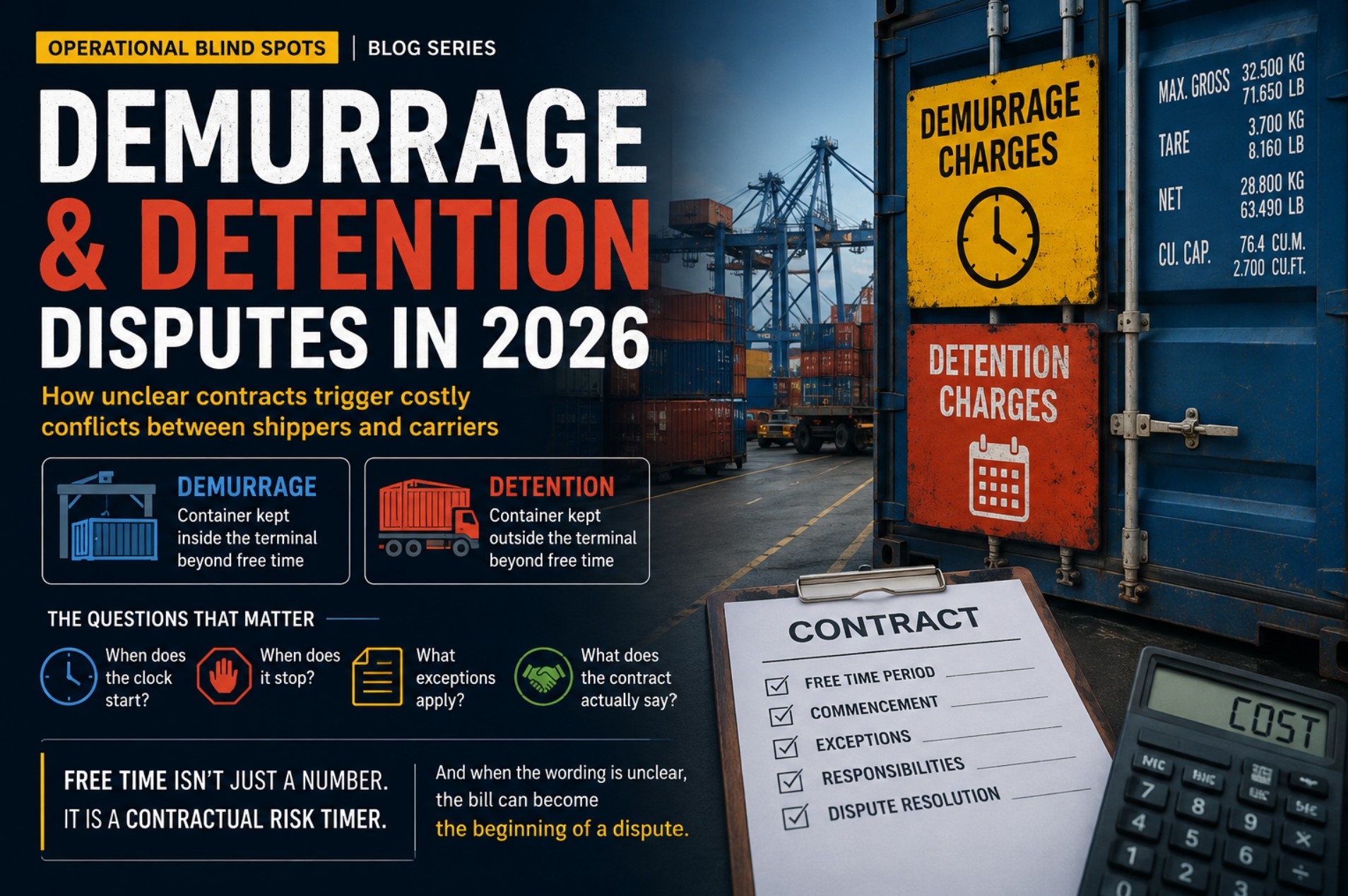
A container arrives at Chattogram Port. The importer expects to clear it, move it to the factory and return the empty box within the agreed free time.
Then something goes wrong.
Customs asks for another document. A physical inspection cannot be completed. A scanner stops working. The terminal becomes congested. Heavy rain disrupts yard operations. A truck appointment is unavailable. The port temporarily stops working.
The container does not move.
The clock does.
When the invoice finally arrives, the dispute begins.
Who caused the delay?
Who controlled the process?
Who was actually capable of preventing it?
And most importantly, who should pay?
These questions are no longer theoretical for Bangladesh. In 2026, Chattogram Port has provided several real examples of how operational disruption can quickly become a financial and contractual problem.
The port is often where the dispute becomes visible, not where it begins
The first mistake is to treat demurrage and detention as a port problem.
They are usually a contract problem that becomes visible at the port.
The commercial relationship may involve a shipper, consignee, carrier, freight forwarder, customs agent, terminal, inland transporter and government authority. Each party controls a different part of the shipment.
Yet the container has one clock.
That creates the blind spot.
If the booking confirmation says ten days free time, that sounds straightforward. It is not.
When does day one begin?
Does the clock run on calendar days or working days?
Are weekends included?
What about public holidays?
Does free time begin when the vessel arrives, when the container is discharged, when the container becomes available or when customs completes a particular process?
What happens if the terminal is closed?
What happens if customs has not released the cargo?
What happens if the consignee is ready but the equipment cannot be returned?
If these questions are not clearly answered before the shipment moves, the commercial risk has already been created.
Bangladesh has shown what happens when the clock meets the system
In February 2026, work stoppages at Chattogram Port created severe disruption. Import cargo clearance slowed, export shipments were affected and storage charges, vessel demurrage and truck penalties began accumulating. BGMEA subsequently asked the National Board of Revenue to keep port and customs operations running around the clock and sought relief from demurrage created by the shutdown.
This is an important distinction.
The cargo was delayed.
But delay alone does not explain liability.
A shipper cannot simply control a port shutdown. A forwarder cannot manufacture terminal capacity. A carrier cannot necessarily release cargo before the required regulatory process is completed.
The contractual question is therefore not simply whether the container exceeded free time.
It is whether the party being charged had control over the event that caused the delay.
That is where D and D disputes become complicated.
The numbers at Chattogram make the problem impossible to ignore
By 30 June 2026, 9,330 TEUs of stranded containers were occupying around 22 percent of Chattogram Port’s yard capacity, according to Chattogram Port Authority data reported by The Business Standard.
The problem was not simply congestion caused by too many ships arriving at once.
The stranded cargo was linked to customs procedures, legal disputes and slow disposal of abandoned cargo. The port authority said storage charges for containers and goods had reached Tk8,000 crore to Tk10,000 crore.
One reported case shows how quickly the economics can become irrational.
An imported shipment valued at only $6,440 accumulated approximately $22,000 in demurrage and other charges after customs clearance was delayed. Another container carrying plaster of Paris had reportedly remained at Chattogram Port for 1,764 days by July 2026, with accumulated port charges of approximately $193,072.
These are not normal commercial delays.
They demonstrate what happens when the physical movement of cargo, regulatory decision making and contractual charging mechanisms become disconnected.
Sometimes the trigger is painfully small
On 6 April 2026, a scanner malfunction at Patenga Container Terminal left more than 500 containers stuck without clearance, according to The Daily Star.
The disruption affected both import and export activity and created additional pressure on the terminal and inland movement.
Consider what happens next.
The cargo owner may be ready.
The customs declaration may already exist.
The forwarder may have arranged transport.
The truck may be available.
But the container still cannot move because a piece of port equipment is not functioning.
The commercial clock, however, does not automatically understand operational responsibility.
That is why contracts need more than a free time number.
They need a mechanism for dealing with events that are outside the reasonable control of the party being charged.
Free time is a risk allocation mechanism
This is the part of D and D contracting that companies often underestimate.
Free time is not merely a commercial concession.
It is a risk allocation mechanism.
A longer free time period can protect an importer from operational uncertainty. A clearly defined calculation method can prevent arguments. A properly written exception clause can determine whether a terminal closure becomes a carrier exposure, a customer exposure or a matter requiring negotiation.
The wording should establish, at minimum:
- The exact starting point of free time
- The exact ending point
- Calendar days or working days
- Treatment of weekends and public holidays
- Treatment of terminal closures
- Treatment of customs or regulatory holds
- Responsibility for documentation
- Equipment return requirements
- Empty container depot rules
- Separation between carrier D and D and port storage
- Evidence required for a dispute or waiver
Without these details, two parties can read the same booking confirmation and reach completely different conclusions.
2026 has also shown that responsibility cannot simply be assumed
In July 2026, Chattogram Port Authority and Chattogram Customs became involved in a serious dispute over approximately 250 containers that had been locked in the ASYCUDA World system over an extended period.
Both institutions disputed responsibility for the operational problem.
That case matters because it illustrates the fundamental issue behind many private sector D and D disputes.
If government agencies themselves can disagree over who controls a container and where responsibility sits, businesses cannot afford vague internal responsibility matrices.
A freight forwarder therefore has a role that goes well beyond booking space.
The forwarder can become the party connecting the commercial contract to the operational reality.
The forwarder’s real value begins before the container moves
A strong forwarder should not wait for a D and D invoice before becoming involved. The work should begin at booking. Before accepting the shipment, the forwarder should identify the risk points.
- What is the agreed free time?
- Which carrier terms govern it?
- Does the customer’s quotation match the carrier’s actual tariff?
- Who handles customs documentation?
- Who monitors cargo availability?
- Who arranges the truck?
- Who monitors the empty return?
- What happens if the terminal cannot provide an appointment?
- Who records the evidence?
This is where local logistics capability becomes commercially valuable.
A forwarder with people on the ground can monitor container status, customs progress, terminal conditions, transport availability and equipment return in real time. More importantly, that information can be documented while the event is happening.
That matters because a dispute six weeks later is won with evidence, not memory.
Bangladesh needs a stronger local layer between global carriers and local cargo owners
This is also where Bangladesh’s logistics industry has a larger opportunity.
Global carriers control vessels, equipment, networks and international contractual frameworks.
Local operators understand the port, customs, transport market, documentation process and the realities of moving cargo inside Bangladesh.
The strongest freight forwarding companies can connect those two worlds.
- They can translate international carrier terms into practical local operating instructions.
- They can identify a D and D risk before it becomes a charge.
- They can escalate a customs issue before free time expires.
- They can arrange alternative transport when the normal plan fails.
- They can maintain a documentary trail when a waiver becomes necessary.
That is not simply forwarding. It is risk management.
Even the port itself is changing
Chattogram’s operational picture is not entirely negative.
In June 2026, the Shipping Minister told Parliament that average container vessel turnaround had improved from 2.58 days in fiscal year 2024 to 2025 to 2.1 days in the ongoing fiscal year. Vessel waiting time had also fallen close to zero following operational improvements and the addition of Patenga Container Terminal.
Yet customs and cargo clearance remain major bottlenecks.
That distinction is critical.
Improving the port’s marine side does not automatically solve the landside supply chain.
Bangladesh can handle a vessel faster and still leave cargo trapped because customs, documentation, inspection, transport or legal processes are slow.
The next generation of logistics performance must therefore measure the entire cargo journey, not just vessel turnaround.
Bangladesh Shipping Corporation has a larger opportunity
There is another strategic piece of this discussion that deserves attention.
Bangladesh Shipping Corporation is no longer simply a state owned institution trying to survive.
It has demonstrated that a national shipping company can become commercially relevant.
BSC reported a record Tk306.56 crore profit for fiscal year 2024 to 2025. Its fleet expanded to seven vessels in early 2026, while the corporation has been pursuing further fleet expansion, including container vessels.
That creates a much bigger possibility.
If BSC develops the right container fleet, international commercial partnerships, professional customer service and technology driven cargo visibility, Bangladesh can move from being mainly a cargo generating market to becoming a stronger participant in the shipping value chain.
The objective should not be simply to put Bangladeshi flagged vessels on the water.
The objective should be to build an internationally competitive maritime logistics institution.
That means reliable schedules, transparent contracts, professional claims handling, modern container management and strong relationships with freight forwarders and shippers.
A national carrier should understand that customers do not buy vessel capacity alone.
They buy predictability.
The real blind spot is not demurrage
The real blind spot is assuming that operational delay and contractual responsibility are the same thing.
They are not.
A container can be delayed because of customs.
- It can be delayed because of terminal congestion.
- It can be delayed because of weather.
- It can be delayed because of equipment failure.
- It can be delayed because the consignee failed to act.
- It can be delayed because the carrier did not provide the required information.
Every event has a different owner.
The companies that manage D and D well are not necessarily the companies that negotiate the biggest waiver after receiving an invoice.
They are the companies that identify the risk before the clock starts.
- For shippers, that means reading the contract.
- For carriers, it means writing clearer terms.
- For ports and regulators, it means removing avoidable bottlenecks.
- For forwarders, it means taking responsibility for visibility, coordination and evidence.
- And for Bangladesh, it means building a logistics ecosystem where the movement of cargo is governed by clear responsibility rather than institutional blame.
Because when the contract is unclear, the container may stop moving.
But the bill does not.
References
- Chattogram Port Authority (2026) Port performance and container handling data, 2026. Chattogram Port Authority.
- The Business Standard (2026) ‘Cargo logjam for years eating up 40% of Ctg Port’s capacity’, 3 August 2026.
- The Business Standard (2026) ‘Why are thousands of cargo containers remaining stranded at Ctg Port?’, 3 August 2026.
- The Daily Star (2026) ‘Scanner glitch stalls 500 containers at Ctg port’, 9 April 2026.
- The Business Standard (2026) ‘Ctg Port standoff threatens ripple effects across economy’, 2 February 2026.
- The Business Standard (2026) ‘Work stoppage at Ctg Port enters third day, blockade announced for tomorrow’, 2 February 2026.
- The Business Standard (2026) ‘Indefinite work stoppage announced until NCT lease decision withdrawn, Ctg Port operations disrupted’, 3 February 2026.
- The Business Standard (2026) ‘Ctg Port workers to resume indefinite strike tomorrow after 2-day pause’, 7 February 2026.
- The Business Standard (2026) ‘BSC’s newly acquired MV Banglar Nabojatra begins commercial voyage to US’, 3 February 2026.
- The Business Standard (2025) ‘Shipping Corp aims to buy one ship per year with own funds till 2030, driven by record profits’, 13 November 2025.
- The Business Standard (2025) ‘For the first time, Shipping Corp to buy two vessels using Tk900cr of its own funds’, 25 June 2025.
- The Business Standard (2025) ‘Shipping Corporation reports record net profit of Tk306.56cr, plans fleet expansion’, 22 December 2025.
- Federal Maritime Commission (2026) Demurrage and detention proceedings and incentive principle. Federal Maritime Commission.
- Federal Maritime Commission (2025) Order on Initial Decision concerning demurrage and detention practices. Federal Maritime Commission.