

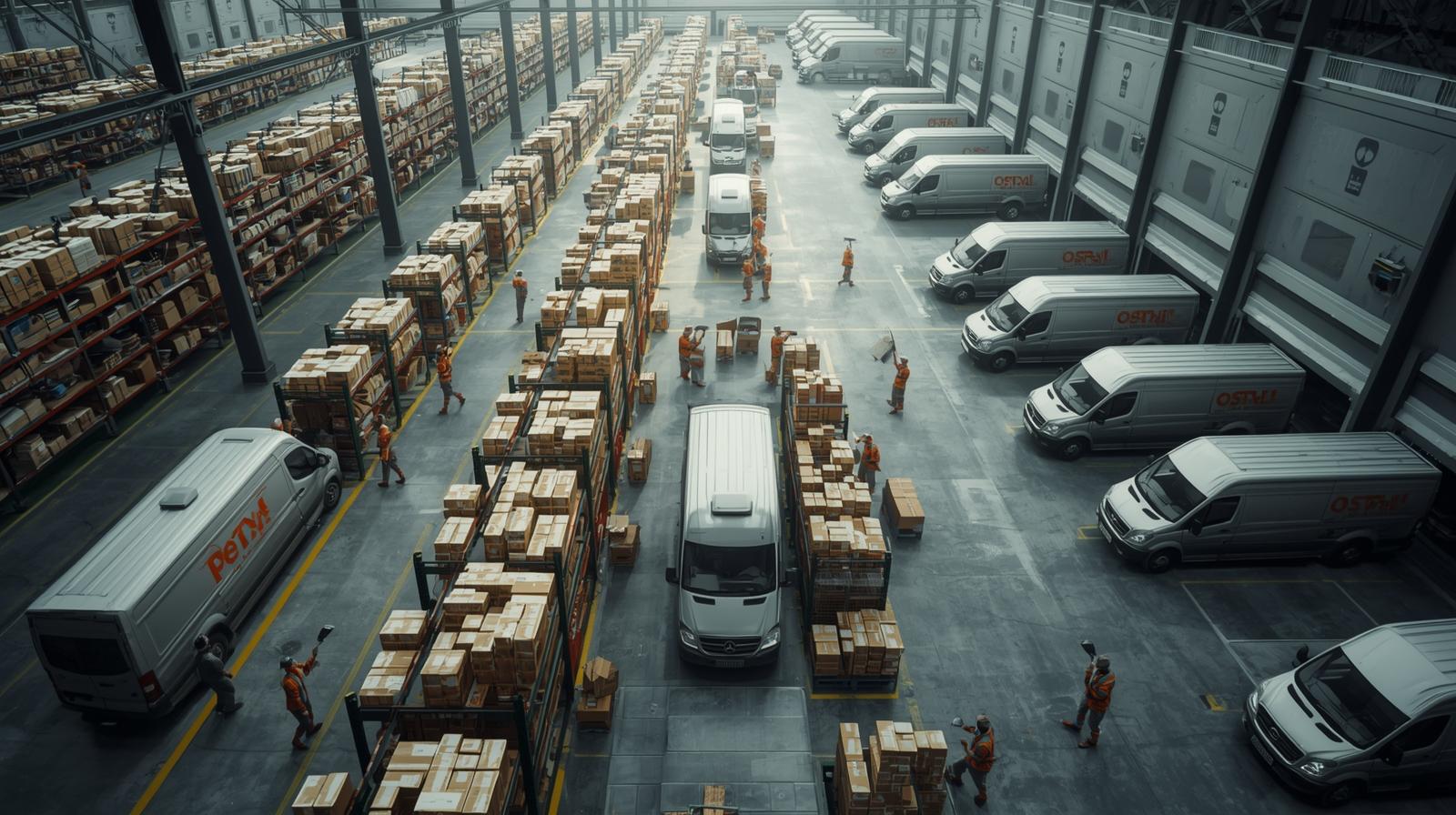
Bangladesh’s e-commerce story is no longer just about apps, discounts, or last-mile riders. Over the last decade, the center of gravity has quietly shifted upstream, into warehouses, fulfillment centers, cross-dock hubs, and urban distribution facilities. While consumers still experience e-commerce through mobile screens and doorstep deliveries, the real competition today is happening inside storage yards, sorting lines, inventory systems, and transport interfaces. In Bangladesh, where logistics inefficiencies directly translate into higher costs and service failures, warehouses have emerged as the decisive battlefield that will determine which platforms scale sustainably and which collapse under operational pressure.
This transformation is not theoretical. It is visible in the evolution of leading local platforms, the failures of several high-profile e-commerce ventures, and the growing involvement of third-party logistics and freight forwarding companies in domestic distribution. Unlike mature markets where fulfillment automation matured over decades, Bangladesh is attempting to compress this learning curve into a short span while contending with land scarcity, urban congestion, power reliability issues, and fragmented transport infrastructure.
To understand why warehouses are becoming the new battleground, one must examine how e-commerce actually operates on the ground in Bangladesh, how fulfillment constraints have shaped business outcomes, and what structural changes are now required to support the next phase of growth.
The Early E-Commerce Phase: Platform First, Logistics Later
Bangladesh’s modern e-commerce expansion began in earnest in the early 2010s, driven by increasing internet penetration, smartphone adoption, and the emergence of platforms such as Daraz, AjkerDeal, Chaldal, Pickaboo, and Evaly. During this phase, most companies prioritized customer acquisition, marketing, and merchant onboarding. Logistics was treated as a support function rather than a strategic pillar.
Warehousing, where it existed, was largely basic storage often rented spaces with limited inventory management systems, manual picking, and minimal standardization. Many platforms relied on merchants to hold inventory themselves, while platforms focused on order aggregation and delivery coordination. This model appeared viable in the early growth stage, when order volumes were low and customer expectations around delivery speed were modest.
However, as daily order volumes increased and same-day or next-day delivery became a competitive expectation, weaknesses in fulfillment infrastructure became impossible to ignore. Delays, stock mismatches, lost inventory, and delivery failures started to erode customer trust. Several platforms discovered that marketing growth without backend fulfillment discipline created operational liabilities that were difficult to unwind.
The collapse of high-profile platforms in the early 2020s highlighted this structural flaw. While governance and financial misconduct played major roles, investigative reporting in Bangladeshi newspapers also repeatedly pointed to weak inventory control, absence of centralized warehousing, and overreliance on manual logistics processes as contributing factors. Warehousing was not just a cost center it became a risk amplifier.
Why Warehouses Matter More Than Last-Mile Delivery
In popular discourse, last-mile delivery is often portrayed as the most complex part of e-commerce logistics in Bangladesh, due to traffic congestion, address ambiguity, and rider shortages. While last-mile challenges are real, they are symptoms of upstream inefficiencies rather than the root cause.
Warehouses determine:
- Whether inventory data is accurate or speculative
• Whether orders can be consolidated or must be shipped individually
• Whether delivery routes are optimized or reactive
• Whether returns can be processed efficiently or pile up as dead stock
In Bangladesh, poor warehouse design frequently forces platforms to compensate with expensive last-mile solutions, increasing delivery costs without improving service reliability. For example, when inventory is scattered across multiple small storage locations, platforms cannot batch deliveries or plan efficient line-haul movements. As a result, riders make more trips with lower drop density, driving up per-order logistics costs.
Leading players have recognized this reality. Chaldal’s public interviews and media coverage consistently emphasize the role of dark stores and micro-fulfillment centers located close to demand clusters. These facilities are not traditional warehouses; they are strategically positioned inventory nodes designed to reduce picking time and delivery distance. Similarly, Daraz has invested heavily in centralized fulfillment centers and sorting hubs to support nationwide campaigns such as 11.11 and Eid sales.
These investments reflect a fundamental shift: competitive advantage is increasingly determined by how well inventory flows through warehouses; not how fast riders move on the road.
Urban Warehousing Constraints in Bangladesh
Warehousing in Bangladesh faces unique structural constraints that make fulfillment particularly challenging.
First, land scarcity in major cities like Dhaka and Chattogram severely limits the availability of large, purpose-built logistics facilities. Most warehouses operate in converted industrial buildings or residential structures, lacking proper loading docks, fire safety systems, and vehicle maneuvering space. This directly affects throughput capacity and operational safety.
Second, zoning regulations and urban planning have historically not prioritized logistics infrastructure. Warehouses are often pushed to city peripheries without adequate road connectivity, forcing delivery vehicles to traverse congested urban corridors multiple times a day. This undermines the very efficiency warehouses are meant to create.
Third, power reliability and ICT infrastructure vary widely across industrial zones. Fulfillment operations depend on uninterrupted power for warehouse management systems, scanning devices, and security systems. Frequent outages force manual overrides, increasing error rates and labor dependency.
Fourth, skilled warehouse labor remains limited. While Bangladesh has abundant manpower, fulfillment requires trained supervisors, inventory planners, and system operators. Many warehouses still rely on manual stock counts and paper-based processes, making scalability difficult.
These constraints mean that simply adding warehouse space is not enough. The quality, location, and integration of warehouses into the broader logistics network are what determine performance outcomes.
The Shift Toward Fulfillment-Centric Competition
Over the last few years, a clear pattern has emerged: platforms that invested early in structured fulfillment infrastructure have survived and scaled, while those that treated warehousing as an afterthought struggled.
This shift mirrors the early evolution of Amazon in the United States, where fulfillment centers became strategic assets rather than operational expenses. In Bangladesh, the scale is smaller, but the principle is identical. Warehouses are no longer passive storage points; they are active processing engines that define customer experience and cost structure.
Key characteristics of competitive fulfillment operations in Bangladesh today include:
- Centralized inventory ownership or control
• Real-time stock visibility across channels
• Dedicated sorting and cross-docking zones
• Integration with transport partners for line-haul and last-mile delivery
Platforms that lack these capabilities are increasingly dependent on third parties, limiting their control over service quality and margins.
The Expanding Role of Freight Forwarders and Logistics Companies
Traditionally, freight forwarding companies in Bangladesh focused on international cargo handling imports and exports through Chattogram Port, ICDs, and airports. Domestic e-commerce fulfillment was considered outside their core scope. That boundary is now dissolving.
Several developments have pulled freight forwarders into the e-commerce ecosystem:
- Growth of cross-border e-commerce imports requiring bonded warehousing
• Demand for nationwide distribution beyond Dhaka
• Need for professional inventory handling and compliance
Freight forwarders bring capabilities that many e-commerce platforms lack: standardized processes, documentation discipline, cargo security, and experience managing complex transport networks. As fulfillment becomes more capital-intensive and compliance-driven, these capabilities are increasingly valuable.
In Bangladesh, some logistics companies have begun offering hybrid services combining warehousing, domestic line-haul, and last-mile coordination. This mirrors models seen in India, where freight forwarders evolved into integrated logistics service providers supporting both B2B and B2C supply chains.
However, this transition is not automatic. Freight forwarders must adapt their operating models to handle high-velocity, low-value parcels rather than containerized cargo. This requires investment in warehouse layout redesign, IT systems, and service culture oriented toward speed rather than batch efficiency.
What Bangladesh Actually Needs in Fulfillment Infrastructure
The discussion around e-commerce logistics in Bangladesh often focuses on scale, but the more urgent requirement is structural alignment.
What the market actually needs includes:
- Medium-sized, well-located urban fulfillment centers rather than mega warehouses
• Cross-dock hubs near highway junctions to support inter-city movement
• Bonded and non-bonded warehousing options for cross-border e-commerce
• Standardized warehouse management systems shared across platforms and partners
Bangladesh does not need Amazon-scale robotics to improve fulfillment performance. It needs consistency, predictability, and integration across existing logistics assets. Even modest investments in racking systems, barcode scanning, and route planning software can dramatically improve throughput and accuracy.
Public policy also plays a role. Incentives for logistics parks, clearer zoning for warehousing, and faster approvals for bonded facilities would directly support e-commerce growth. Without such support, platforms will continue to improvise within constrained urban environments, limiting efficiency gains.
Returns, Reverse Logistics, and the Warehouse Bottleneck
One of the least discussed but most costly aspects of e-commerce in Bangladesh is reverse logistics. High return rates driven by cash-on-delivery practices and consumer trust issues place enormous strain on fulfillment systems.
Returned goods often re-enter warehouses in unstructured ways, creating inventory ambiguity and storage congestion. Many platforms lack dedicated reverse logistics zones, forcing returned items to mix with outbound inventory. This increases error rates and delays restocking or liquidation.
Freight forwarders and professional logistics firms can add value here by designing structured reverse logistics flows, including inspection, refurbishment, and redistribution processes. Without such systems, warehouses become choke points rather than efficiency engines.
Warehouses as Strategic Assets, Not Cost Centers
The central insight emerging from Bangladesh’s e-commerce experience is that warehouses are not neutral infrastructure. They shape cost structures, customer satisfaction, and platform resilience.
Companies that treat warehouses as strategic assets invest in:
- Location strategy aligned with demand clusters
• Process standardization rather than ad-hoc labor
• Long-term partnerships with logistics providers
Those that treat warehouses as temporary storage facilities inevitably face scalability limits.
For freight forwarding companies, this shift presents a strategic opening. By positioning themselves as fulfillment partners rather than transport vendors, they can integrate deeper into the e-commerce value chain. This requires mindset change, but the opportunity is real.
The Real Battleground Ahead
Bangladesh’s e-commerce sector is entering a more disciplined phase. Capital is tighter, consumers are more demanding, and regulators are more attentive. In this environment, operational efficiency not aggressive discounting will determine survival.
Warehouses sit at the heart of this transition. They are where digital promises meet physical reality. Platforms that master fulfillment will scale sustainably; those that do not will continue to struggle regardless of marketing spend.
The “Amazon-style wars” in Bangladesh will not be fought with drones or robots anytime soon. They will be fought in loading bays, inventory systems, and transport coordination rooms. The winners will be those who understand that in e-commerce, warehouses are not background infrastructure they are the battlefield itself. Fundex Bitport
References
- Bangladesh Bank (2021) Guidelines on Digital Commerce Operations. Dhaka: Bangladesh Bank.
- Bangladesh Telecommunication Regulatory Commission (2023) Internet Subscribers in Bangladesh. Dhaka: BTRC.
- The Daily Star (2021) ‘E-commerce sector needs stronger logistics backbone’, The Daily Star, 18 July.
- The Daily Star (2022) ‘Why many e-commerce firms failed despite booming demand’, The Daily Star, 12 February.
- Dhaka Tribune (2023) ‘Warehousing crisis slows down e-commerce delivery’, Dhaka Tribune, 07 September.
- The Business Standard (2023) ‘Dark stores and micro-fulfilment: How grocery e-commerce is evolving in Bangladesh’, The Business Standard, 21 June.
- Ministry of Commerce (2022) National Digital Commerce Policy. Dhaka: Government of Bangladesh.
- World Bank (2020) Bangladesh Logistics Sector Assessment. Washington DC: World Bank.


