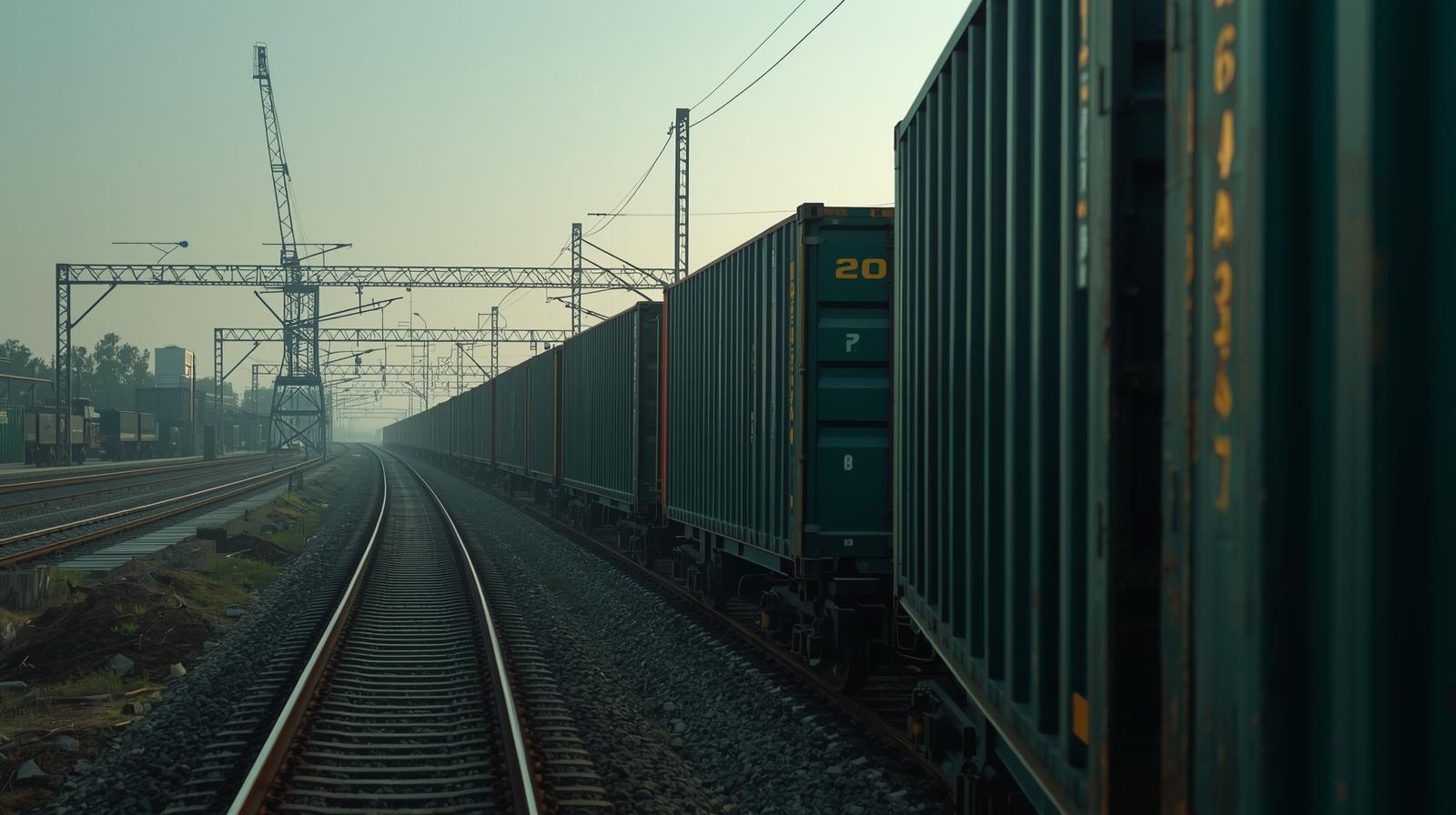
Rail transport has been part of Bangladesh’s economic backbone since the first lines were laid in the mid-19th century. While the network was originally designed to serve passenger movement and agricultural bulk goods, freight rail particularly containerized cargo movement between Chattogram and Dhaka has historically offered an alternative to road transport that could be more cost-effective, sustainable, and efficient. However, decades of underinvestment, operational challenges, and structural constraints have limited rail’s share of national freight traffic and forced exporters and importers to rely heavily on road movements. With growing congestion on key corridors like Dhaka-Chattogram, there is renewed policy interest in understanding rail freight’s actual prospects both as a historical logistical pillar and as a potential lever for future competitiveness.
This article examines the evolution of freight rail in Bangladesh, current challenges that impede its utilization, and the realistic prospects for expanding nationwide rail freight movement particularly along the Dhaka-Chattogram corridor as an alternative to road dependence.
The Historical Footprint of Rail Freight in Bangladesh
Railway operations in the territory now known as Bangladesh began on 15 November 1862, when 53 km of broad-gauge track opened between Darshana and Jogotee, laying the foundation for the nation’s rail network. Over time, additional meter gauge lines extended connectivity across key districts, establishing intercity passenger services and freight routes. By the 1970s, rail freight carried a significant share of the country’s transport demand, especially for agricultural and bulk commodities.
Early Freight Initiatives
Rail movement assumed strategic importance when the Kamalapur Inland Container Depot (ICD) was established in 1987, enabling containerized freight operations tied to Chattogram Port. This development marked a pivotal shift: it allowed containers to be moved in block trains between port and ICD with customs facilitation rather than by road. Later, dedicated container trains were introduced on 5 August 1991, ushering in a new phase of rail freight focused on export-import cargo.
For decades thereafter, rail freight expanded its role in the national logistics mix. Data compiled for 2021-22 showed that Bangladesh Railway moved 101,763 containers equivalent to over 831,000 tons of import-export goods on the Dhaka-Chattogram route, generating revenue of over Tk 113.59 crore. This was the first time in nearly two decades that container rail volumes exceeded 100,000 units, highlighting rail’s latent capacity when utilization was strong.
Declining Freight Share and Structural Shift
Despite these gains, rail’s share in overall freight transport has declined over the past several decades. Government assessments note that the railway’s freight market share fell sharply from around 30 % in 1970 to about 7 % by 2005. While container traffic grew at around 9 % annually, overall freight ton-kilometers diminished, reflecting competition from road transport and broader structural challenges.
This long-term contraction was driven by multiple factors: stagnation in rail infrastructure investment, limited fleet and rolling stock upgrades, and preferential policy focus on road expansion. While the road network saw dramatic growth post-independence, rail infrastructure remained largely unchanged in capacity and technology.
Present-Day Rail Freight Dynamics
Today, Bangladesh Railway (BR) continues to operate freight services across major national corridors, including the crucial Dhaka-Chattogram link that connects the capital’s commercial hinterland to the country’s primary seaport. Yet recent data reveals serious operational and capacity challenges that constrain rail freight’s effectiveness.
Falling Service Levels and Engine Shortages
A persistent issue facing BR is a severe shortage of functioning locomotives. As of late 2025, out of 281 locomotives in the fleet, over 90 were inactive or unfit for service. This shortage has halved the number of monthly container trains from Chattogram Port from over 120 trains per month to around 50-60 significantly disrupting freight flows. These inactive engines and frequent mechanical breakdowns reduce service reliability and push freight customers back toward road transport.
Locomotive shortages also force operational trade-offs. For example, when passenger services face equipment failures, locomotives are often diverted from freight duties, further delaying cargo services. Freight trains also experience schedule disruptions due to track incidents such as derailments, which in recent years have caused partial suspension of services on key sections like Dhaka-Brahmanbaria.
Declining Container Movement and Yard Congestion
Containerized goods movement by rail decreased by more than 9 % in fiscal year 2023-24 compared with the prior year due to locomotive and staffing shortages. Around 84,811 containers were transported, down from 92,908 illustrating that potential capacity exists but is not being fully realized. This decline contributes to increased congestion at Chattogram Port yards as containers await rail pickup.
Freight train suspensions also have immediate operational impacts. For instance, in August 2024, a suspension of freight services for security reasons led to a significant buildup of containers at Chattogram Port’s ICD yard up to nearly three times its intended storage capacity intensifying urban logistics pressure and container backlog.
Cost Competitiveness and Modal Choice
Despite these challenges, rail remains cost-competitive for moving containers between Chattogram and Dhaka. Estimates from 2025 indicate that transporting a 20-foot import container by rail costs around Tk 28,000, compared with up to Tk 35,000 by prime mover on the Dhaka-Chattogram highway. This price advantage, however, loses traction if service reliability and transit times are poor.
The Reality of Dhaka-Chattogram Rail Freight Corridor
While rail offers a potentially cheaper and climate-friendly alternative to road transport, the Dhaka-Chattogram route exemplifies both opportunity and constraint.
Chattogram Port to Kamalapur ICD Link
BR maintains four pairs of scheduled freight trains that serve container transport, carrying not just containers but raw materials and industrial commodities. However, irregular operations due to mechanical and resource shortages have reduced frequency and reliability. Critics argue that improved locomotives, better logistics planning, and enhanced yard facilities are essential to tangibly shift cargo volumes from road to rail.
Capacity constraints at the Kamalapur ICD complicate matters further. When freight services falter, containers back up at port and ICD yards, creating storage bottlenecks that encourage exporters and importers to revert to road delivery to meet tight schedules. This feedback loop undermines rail freight’s competitive advantage and contributes to urban congestion along road corridors.
Infrastructure and Operational Bottlenecks
Operationally, rail freight faces infrastructure constraints related to ageing tracks, limited dual gauge coverage, and single-track segments. Although dual gauge projects and track improvements are underway under various master plans, these investments have yet to translate into substantial freight capacity increases.
Derailments and service interruptions as reported on segments of the Dhaka-Tongi and Brahmanbaria lines further reduce reliability and cast doubts on rail as a consistent alternative to roads for just-in-time freight logistics.
Nationwide Rail Freight: Possibilities and Limitations
Expanding rail freight beyond the Dhaka-Chattogram corridor to become a nationwide logistics backbone requires tackling several interconnected challenges.
Untapped National Freight Routes
Beyond the central corridor, there are freight movement prospects connecting industrial hubs in Rajshahi, Khulna, Sylhet, and Rangpur via rail. Linking these nodes with efficient freight rail requires improved track capacity, enhanced transload facilities, and better integration with inland container depots. This can provide a distributed logistics advantage over the current road-centric model.
Institutional and Investment Barriers
Rail freight expansion is constrained by funding shortages and locomotive deficiencies. Despite rail being historically profitable in freight operations, competition for budget with passenger services and wider infrastructure limits restricts dedicated investment. Modernization requires both public funding and potential engagements with foreign investors and development partners who could contribute to locomotives, rolling stock, and digital rail systems.
Safety, Operational Efficiency, and Workforce Support
Operational disruptions such as strikes, staff shortages, and safety incidents have disrupted freight services in the past; national workforce stability and investment in training and equipment maintenance are essential. A modern freight rail ecosystem necessitates reliable safety protocols, continuous spare part supply chains, and effective workforce policies.
Comparative Advantages of Rail Over Roads
When functioning effectively, rail freight offers several advantages that address core logistics challenges in Bangladesh:
- Cost Efficiency: Rail transport generally offers lower per-ton costs over long distances compared with road transport.
- Reduced Road Congestion: Shifting containers away from highways like Dhaka-Chattogram can relieve urban road congestion that currently hampers both trade and commuter flow.
- Lower Environmental Impact: Trains generate lower carbon emissions per ton-km than prime movers, aligning with environmental sustainability goals.
- Bulk Handling Capacity: Rail can handle large volumes of bulk goods and containers that would otherwise strain road networks.
- Safety and Reliability (When Operational): Track-based movement is less affected by urban traffic delays and weather-related road risks when properly maintained.
However, these comparative gains materialize only when rail operations are consistent, reliable, and integrated with port and industrial logistics networks.
Policy Directions and Strategic Investments
To unlock rail freight’s potential in Bangladesh, policymakers and investors must prioritize:
a) Fleet Modernization and Locomotive Procurement
Given the acute shortage of functional locomotives and the age profile of the existing fleet, targeted procurement of new engines and rehabilitation of inactive units is crucial. Without adequate motive power, expanded freight services remain elusive.
b) Infrastructure Upgrades and Dual Gauge Completion
Expanding dual gauge and double-tracking on key freight corridors increases capacity and reduces bottlenecks, enabling more frequent and reliable freight schedules. Track improvements also reduce derailment risks and speed up transit times.
c) Integrated Port-Rail Logistics Planning
Collaboration between Bangladesh Railway, Chattogram Port Authority, and private terminal operators can enable smoother container handling, yard operations, and scheduling efficiency. Integrated data systems can help synchronize rail slots with port unloads.
d) Development of Inland Container Depots Nationwide
Strengthening ICDs beyond Kamalapur can decentralize container clearance and reduce urban congestion. Rail connectivity to ICDs in regional cities can distribute freight flows more evenly across the national logistics landscape.
e) Foreign Investment and Public-Private Partnerships
Foreign capital and expertise can accelerate locomotive and infrastructure upgrades. Strategic PPPs can leverage international rail technology, financing mechanisms, and operations best practices to modernize freight services.
Towards a Balanced Logistics Future
Rail freight in Bangladesh has a long history and an unfulfilled potential. Its role in national logistics particularly on the Dhaka-Chattogram corridor has waxed and waned with policy focus, infrastructure investment, and operational capacity. Today’s significant urban road congestion, rising export demands, and the economic imperative for lower logistics costs make a compelling case for revitalizing rail freight.
However, potential can only translate into performance with sustained investment, institutional reform, and integrated planning across rail, port, and industrial stakeholders. If Bangladesh can overcome the locomotive shortage, address infrastructure bottlenecks, and develop nationwide rail freight corridors connected to both ports and inland industrial hubs, rail can shift from a neglected mode to an indispensable backbone of national trade logistics.
This is not merely an infrastructure issue it is a strategic economic lever for export competitiveness, cost efficiency, and sustainable logistics growth.
References
- Bangladesh Railway (2021) Information Book 2021. Dhaka: Ministry of Railways.
- Bangladesh Railway (2016) Information Book-2016. Dhaka: Ministry of Railways.
- The Business Standard (2025) ‘Railway’s profitable freight operations shrink amid severe locomotive shortage’, The Business Standard, 07 December.
- The Daily Star (2025) ‘Container transport by train falls amid engine crisis’, The Daily Star, 05 March.
- The Daily Star (2024) ‘Freight train suspension deepens Ctg port’s container congestion’, The Daily Star, 11 August.
- The Financial Express (2025) ‘Train shortage disrupts container transport from Ctg port’, The Financial Express, 30 July.
- Bangladesh Railway history and background (2025) Bangladesh Railway, (Accessed: December 2025).
- World Bank (1991) Bangladesh Transport Sector Review. Washington DC: World Bank.