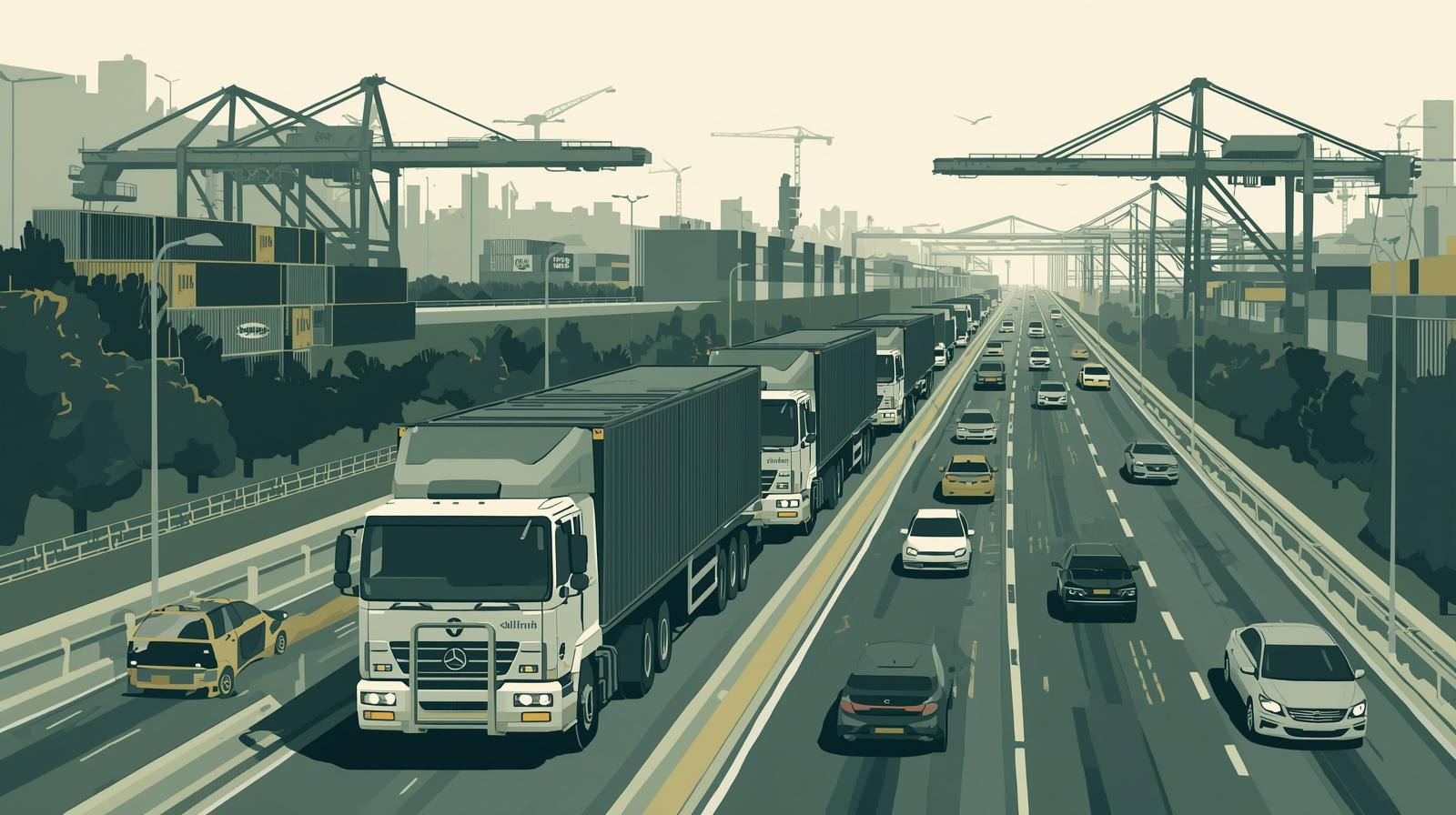
Every hour that a truck loaded with export goods crawls through Chattogram’s congested city streets, Bangladesh pays an economic price that never appears on balance sheets but quietly erodes competitiveness. For a nation whose economy increasingly depends on global markets particularly garment exports and imported industrial inputs the inability of Chattogram’s road system to reliably deliver export-bound cargo and bring in imports is an invisible constraint on growth that rivals port capacity, customs systems, and logistics tariffs in importance.
This crisis is not hypothetical. It is a measurable reality: traffic congestion, deteriorated city roads, flooding, strikes, and institutional friction are cutting into operational productivity and national trade throughput. This article unpacks how Chattogram’s road infrastructure undermines Bangladesh’s international trade export and import alike amplifies logistics costs, and what evidence-based reforms (including roles for foreign investment) could transform this narrative into one of resilient supply chain infrastructure.
The Strategic Importance of Chattogram and Its Roads
Chattogram (formerly Chittagong) is the commercial and industrial heart of Bangladesh, home to the nation’s largest seaport and the primary gateway for international trade. Over 90-92 % of Bangladesh’s seaborne trade passes through Chattogram Port, making the efficiency of road connectivity not a local issue but a national economic imperative.
Despite this centrality, the road network linking the port with inland producers, warehouses, and economic centers is failing to keep pace with the volume of trade it must carry and the consequences are significant.
One recent analysis found that nearly 96 % of containers handled at Chattogram Port were transported by road, with only 3 % by rail and 1 % by inland waterways. The reliance on an overburdened road system has raised freight transport costs by up to 35 %, according to logistics experts who say the main Dhaka-Chattogram highway requires significant expansion to handle current volumes.
Urban Road Conditions: Congestion, Deterioration, and Economic Risk
The first and most visible problem is the poor condition and chronic congestion of city roads in Chattogram.
-
Structural Deterioration and Monsoon Vulnerability
Chattogram’s road infrastructure is being battered by monsoon rains, resulting in widespread damage that disrupts vehicle movement. Recent reports indicate that 142 km of urban streets became seriously compromised, with major arterial routes around Muradpur, Bahoddarhat, Oxygen Intersection, and Strand Road showing severe degradation after heavy rainfall. Residents and transport operators describe conditions so poor that traffic movement has slowed dramatically, and even pedestrians struggle to navigate the streets.
The Financial Express drawing on statements from city authorities reported that numerous roads across the port city have deteriorated due to water-logging and inadequate drainage, creating risks for heavy vehicles and contributing to congestion. Road conditions in areas like Agrabad, Patenga, and the port connecting road were highlighted as particularly bad, affecting not just passenger vehicles but goods carriers critical for trade flows.
When heavy rainfall forces trucks to slow or halt, this directly affects the throughput of containers destined for export markets or arriving with imports, lengthening supply chain lead times and raising costs for manufacturers and traders.
-
Highway Deterioration: A National Trade Lifeline Under Strain
The Dhaka-Chattogram highway the principal land route between the port and the nation’s economic heartland has seen significant wear and tear, especially in the Cumilla segment between Chauddagram and Daudkandi. Cracks, potholes, and degraded pavement force truckers to reduce speeds drastically, creating choke points that ripple through the entire logistics chain.
The deterioration of this highway poses two correlated problems:
- Transport Time Increases: Slower vehicle speeds lengthen delivery times both for export consignments leaving Chattogram and for import cargo moving inland.
- Higher Operating Costs: Vehicles operating at slower speeds consume more fuel and incur greater wear, increasing freight charges that ultimately raise input costs for manufacturers and reduce export margins.
These inefficiencies are not peripheral issues they affect the competitiveness of Bangladesh’s export-oriented sectors, particularly the ready-made garments (RMG) industry, which depends on just-in-time delivery of inputs and rapid shipment of finished goods to global markets.
Clashes, Strikes, and Systemic Bottlenecks: Logistics Delays Beyond Roads
The problem isn’t limited to poor physical infrastructure. Institutional and operational disruptions exacerbate supply chain fragility.
Transport Strikes and Port Logistics Interruptions
In February 2025, a strike by prime mover and trailer workers at Chattogram Port caused a significant stoppage in container movement, leaving thousands of containers delayed and underscoring how fragile the link between port operations and road transport has become. During the three-day stoppage, shipment schedules were disrupted, ship turnaround times increased, and storage costs escalated all hitting both exporters and importers hard.
Later in October 2025, protests by transport associations against an increase in vehicle entry fees at the port gate led to a near 45 % drop in container delivery over four days. The standoff caused over 3,300 additional containers to pile up, illustrating how quickly operational disagreements can paralyze the logistics chain.
These incidents show that even when road infrastructure exists, labor relations and port fee policies can render that infrastructure ineffective, creating bottlenecks that slow national trade flows.
Customs Shutdowns and Backlogged Containers
Institutional disruptions can compound road problems. A prolonged shutdown of the National Board of Revenue (NBR) operations earlier in 2025 halted customs processing at Chattogram’s customs houses, leaving import-export clearances frozen for days. During this period, port operations continued, but delivery and clearance could not proceed, intensifying container backlogs and adding pressure on both the road transport system and depot storage capacities.
The Supply Chain Consequences: Export Delays, Costs, and Capacity Strain
Every delay or bottleneck on Chattogram’s roads carries economic weight:
-
Missed Export Deadlines
Exporters risk missing sailing windows when transport times are unpredictable. For industries like RMG that operate on tight schedules, delayed shipments can lead to penalties, cancellation of orders, reduced buyer confidence, and loss of premium market access.
Even if these qualitative effects are difficult to quantify, the pattern of disrupted deliveries correlates with known trade losses during past congestion events particularly when combined with external disruptions such as strikes or floods.
-
Elevated Import Costs and Production Slowdowns
Importers of raw materials and intermediate goods are equally affected. Delays in receiving critical inputs whether industrial fabrics, machinery parts, or chemicals can stall production lines, force inventory stockpiles, and inflate finance costs.
When roads are impassable or congested, delivery times extend beyond contractual expectations, often requiring businesses to hold larger buffer stocks, which in turn raises working capital requirements.
-
Container Pile-Ups and Port Capacity Stress
The container yards at Chattogram Port have limited capacity. When road movement slows, containers cannot be evacuated quickly enough, reducing yard space available for new imports and exports. This has been a recurring theme: port authorities have had to expand yard facilities and rely on private inland container depots (ICDs), but container backlog continues to pressure capacity.
When containers remain on port premises longer, shipping lines and freight forwarders also suffer cost increases due to demurrage, reversing some of the competitive advantages Bangladesh might otherwise gain from rising export volumes.
Economic Costs: Hard Numbers from Logistics Impact
While precise national loss figures from Chattogram’s road congestion are hard to capture in real time, transport analysts estimate that traffic congestion has increased freight transport costs on the Dhaka-Chattogram corridor by up to 35 % compared with ideal conditions.
Add to that the cost of vehicle wear and tear, fuel inefficiencies, and longer driver hours, and the hidden logistics tax imposed by poor road infrastructure becomes significant.
Strategic Interventions: What Needs to Happen Next
Fixing Chattogram’s logistics road choke points cannot rely solely on local government action. The nature of the challenge spans physical infrastructure, institutional coordination, climate resilience, and technology deployment.
Here are actionable, evidence-based strategies:
-
Physical Upgrades and Climate Resilience
- Widen Dhaka-Chattogram Highway to at least eight lanes, as logistics experts have recommended, to increase capacity and reduce bottlenecks from four-lane constraints.
- Rebuild city roads with climate-resilient drainage to withstand monsoon rains and prevent water-logging that cripples movement.
- Upgrade key arteries within Chattogram that are vital for freight movement (e.g., Muradpur-Bahoddarhat and Oxygen-Quaish roads) to a standard that accommodates heavy goods vehicles.
-
Institutional Reform and Coordination
- Establish a Chattogram Logistics Task Force that includes port authority officials, transport associations, freight forwarders, city planners, and customs representatives to pre-empt logistics breakdowns.
- Align policies on port entry fees and labor conditions through stakeholder consultation to reduce strikes triggered by unilateral fee changes.
-
Modal Shift and Diversification
- Invest in rail freight and inland waterways as viable alternatives to roads. With only 3 % of containers moved by rail and 1 % by waterways, there is substantial untapped capacity that could relieve pressure on highways.
- Expand ICDs and off-dock deliveries to decentralize container clearance away from congested port yards, easing pressure on road and storage space.
-
Smart Traffic Management Technologies
Deploy intelligent systems for real-time traffic monitoring, priority signaling for freight movement, and predictive congestion alerts approaches that have shown results in other South Asian cities when combined with enforcement.
-
Public–Private Partnerships and Foreign Investment
The scale of transformation needed invites foreign capital and expertise:
- PPP models for highway expansion and maintenance can attract international infrastructure funds from development banks and private investors.
- Tech partnerships for traffic management systems, IoT-based flood detection, and predictive logistics routing can modernize Chattogram’s supply chain infrastructure.
- Green logistics corridors, financed by climate funds, can build drainage upgrades, resilient pavements, and flood-proof freight corridors an investor opportunity as climate risks rise.
From Bottleneck to Breakthrough
Chattogram’s roads are not merely local infrastructure lines; they are national economic arteries. Their current state fraught with congestion, weather vulnerability, institutional friction, and capacity shortfalls imposes an invisible but palpable tax on Bangladesh’s export-import trade.
Removing these constraints requires a multifaceted, data-driven approach rooted in physical upgrades, institutional reform, multimodal logistics development, and strategic foreign investment. If Bangladesh can transform Chattogram’s supply chain infrastructure, it will not only fortify its competitiveness but also signal readiness for larger volumes, diversified markets, and resilient growth in the decades ahead.
Fixing Chattogram’s roads is not optional. For the sake of the nation’s trade competitiveness and economic resilience, it is imperative. Ren Sparevoll
References
- Ahmed, S. (2024) ‘Port congestion worsens as city traffic cripples container evacuation in Chattogram’, The Daily Star, 14 March. (Accessed: 12 December 2025).
- Bangladesh Bureau of Statistics (BBS) (2023) Transport and Communication Statistics of Bangladesh 2022–23. Dhaka: BBS.
- Bonik Barta (2024) ‘Dhaka-Chattogram highway capacity constraints raise logistics costs’, Bonik Barta, 19 November. (Accessed: 11 December 2025).
- Chattogram Port Authority (CPA) (2024) Annual Report 2023-2024. Chattogram: Chattogram Port Authority.
- Dhaka Tribune (2024) ‘Waterlogging disrupts industrial and port connectivity in Chattogram’, Dhaka Tribune, 6 July. (Accessed: 13 December 2025).
- The Business Standard (2025) ‘Transport strike disrupts export-import operations at Chattogram Port’, The Business Standard, 17 February. (Accessed: 15 December 2025).
- The Business Standard (2025) ‘Key sections of Dhaka-Chattogram highway in dire need of repair’, The Business Standard, 3 January. (Accessed: 10 December 2025).
- The Financial Express (2024) ‘Road conditions in Chattogram worsen amid monsoon rains’, The Financial Express, 22 August. (Accessed: 14 December 2025).
- Planning Commission, Government of Bangladesh (2021) Integrated Multimodal Transport Policy. Dhaka: Ministry of Planning.
- World Bank (2022) Enhancing Trade Competitiveness through Logistics Reform in Bangladesh. Washington, DC: World Bank.