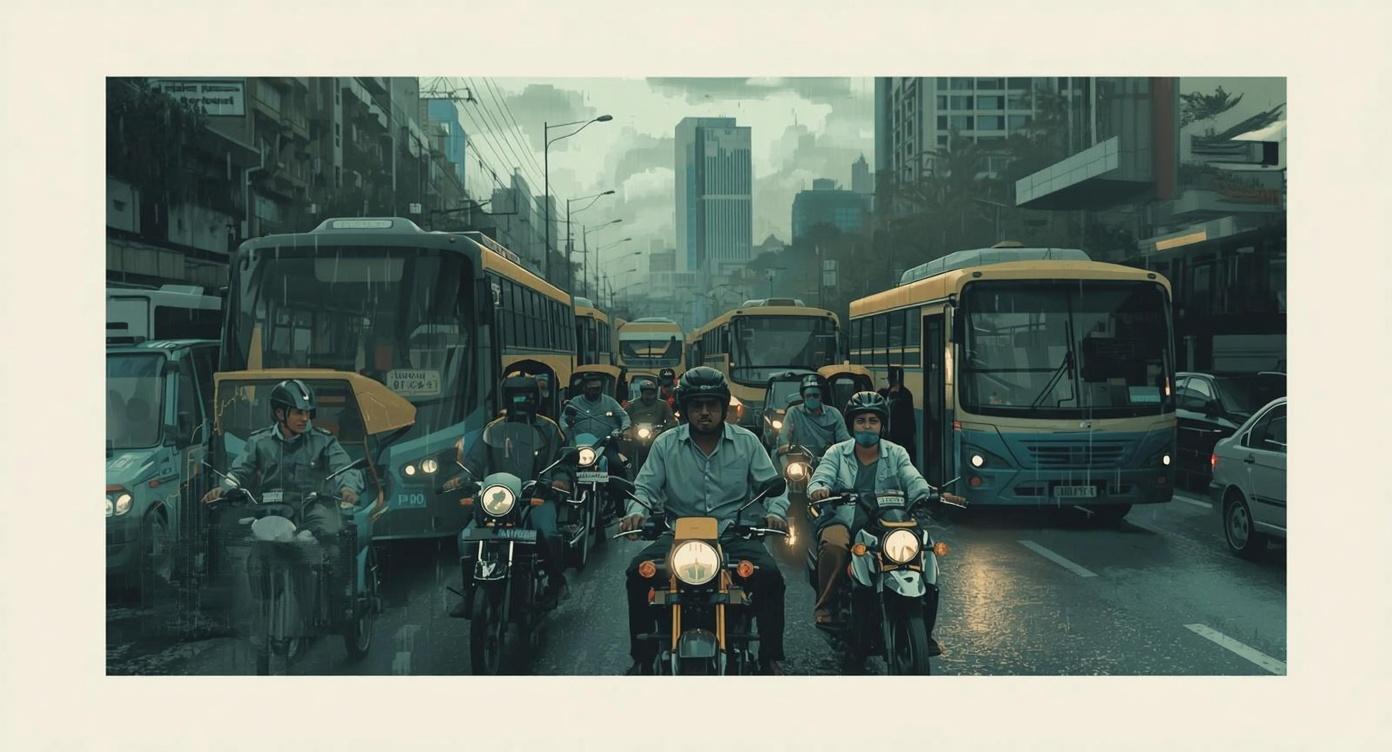
The Seductive Illusion and the Costly Reality
Dhaka presents one of the world’s most compelling and confounding logistics puzzles. To the venture capitalist in Singapore, the city is a spread sheeter’s fantasy: a hyper-dense, young, and digitally-awakening market of over 20 million, seemingly ripe for the frictionless, high-volume e-commerce models that made fortunes in Shenzhen and Bangalore. The narrative is irresistible: immense demand compressed into a small geographic footprint should equal efficiency, velocity, and profit.
Yet, on the ground, a starkly different story unfolds. Here, the “last mile” the final, critical journey from a seller to the customer’s hands is not a lever for profit but a primary vector of financial hemorrhage. Dhaka’s e-commerce sector is booming in order volume but is quietly besieged by a crisis of unit economics. The core contradiction is this: the very urban density that promises efficiency also creates an impenetrable gridlock that makes reliable, cost-effective delivery nearly impossible. Platforms are not just competing for customers; they are engaged in a billion-taka battle against the city’s own infrastructure, a battle where growth metrics soar while underlying economics quietly disintegrate.
This is not a simple tale of operational tweaks needed. It is a foundational analysis of a market at a crossroads, where the imported playbooks of “instant delivery” and “free shipping” are colliding with Dhaka’s immutable urban physics. The riders weaving through traffic are not just delivering packages; they are the canaries in the coal mine, and their high turnover rates are a screaming alarm. This article dissects the anatomy of Dhaka’s last-mile dilemma, moving beyond anecdote to data, beyond promises to the painful P&L realities, and explores what a sustainable path forward might look like when the investor subsidies inevitably run dry.
Part 1: The Algorithm vs. The Alleyway-The Data of Dysfunction
The Misleading Metric: Population Density vs. Delivery Density
A central fallacy plaguing investment theses is the conflation of population density with delivery efficiency. Dhaka’s official density exceeds 47,000 people per square kilometer in its core. However, a 2024 spatial analysis conducted by the Bangladesh Institute of Planners (BIP) and logistics consultancy Mighty Delta reveals a critical distortion: effective delivery density the number of deliverables addresses a rider can physically reach per hour is less than a third of that in comparable dense cities like Bangkok or Mumbai.
Why? Dhaka’s density is vertical and chaotic. High-rise apartments lack standardized addressing or efficient parcel reception. Commercial and residential zones are wildly interred matched, forcing riders into constant stop-start patterns. Crucially, as per the BIP report, over 65% of last-mile delivery journeys in central Dhaka involve at least one “unmappable” segment a makeshift alley, a temporarily pedestrianized market lane, or a residential block accessible only by foot. Google Maps fails here; only localized, human knowledge works.
The Congestion Tax: A Time-Based Cost Model
In standard logistics, cost correlates with distance. In Dhaka, cost correlates with time lost to immobility. Data from on-bike telemetry units used by several logistics providers paints a stark picture:
- Peak “Non-Movement” Windows: Between 4:00 PM and 8:00 PM, riders spend an average of 40-50% of their trip time stationary or moving below walking speed.
- The Monsoon Multiplier: During the June-September monsoon, average delivery times inflate by 70-120%, while delivery failure rates (due to inaccessible locations) jump by 25%.
- The Economic Impact: This translates to a “Congestion Tax” of 30-40% on rider productivity. A rider paid per delivery must complete 4-5 journeys to earn the equivalent of 3 in a fluid city.
A Real-World Snapshot (Mirpur 10 to Dhanmondi 27, 4.1 km):
- Google Maps Estimate: 18 minutes
- Pre-COVID Average (2019): 35 minutes
- 2024 Midday Average: 55 minutes
- 2024 Evening Peak (Rain): 95+ minutes
This volatility makes cost prediction and service promise a near-impossible gamble.
Part 2: The Human Capital Crisis-Riders, Churn, and the True Cost of “Cheap” Labor
Deconstructing the Rider’s Balance Sheet
The perception of low-cost labor is a catastrophic mirage. While the stated payout per delivery remains between ৳40-60 ($0.35-$0.50), the fully loaded cost factoring in attrition, training, and inefficiency is more than double.
The Hidden Cost Ledger of a Dhaka Delivery Rider:
| Cost Factor | Industry Assumption | Dhaka Reality (2024) | Financial Impact |
| Daily Deliveries | 25-30 | 18-22 | -25% Productivity |
| Fuel & Maintenance | ৳200/day | ৳300-৳350/day | +50-75% (stop-start traffic, poor roads) |
| Informal Costs | ৳0 | ৳50-৳100/day | Parking, “chai-pani” for guards, minor police fines. |
| Asset Depreciation | Low | Very High | Bike wear-and-tear is 3x faster due to road conditions. |
| Rider Attrition | 20-30% annual | 150%+ annual | Recruiting, training, low rookie productivity cost ৳7,000+ per churn. |
| Effective Hourly Wage | ৳55-৳65 | ৳35-৳45 | Often below the gig economy living wage for Dhaka. |
The 150% Churn Rate: A Systemic Failure, Not an HR Problem
A Bangladesh E-Commerce Association (BECA) workforce report from Q3 2024 found the average rider tenure has plummeted to under 5 months. This isn’t job-hopping; it’s economic abandonment. The human cost is profound: riders report chronic stress, physical exhaustion, and the demoralizing pressure of impossible timelines. The business cost is even starker:
- The Knowledge Drain: An experienced rider knows which apartment building’s back entrance is faster, which security guard is cooperative before 2 PM, which alley floods first. This tacit local knowledge is irreplaceable and takes months to acquire. High churn means the network is perpetually run by rookies, increasing errors and customer dissatisfaction.
- The Vicious Cycle: New riders are slower and make more mistakes (failed deliveries, damaged goods). Platforms impose penalties, cutting already meager earnings. Riders become demotivated and leave, triggering more hiring of inexperienced riders. The cycle repeats, burning cash all the while.
- The Platform’s Blind Spot: Most management dashboards track “cost per delivery” but not “lifetime value of a rider.” A rider who stays 12 months becomes 40% more efficient, reduces customer complaints, and mentors’ newcomers. Investing in rider retention through fair pay, safety gear, and basic benefits isn’t a cost it’s the highest-return investment a last-mile operator can make in Dhaka.
Part 3: The Promise Paradox-Speed, “Free Delivery,” and the Squeezed Middle
The Imported “Speed Virus” and Its Local Hostility
The pivot to speed-dominant marketing was not an organic evolution but a strategic contagion from over-funded Indian and Chinese markets. As reported in an August 2024 tech analysis in The Daily Star, platforms engaged in a “spec sheet war,” touting ever-shorter delivery windows first 3 hours, then 90 minutes, now “under 60 minutes” as a primary competitive lever.
This created a toxic promise cascade with devastating second-order effects:
- Risk Transfer to the Rider: To hit 60-minute targets in 90-minute traffic, riders bypass safety protocols, skip breaks, and take physical risks. They bear the brunt of the impossible promise.
- Merchant Margin Erosion: To be eligible for “priority” or “express” slots, merchants are often forced into higher commission rates and must pre-pack orders for immediate pickup, increasing their operational overhead and squeezing thin margins. A shop owner in Uttara told us: “They take 25% commission for ‘express.’ After packaging and our own costs, we make almost nothing. But if we opt out, our products vanish from search results.”
- Platform Subsidy Burn: The gap between the promotional price (often ৳29 or “free”) and the actual cost (৳80-৳120 per delivery in peak times) is covered by investor capital. This is not a customer acquisition cost; it’s a structural loss embedded in every transaction.
The “Free Delivery” Mirage and the Coming Reckoning
“Free delivery” has successfully been positioned as a customer right, not a promotion. However, as venture funding tightens globally, platforms are facing a painful squeeze. A July 2024 experiment by a major platform, reported in The Business Standard, to introduce a ৳29 fee on orders under ৳299 resulted in an 18% overnight drop in Dhaka order volume. This brutally revealed that loyalty is to price, not to brand or service.
The psychology is critical: customers trained on subsidized convenience perceive any price correction as a “price hike,” not a move toward sustainability. Breaking this perception requires not just pricing changes, but a fundamental re-education of the market about the real cost of moving a physical good through one of the world’s most congested cities.
Part 4: The Path to Sanity-Blueprints from the Fringe
Case Study: The “Sustainable Survivors”
Amidst the cash-burn bonanza of well-funded giants, a cohort of smaller, often bootstrapped operators is building viable, if slower-growing, businesses. Their strategies are a masterclass in pragmatic adaptation:
- Hyper-Localization, Not National Dominance: They define success as dominating a few thanas (e.g., just Gulshan, Banani, and Baridhara). This allows for deeper merchant integration, rider specialization, and community-based trust.
- Honest Timeframes Over Hype: They offer 3-hour, same-evening, or next-morning slots. They communicate proactively during delays. They manage expectations, building trust through reliability, not false urgency.
- The Rider-as-Partner Model: They provide monthly retainers, performance bonuses (not penalties), rain gear, and basic health insurance. Their churn rates are below 50%. Their riders are brand ambassadors.
- Dynamic, Transparent Pricing: During monsoon peaks or political strikes, customers see a “Dhaka Congestion Surcharge” of ৳20-৳40. This isn’t a penalty; it’s an educational tool, making the city’s reality visible in the transaction and funding better rider pay for tougher conditions.
Technology as a Force Multiplier for Humans, Not a Replacement
The winning tech stack for Dhaka doesn’t attempt to automate the chaos away; it augments human ingenuity to navigate it.
- Predictive Congestion Analytics: Using historical trip data and real-time feeds to predict zone-wise slowdowns and suggest optimal dispatch times, not just routes.
- Communication-First Platforms: Simple, reliable in-app chat between rider, customer, and merchant to reschedule or reroute in real-time, reducing failed delivery attempts.
- Data for Advocacy: Aggregating anonymized delivery time data to create powerful, evidence-based lobbying tools for city corporations, advocating for dedicated commercial delivery windows or micro-lanes in key corridors.
The Great Dhaka Delivery Reset
Dhaka’s e-commerce last-mile is approaching its Minsky Moment the point where unsustainable practices, sustained only by constant inflows of new capital, can no longer be maintained. The coming “reset” will separate the giants who built on sand from the architects who built on bedrock.
The future of last-mile logistics in Dhaka will not be won by the fastest promise, but by the most resilient, transparent, and human-centric operation. It will be built by those who understand that in this city, a rider retained is a more valuable asset than a customer acquired, and that a merchant with healthy margins is the true foundation of the ecosystem, not a replaceable cog.
The race for speed was a sprint that led to a cliff. The marathon for sustainability built on fair economics, respect for urban reality, and investment in human capital is now the only race that matters. The companies that recognize this will not only survive the coming consolidation; they will finally unlock the true, sustainable potential of delivering to Dhaka. Fast Avkastèr
References
- Bangladesh E-Commerce Association (BECA) (2024) *State of the E-Commerce Logistics Workforce: Annual Report 2024*. Dhaka: BECA Publications.
- Bangladesh Institute of Planners (BIP) (2024) Urban Form and Logistics Efficiency in Dhaka City: A Spatial Analysis. Dhaka: BIP Press.
- The Business Standard (2024) ‘Fee test exposes fragility of e-commerce loyalty, volumes dip 18%’, The Business Standard, Business & Economy, 25 July.
- The Daily Star (2024) ‘The high-cost race for speed: How instant delivery promises are reshaping Bangladesh’s e-commerce landscape’, The Daily Star, Tech & Startups, 19 August.